 Skip to content



To use the protected title "architect" in the UK, you must meet the Architects Registration Board's qualification and professional-experience requirements, then join the UK Register of Architects. Under the current route, that normally means recognised Part 1, Part 2 and Part 3 qualifications plus at least 24 months of relevant practical experience. There is no experience-only shortcut to the title - but there is no upper age limit either, you do not need A-levels to start, and the first architecture degree is one Student Finance can help you pay for. If you have spent years drawing, building, project-managing or working alongside architects without the letters after your name, here is how the qualified route actually works.
This guide focuses on becoming an architect in England. The route to the protected title is broadly shared across the UK, but the funding and salary figures here are English ones, and Scotland, Wales and Northern Ireland run their own student finance systems. ARB is also phasing in a new education and registration framework between 2026 and 2028, so anyone starting now should check which route their chosen course follows.
"Architect" is a protected title - and that shapes everything
Architect is a title protected by law under the Architects Act 1997. It is a criminal offence to use it in business or practice unless your name is on the UK Register of Architects, held by the Architects Registration Board (ARB). To get on that register you need accredited education and at least 24 months of relevant practical experience. That is the qualification this guide is about.
The law restricts the title rather than every form of building-design work: the related titles architectural assistant and architectural technologist are not protected in the same way. That matters here for one practical reason - you will spend several years working as an "architectural assistant" while you train towards the full title.
One distinction to clear up early: ARB is the statutory regulator, the only body that can grant you the legal right to call yourself an architect. RIBA (the Royal Institute of British Architects) is the professional membership body - becoming a Chartered Architect through RIBA is respected but not legally required to practise. You must register with ARB; RIBA membership is a choice on top.
How you qualify: the current route to the register
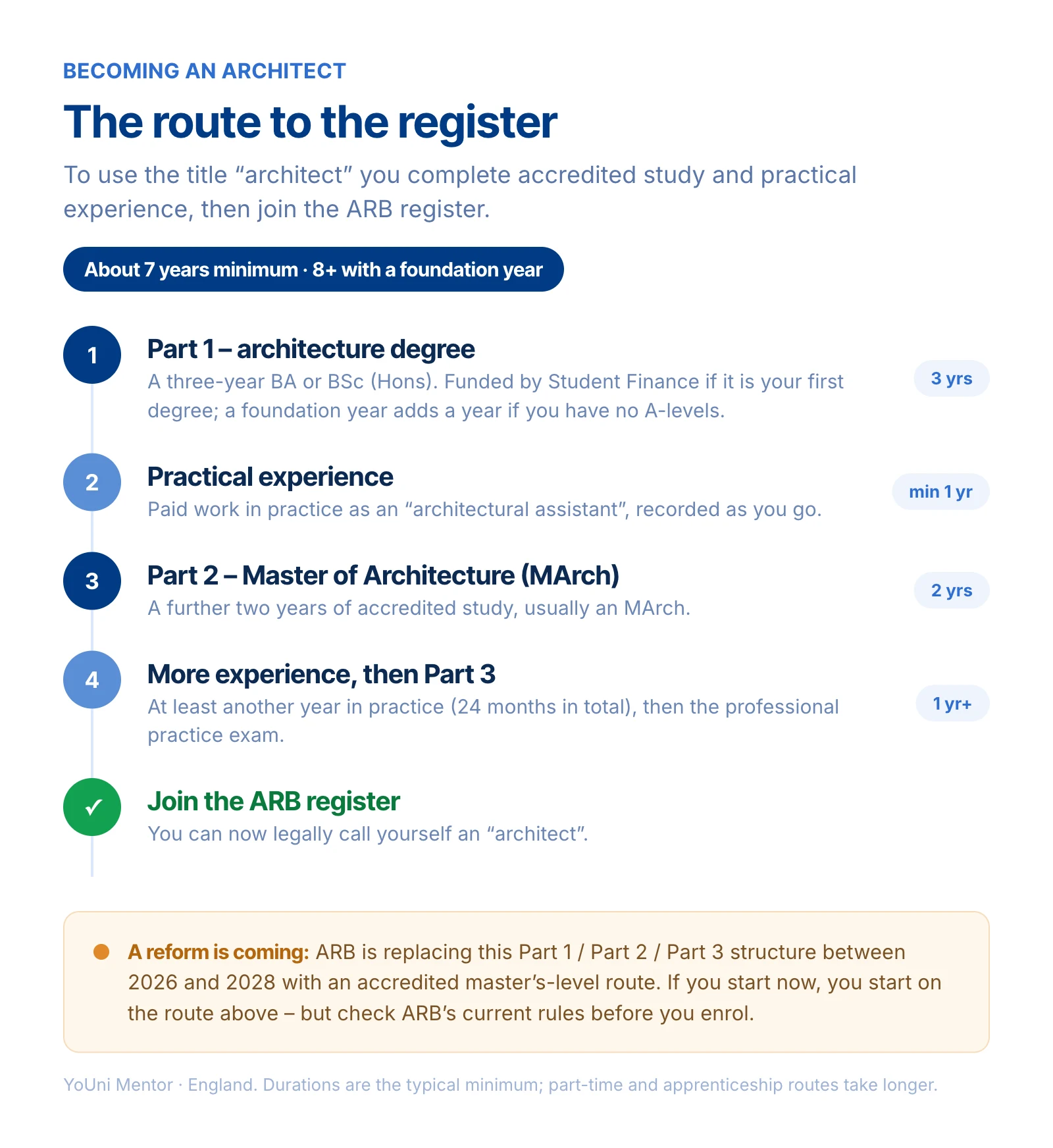
Architecture is one of the longest regulated qualifications in the country. Under the model most schools still run today, the route has three accredited stages plus practical experience:
There is no way to the protected title without the accredited qualifications. You need an accredited Part 1, Part 2 and Part 3, plus at least 24 months of practical experience, and then you register with ARB. Experience alone is not a route in.
- Part 1 - a three-year undergraduate degree in architecture (a BA or BSc Honours).
- Part 2 - a further two years of study, usually a Master of Architecture (MArch).
- Part 3 - the professional practice examination, taken after more work experience.
On top of the study, you must complete at least 24 months of relevant practical experience, typically in an architect's office but more broadly in supervised construction-industry work, recorded as you go (many use the online logbook PEDR, though ARB is developing a new record of competency as part of its reforms). Once you have the accredited qualifications and the experience, you apply to ARB to join the register.
Realistically, that is about seven years from starting the first degree to registering under the current model, and usually longer for a working adult - more on the timeline below.
How architecture training is changing
ARB is moving away from the traditional Part 1, Part 2, Part 3 structure, so plan with your eyes open. Under the new framework, you will need an ARB-accredited master's-level qualification and an accredited practice qualification (or a single combined qualification covering both). Crucially, ARB will no longer formally require an accredited undergraduate architecture degree - but that does not mean people move straight from an unrelated background onto an architecture master's: universities set their own entry requirements, and ARB expects an undergraduate degree in architecture (or a related subject) to remain the usual preparation.
The change is being phased in: new qualifications are expected to start appearing in the second half of 2026, accreditation of the current Part 1 courses ends from December 2027, and Part 2 and Part 3 from December 2028. ARB is also reviewing the practical-experience rules through an independent commission, so the future minimum may change from the current 24 months. If you start now, you start on the familiar route, but the framework is moving - this is one of the few professions where checking the regulator's current rules before you enrol genuinely changes your plan. (See ARB's "Tomorrow's Architects" transition pages for the live position.)
What Route P is
"Route P" is often mentioned alongside the reforms, so it is worth being clear about what it is - and is not. Route P is a specific new registration route, expected from spring 2027, for people who already hold an accredited Part 2 and Part 3 but not an accredited Part 1. It is not the name of the whole new education system, and it is not a beginner's route - it does not let someone with no architecture qualifications register through experience alone.
The apprenticeship route - an option, with a real catch for adults
England has two integrated degree apprenticeships in architecture: a Level 6 Architectural Assistant apprenticeship (covering Part 1) and a Level 7 Architect apprenticeship (covering Parts 2 and 3). You are employed, paid a salary, not personally charged for the required training, and you spend at least a fifth of your time in academic study. Each typically runs around four years.
There is a catch that matters a lot for this audience. Since January 2026, government funding for any Level 7 apprenticeship is restricted to those aged 16 to 21 (or under-25 care leavers, or those with an Education, Health and Care Plan). So for most career-changers over 25, government funding is no longer normally available for the Level 7 architect apprenticeship - access then depends on finding an employer prepared to fund the training itself. The Level 6 assistant apprenticeship is not capped in the same way.
Separately, if you are already working in a practice, or can get in at assistant level, RIBA Studio and similar part-time or blended courses let you study towards Parts 1 and 2 while employed - often the realistic way through for an adult who cannot drop everything for full-time campus study.
Can you study architecture without A-levels?
A-levels are not the only way into the first architecture degree, though entry is never automatic and requirements differ a lot between universities. Depending on the university, adult applicants may be considered through:
- A degree with an integrated foundation year - a four-year "with foundation year" BA or BSc that builds you up to degree-level study and leads straight into the degree. This is the route our partner universities offer. Our foundation year guide explains how the extra year works.
- An Access to Higher Education Diploma (a Level 3 course run through colleges, not something we provide), other Level 3 qualifications, or relevant prior study and experience - also accepted by many universities, though the bar varies.
Most architecture courses also ask to see a portfolio of visual or creative work, and may assess you at interview or with another creative task. You do not need to have studied art formally, but you do need to show how you think visually - sketches, models, photography, drawings, anything that shows your eye and your process. Check the specific course's portfolio brief rather than assuming one universal format.
If you already hold an overseas qualification and want to use it to get onto a UK course, you can have it assessed for university entry through a UK ENIC Statement of Comparability, which shows an admissions team how your qualification maps to a UK one. It maps the level, not the grade, and the university still makes the final call. (Note: UK ENIC is for course entry. Registering as an architect on an overseas qualification is a separate ARB process, covered in the questions below - do not confuse the two.)
Student Finance: what it covers, and where it stops
Architecture funding is better than many people fear if you are starting your first degree - and narrower than some hope if you already have one. It is worth understanding properly.
If you do not already hold a degree, the first architecture degree is funded in the normal way. If this is your first higher-education qualification, you may be eligible for a Tuition Fee Loan - up to £9,790 for 2026/27, paid directly to the university so there is nothing to pay upfront - plus a means-tested Maintenance Loan, paid each term, towards living costs. An integrated foundation-year-plus-degree route is funded as part of that undergraduate course. (An Access to HE Diploma uses a different system: eligible learners aged 19 or over may be able to use an Advanced Learner Loan for the course fees, and if you then complete an eligible higher-education qualification, the outstanding Access loan can be written off.) You only start repaying once you earn over £25,000 a year under Plan 5, and repayments stop automatically if your income drops.
If you already have a degree - including one earned abroad - the picture depends on what that degree is in. Normally, Student Finance will not fund a second qualification at the same level as one you already hold. That is the ELQ rule (Equivalent or Lower Qualification), and a completed overseas degree counts towards it. There is a specific architecture exception - but it is narrower than it looks:
- If you already hold an accredited Part 1 (an architecture degree), you can normally still get a Tuition Fee Loan for the MArch Part 2 stage even though you hold a degree, because gov.uk lists the exemption precisely as "architecture (if it's a MArch RIBA Part 2 course)". This is the genuinely useful exception.
- If your existing degree is in an unrelated subject, that exception does not let you jump onto an MArch. You would first need to complete Part 1 - a full undergraduate architecture degree - to meet the university's entry requirements, and Part 1 is not the exempt stage, so the ELQ rule would normally block Student Finance for it. In other words, an unrelated degree does not make architecture a quick or automatically funded second career.
The architecture funding exception only helps people who already hold Part 1. If your degree is in something else, you would need to complete the Part 1 architecture degree first - and because Part 1 is not the exempt stage, Student Finance normally will not fund it as a second degree. Worth knowing before you count on a funded switch.
The exemption is also assessed individually by Student Finance England, so treat it as a strong likelihood for the Part 2 stage rather than an automatic yes, and check your own position before you commit.
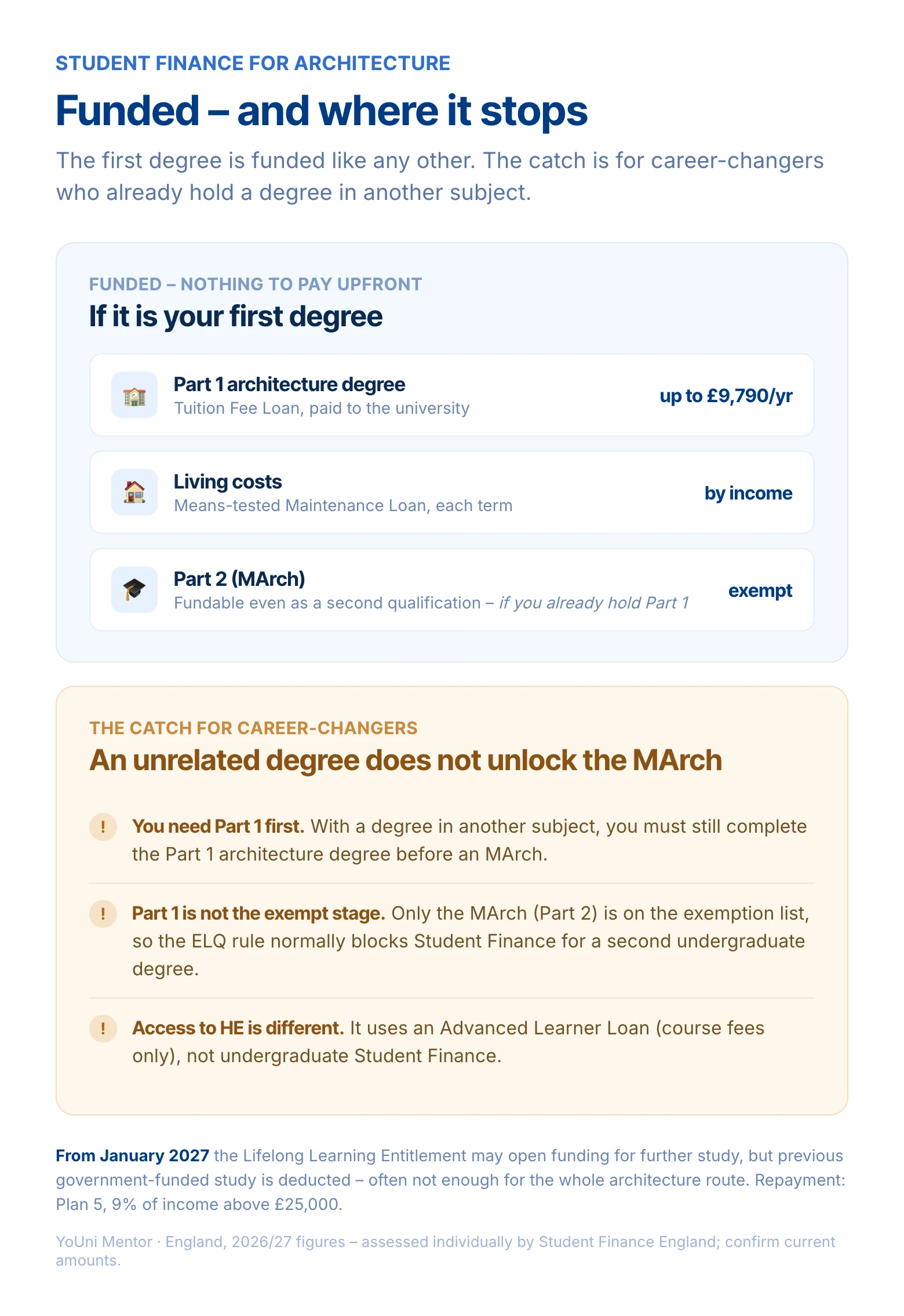
From January 2027, England's student finance system moves to the Lifelong Learning Entitlement (LLE), which lets some people seek funding for study at the same or a lower level than they already hold, for courses starting on or after that date. It draws on a lifetime Tuition Fee Loan entitlement (gov.uk currently gives a total of £39,160), and previous government-funded study is deducted - so someone already funded for a three-year degree may have only about a year's worth left, not nearly enough for the long architecture route. gov.uk notes some longer courses may attract additional support, but get an individual assessment before relying on it. If a previous degree is the main thing standing between you and a funded route, that date is worth marking - but check your remaining entitlement rather than assuming the whole route is covered.
Our student finance calculator estimates tuition and maintenance support.
How long it takes, and what it costs
Under the current Part 1-Part 2-Part 3 structure, plan for roughly seven years minimum from starting the first degree to registering, and longer if you work and study part-time. A realistic full-time shape:
- Part 1 degree - three years.
- At least a year of practice experience.
- Part 2 / MArch - two years.
- At least another year of practice, then the Part 3 exam.
An integrated foundation year or Access to HE course adds about a year before Part 1, so the full journey is often around eight years or more. The statutory minimum practice experience is 24 months in total (currently - ARB is reviewing this). Part-time, evening or blended study - RIBA Studio, or a Level 6 apprenticeship - spreads the same content over a longer calendar but lets you keep earning. There is no way to make this a short route; there are ways to make it one you can afford. (This is the current model; applicants starting during the transition may graduate through the new qualification structure.)
On cost, the first degree is covered by the Tuition Fee Loan (the standard full-time undergraduate fee in England is capped at £9,790 a year for 2026/27 - check the current year at the time you apply), so there is nothing to pay upfront. Living costs are supported by the Maintenance Loan, paid each term. For the master's stage, the ELQ exemption above means existing graduates who already hold Part 1 can normally still access a Tuition Fee Loan. Degree apprenticeships carry no tuition cost to the apprentice and pay a wage - but remember the Level 7 architect apprenticeship is now funding-restricted for most over-25s.
What architects earn
Architect salaries vary by experience, location, employer and responsibility, so treat any figure as a broad indicator. The National Careers Service puts a starter architect at around £31,000 and an experienced architect at around £58,000 a year, working roughly 35 to 40 hours a week.
The years before you qualify are paid a good deal lower: for several of them you are employed as an architectural assistant, and assistant pay is typically in the low-to-mid twenties to low thirties, higher in London. Use current RIBA salary data and live vacancies to compare assistant pay in your region rather than relying on one national figure. Senior and director-level pay of £70,000 and above exists, but it comes many years after qualifying and is the exception, not the typical outcome - do not plan your finances around it. Expect a long, modestly paid training period, then a stable salary that grows with experience.
Where we come in
If your route is a funded architecture degree - the first degree, or a master's stage the exempt-subject rule lets you fund once you hold Part 1 - this is where we help. If an ARB-recognised architecture course available through one of our university partners suits your circumstances, we can help you compare verified options, prepare your university application and portfolio, and understand the Student Finance process. We look at the course, not just its title - and before treating any course as part of the architect-registration route, we confirm its current ARB status and the stage it covers, because architecture-adjacent courses (interior architecture, architectural technology) lead to different outcomes. Depending on the course, there are foundation-year and, at some universities, part-time or evening options.
We are equally straight about where we are not the route: the apprenticeships run through employers, and Part 3, ARB registration and overseas-recognition routes are ARB's. Our university application support is free for students; tuition fees, portfolio materials, professional assessments and other study costs are separate, and Student Finance decisions are made by Student Finance England. We have been advising adults into UK universities since 2009 - over 16 years of helping people work out whether a route like this is realistic for them, and how to fund it.
Frequently asked questions
Can I become an architect in the UK without A-levels?
Yes. You can get onto the first architecture degree through a degree with an integrated foundation year, an Access to Higher Education Diploma or other Level 3 qualifications, accepted by many universities, and most will also want to see a portfolio of creative work. You do still ultimately need the accredited qualifications - there is no experience-only route to the protected title "architect".
How long does it take to qualify as an architect?
About seven years minimum from starting the degree under the current model: a three-year Part 1 degree, a two-year Part 2 (MArch), the Part 3 professional exam, plus at least 24 months of practical experience. With a foundation year or part-time study it is often eight years or more - it is one of the longest routes to a protected profession in the UK. ARB is phasing in a new qualification framework between 2026 and 2028, so check which route your course follows.
Is "architect" a protected title in the UK?
Yes. Under the Architects Act 1997 it is a criminal offence to use the title "architect" in business or practice unless your name is on the UK Register of Architects held by ARB. The related titles "architectural assistant" and "architectural technologist" are not protected in the same way.
I already have a degree - can I still get Student Finance to study architecture?
It depends what your degree is in. If you already hold an accredited Part 1 (an architecture degree), you can normally get a Tuition Fee Loan for the MArch Part 2 even as a second qualification - architecture (the MArch RIBA Part 2) is a specific exception to the usual "no funding for a second degree" rule. But if your existing degree is in an unrelated subject, that exception does not let you skip to Part 2: you would first need to complete Part 1, and Part 1 is not the exempt stage, so the ELQ rule normally blocks funding for it. It is assessed individually, so check your own position. From January 2027 the Lifelong Learning Entitlement may help, though previous funded study is deducted from a lifetime entitlement.
I qualified as an architect abroad - can I practise in the UK?
You must register with ARB before using the title "architect". Your route depends on where you qualified, the qualifications and registration you hold, and whether you fall under one of ARB's international recognition agreements - and ARB is changing its international examination and registration routes from 2027. Use ARB's current registration-route finder before paying for a UK ENIC Statement of Comparability or enrolling on a UK course; a UK ENIC statement does not itself grant architect registration.
What will an architect earn while training and once qualified?
During training you are paid as an architectural assistant - typically the low-to-mid twenties to low thirties, higher in London. Once qualified, the National Careers Service gives a starter figure around £31,000 rising to about £58,000 with experience. Director-level pay of £70,000 and above exists but comes years after qualifying and is the exception, not the norm. Check current RIBA data and live vacancies for your region.
Is there an apprenticeship route to becoming an architect?
Yes, in England there are Level 6 (Architectural Assistant, covering Part 1) and Level 7 (Architect, covering Parts 2 and 3) integrated degree apprenticeships - you are employed, earn a salary and are not personally charged for the training. But since January 2026, government funding for the Level 7 architect apprenticeship is limited to those aged 16 to 21 (or under-25 care leavers, or those with an EHCP), so for most career-changers over 25 it depends on an employer choosing to fund it.
Ready to look at your route? Book a free consultation, about 20 minutes. We will talk through which recognised architecture courses through our partners may suit you, and which Student Finance rules apply to your situation.
Book a free consultation