 Skip to content



Project management is a career adults move into from many different backgrounds. There is no single mandatory qualification, so the planning, coordinating, budgeting and problem-solving you already do at work can count for a lot. A degree in business or management is a strong, structured foundation - it builds knowledge of how organisations, finance and strategy work, and it can support applications to graduate schemes and postgraduate study - but it is one route among several.
This guide focuses mainly on England. Project management itself works the same across the UK, but Student Finance and apprenticeship funding differ in Scotland, Wales and Northern Ireland.
What a project manager does
A project manager takes a piece of work with a clear beginning and end - a new system, a building, a product launch, an office move - and gets it delivered on time and on budget: planning it, organising the people and money, managing the risks, and keeping everyone informed. It sits above roles like project coordinator, project support officer or PMO support, which handle the scheduling and admin that keep a project running, and many project managers started in exactly those support roles and stepped up.
What makes this career worth a serious look as an adult is that there is no single mandatory qualification and no legal registration to hold before you can do the job (unlike nursing or teaching). The leading professional body, the Association for Project Management (APM), holds a Royal Charter and awards Chartered Project Professional (ChPP) status - the profession's highest recognised standard - but that is a milestone you work towards later, not a gate at the entrance. PRINCE2 (from PeopleCert), the Project Management Institute (PMI) and the Chartered Management Institute (CMI) are the other names you will meet.
How you qualify: the routes in, and where a degree fits
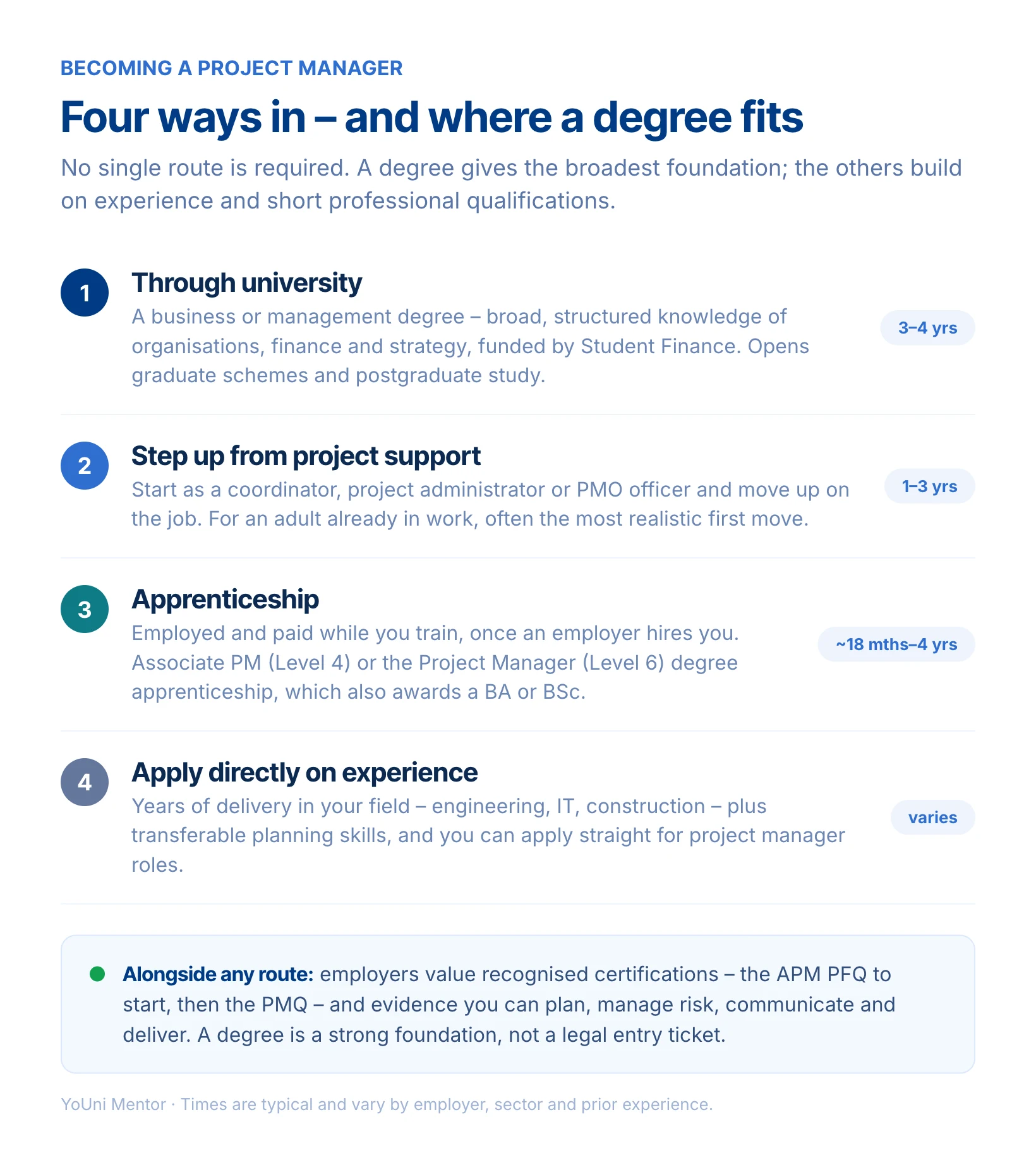
The National Careers Service lists four parallel ways into the Business Project Manager role. They are genuinely parallel - no single one is compulsory - so the right choice depends on where you are starting from.
There is no single required qualification. A degree in business or management is the broadest foundation and the route we help with; stepping up from a support role, an apprenticeship, or applying on experience are the others. Whichever you take, employers value recognised certifications (the APM PFQ, then the PMQ) and evidence you can deliver.
- Through university. A degree gives broad, structured knowledge of how organisations work - finance, strategy, leadership, decision-making - and can support applications to graduate management schemes or a postgraduate project-management qualification. A business or management degree is particularly relevant, though it does not qualify you as a project manager on its own: employers still look for evidence that you can plan, communicate, manage risk and deliver. A first degree is funded by Student Finance (more below), and adults without A-levels can start through a foundation year. It is the route we help with when university study fits your goals.
- Step up from a project support role. Take a job as a project coordinator, project support officer, project administrator or PMO support, and move up while gaining qualifications on the job. For an adult already in work, this is often the most realistic first move.
- Do an apprenticeship. The Associate Project Manager (Level 4) and the Project Manager (Level 6, a degree apprenticeship that also awards a BA or BSc) have no upper age limit and are open to career changers. You are a paid employee and the employer funds the training - though you have to be hired onto one first.
- Apply directly on experience. With several years of in-depth industry experience - in engineering, construction, IT or cyber security, say - plus transferable skills in planning, business analysis or data management, you can apply directly for project manager roles.
Alongside whichever route you take, employers weight recognised certifications and delivery experience heavily. The APM Project Fundamentals Qualification (PFQ) has no entry requirements and is the usual starting credential; the APM Project Management Qualification (PMQ) is a broader step, aimed mainly at people already working in projects (two to three years' experience is typical, though not a formal requirement); PRINCE2 Foundation and Practitioner are widely used method certifications; and PMI's PMP is an experienced-practitioner credential that requires a mix of education and project-management experience, so it is not a beginner's option. A degree does not replace these - it is a broad foundation that sits alongside them.
Can you become a project manager without A-levels?
Yes - A-levels are not the only way in, though each route sets its own bar.
The APM Project Fundamentals Qualification has no formal academic entry requirements, so an adult can earn a first credential regardless of prior education. Project-support roles may be open on skills and work experience. Apprenticeship requirements are set by the employer - you must be 16 or over, living in England and not in full-time education, and the employer may ask for GCSEs, Level 3 qualifications or relevant experience. And for university study, some business and management degrees accept equivalent Level 3 qualifications, relevant prior learning or entry through an integrated foundation year - the route our partner universities offer. Entry and progression requirements vary by provider, so check the specific route rather than assuming. If you already hold a degree from abroad, a UK ENIC comparison is one way to evidence a graduate-level background, though an employer or university may accept other evidence.
Student Finance and the second-degree rule (ELQ)
A degree is one route into project management rather than the only one, so these funding rules matter most when a degree is part of your plan - but for a first degree the funding is genuinely good, so it is worth understanding.
If this is your first higher-education qualification, you may be eligible for undergraduate Student Finance for an approved business or management degree at an eligible provider. For 2026/27 an eligible full-time student can apply for a Tuition Fee Loan of up to £9,790, paid directly to the university so there is nothing to pay upfront, plus a means-tested Maintenance Loan for living costs each term (the amount depends on household income and where you live). Borrowers on Plan 5 currently repay 9% of what they earn above £25,000 a year; thresholds can change. This is a first degree, and it is a strong option - not a requirement.
The ELQ rule normally blocks Student Finance for a second degree at the same level, and business, management and project management are not among the limited exceptions. That matters far less here than for a degree-gated career, because you do not need a business degree to become a project manager - a short certification, an employer-funded apprenticeship or a postgraduate route is the practical way forward.
The complication is the ELQ rule - Equivalent or Lower Qualification. Student Finance normally supports only your first qualification at a given level. Limited exceptions exist - selected part-time or integrated courses in named subjects - but business, management and project management are not among them; we checked this against gov.uk. So if you already have a degree and wanted a Tuition Fee Loan for a second one in business, you generally would not get it.
A Master's in project management sits under a different system: the Postgraduate Master's Loan (a single combined loan, up to £13,206 for courses starting on or after 1 August 2026) is separate from the undergraduate ELQ rule, so it may go towards a Master's even for someone who already holds a first degree. It is one contribution towards fees and living costs (so it may not cover both in full), and you normally cannot get it if you already hold a master's or higher, with the usual age and residency conditions.
From January 2027, England replaces the current system with the Lifelong Learning Entitlement (LLE), which lets some people seek funding even for study at the same or a lower level than they already hold, under a lifetime entitlement of around £39,160 (roughly four years of study). It is not a free second degree - previous government-funded study is deducted from that entitlement, and someone already funded for a three-year degree may have only about one year's worth left, not enough for a whole second business or project-management degree. Study funded privately or abroad may not create the same deduction, but check your own account rather than assuming - and eligibility also depends on the course, residency and age.
To see the figures for your own case, try our student finance calculator.
How long it takes, and what it costs
There is no fixed multi-year pipeline here, which is part of what makes it work around a job. Roughly, by route:
- A starting certification can be earned in weeks of self-study - the APM PFQ is assessed by a one-hour, 60-question multiple-choice exam, and PRINCE2 Foundation is similar.
- The APM PMQ is a bigger step, assessed by a longer written exam and aimed at people already working in projects.
- The step-up route usually means one to three years in a support or coordinator role, building experience alongside these certifications, before a first project manager title.
- The apprenticeships run about 18 months plus assessment for the Associate Project Manager (Level 4), and about four years for the Project Manager (Level 6) integrated degree apprenticeship.
- A business or management degree, if that is your route, is three years full-time (four with a foundation year), or longer part-time around a job.
Chartered status (ChPP) comes later, once you can evidence significant experience. On cost, the routes vary widely - from a few hundred pounds for a first certification to fully funded through an apprenticeship or a first degree:
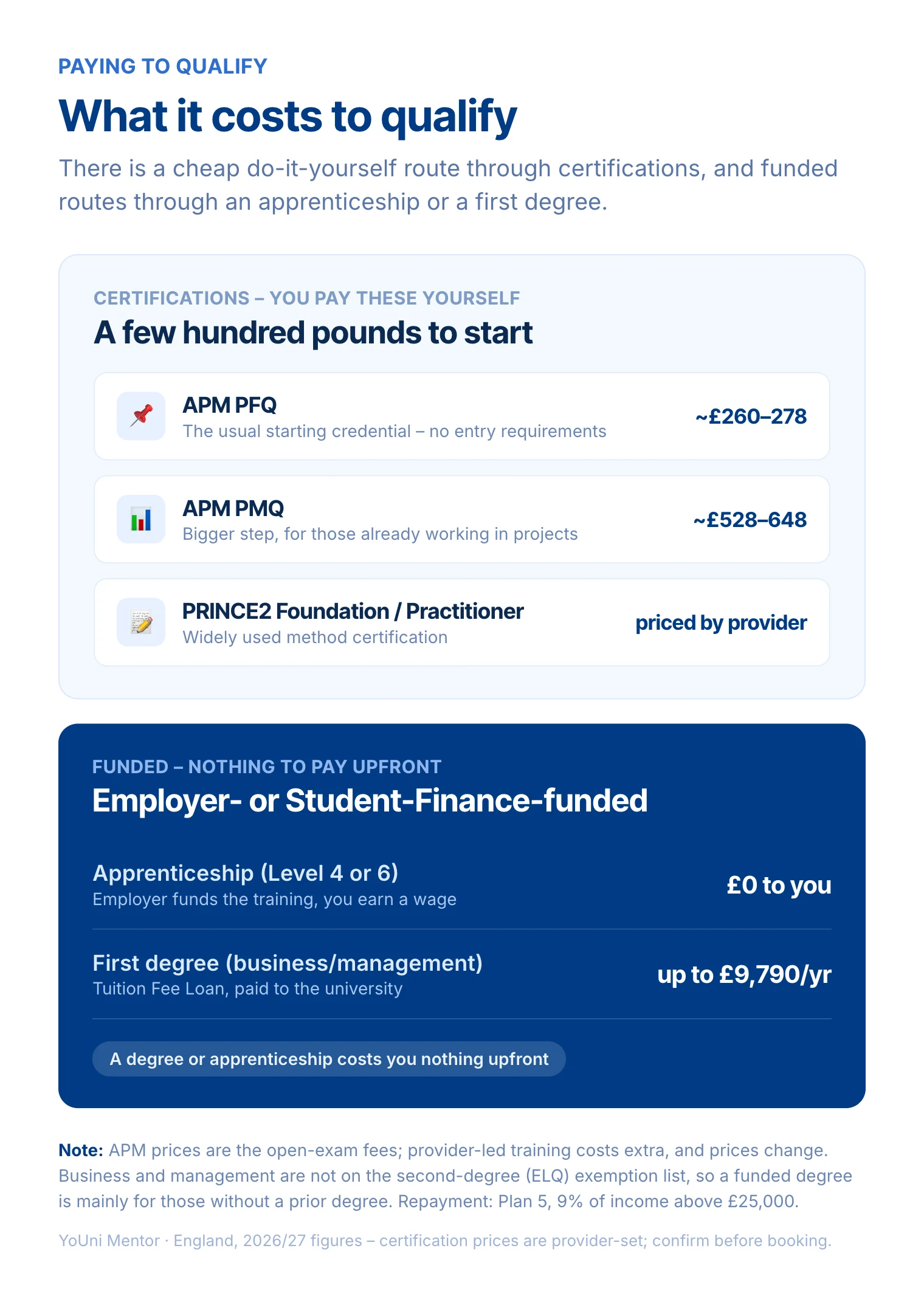
APM prices are the open-exam fees, and you do not need to be an APM member to sit them; provider-led training costs extra and prices change, so check the current figure before you book. An apprenticeship costs the learner nothing (the January 2026 funding cut applies only to Level 7 apprenticeships for over-21s, not to the Level 4 or Level 6 project management ones), and a first degree in business or management is funded by Student Finance for anyone eligible without a prior degree.
What project managers earn
Project-manager pay varies a lot by sector, location, project size and level of responsibility, so treat any figure as a broad indicator. The National Careers Service, using ONS data, gives an indicative range for a Business Project Manager of about £29,000 for a starter up to £75,000 for an experienced practitioner.
In practice, someone entering through a project-administrator, coordinator or support role usually starts below someone appointed straight into a project-manager post, and specialist sectors such as construction, technology, engineering and finance use different pay ranges. The £75,000 end is the senior, experienced level, not a starting point. Compare current vacancies in the sector and location where you want to work.
Where we come in
Where we help is the degree route. If a business or management degree available through one of our university partners is suitable for your goals, we can help you compare verified courses, prepare your application and understand the Student Finance process. We look at the course content, study format and entry requirements, not just the title, and depending on the course there are part-time, evening and weekend options, with a foundation year for people without standard entry qualifications. We guide you through the Student Finance application so it is under way in good time - the decision itself rests with Student Finance England.
If a project-support role, a short certification or an employer-funded apprenticeship would be a more direct first step, we will say so - those are normally accessed through employers or training providers. We have been advising adults into UK universities since 2009 - over 16 years of guiding people through exactly this kind of decision.
Frequently asked questions
Can I become a project manager in the UK without a degree?
Yes. There is no mandatory degree or licence. People enter through a project support role, direct application on industry experience, and apprenticeships. Employers value recognised certifications and delivery experience highly, and a degree is a strong, broad foundation that supports progression rather than being a legal entry ticket.
What qualifications do I actually need to be a project manager?
There is no single required qualification. The most recognised UK options are the APM PFQ (no entry requirements, good for beginners), the APM PMQ (broader, for people already working in projects), and PRINCE2. PMI's PMP is an experienced-practitioner credential that needs project-management experience, not a beginner's certificate. Many project managers add these while working in a support role.
How much do project managers earn in the UK?
The National Careers Service gives an indicative range of about £29,000 for a starter up to £75,000 for an experienced professional. Where you start depends on the role and sector - stepping up from a support role usually starts lower than being appointed directly into a project-manager post. Treat these as broad indicators and check current vacancies.
Can I get Student Finance to study project management or business as a second degree?
Usually not if you already hold a degree at the same level, including one earned abroad - business and management are not among the limited ELQ exceptions. If you have no prior degree, a first degree in business or management is fundable for eligible students. There is also the Postgraduate Master's Loan for a Master's (not if you already hold a master's), and from January 2027 the Lifelong Learning Entitlement lets some people fund further study, though previous funded study is deducted from the lifetime entitlement.
Can I do a project management apprenticeship as an adult over 25 or 30?
Yes. Apprenticeships in England have no upper age limit - you need to be 16 or over, living in England and not in full-time education. The Associate Project Manager (Level 4) and Project Manager (Level 6) apprenticeships are open to career changers, and the employer funds the training; you do have to secure a job to start one. The January 2026 funding cut applies only to Level 7 apprenticeships for over-21s, not to these.
I have an overseas degree - how do I move into UK project management?
An employer or university may ask for evidence of how your overseas qualification compares to the UK system - a UK ENIC Statement of Comparability (currently £69.60, including the electronic statement) is one option, but check what they require before paying, and if a degree is part of your plan we can help you work out how your qualification maps first. Adding a UK-recognised certification (APM PFQ or PMQ, or PRINCE2) and targeting a project-support role to build local experience is often the practical path, though neither guarantees a project-manager role directly.
Ready to look at your route? One free call, about 20 minutes, and you will know where you stand - whether a funded business degree, an apprenticeship or a short certification fits you best, and which Student Finance routes you may be eligible for.
Book a free consultation