 Skip to content



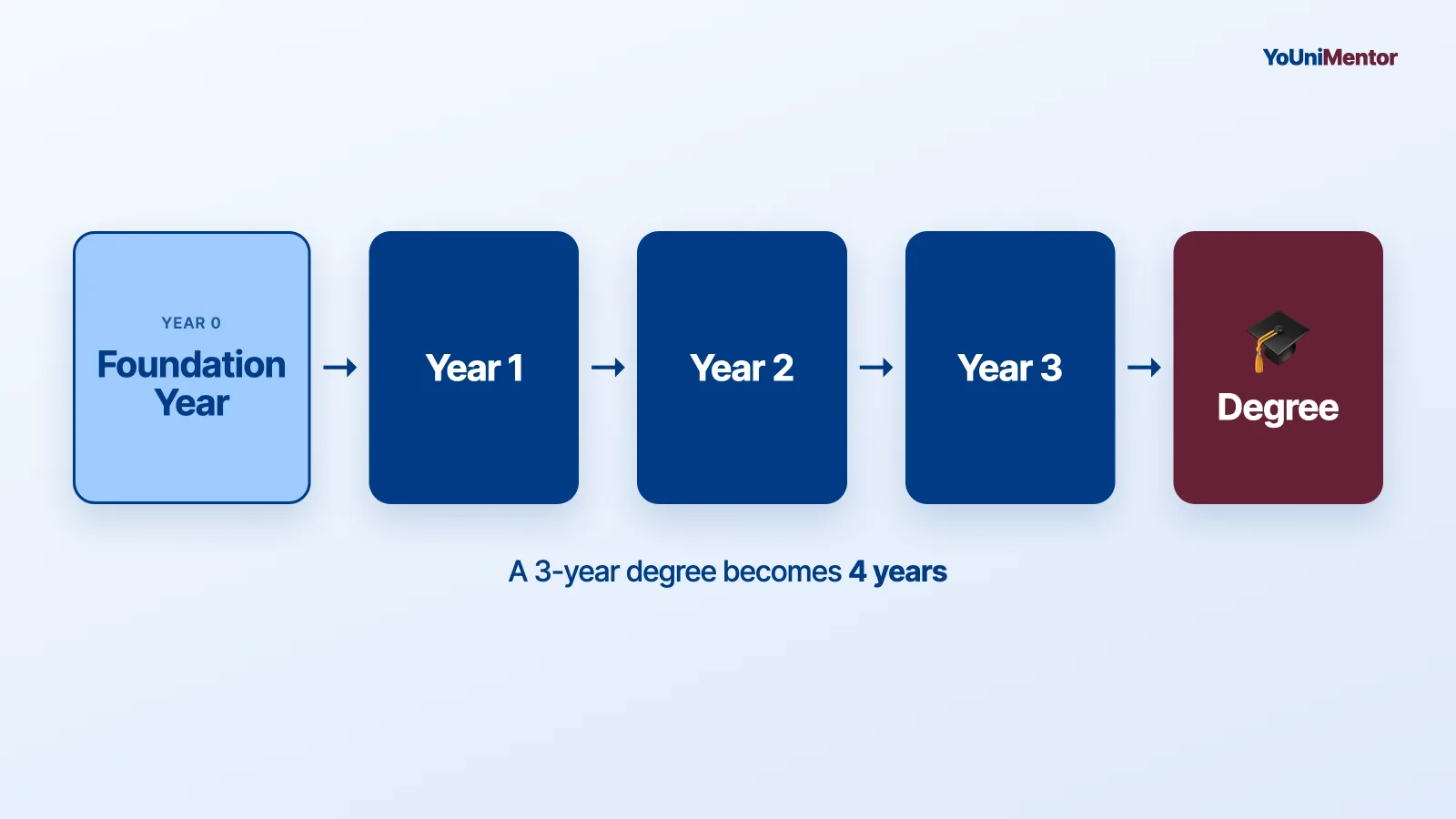
A foundation year is an extra year of study at the start of a UK degree that prepares you for the full course - and it is built for people who do not have A-levels or the standard entry grades. Often called "Year 0", it turns a three-year degree into a four-year one. For working adults returning to education, it is one of the most efficient ways into a UK degree: you apply once, study a supported first year, then move into the degree itself. And because it is part of the degree, Student Finance funds it like any other year - though some classroom-based foundation years now cost less, which we cover below.
This guide explains what a foundation year is, how it compares with A-levels, whether it is worth doing, who it suits, and what it costs - including how Student Finance covers it.
What a foundation year actually is
A foundation year is the first year of a four-year degree. You apply to a single programme - for example, BSc Computer Science with a Foundation Year - and study a preparatory "Year 0" that builds you up to the level needed for Year 1. Pass it, and you normally progress straight into the first year of that degree at the same university, with no separate application or interview.
It exists to open degrees to capable people who do not meet the standard entry requirements:
- Adults who left school without A-levels, or with grades that no longer reflect their ability
- People returning to education after years - or decades - in work
- Career-changers moving into a subject they have never formally studied
- People whose qualifications are from another country and do not map neatly onto UK requirements
During the year you study introductory modules in your chosen field alongside core academic skills - research, academic writing, referencing and study techniques. It is taught at the university and counts as a genuine year of higher education.
What studying a foundation year actually involves
From day one you are a full university student, working towards the same degree as direct entrants - you simply start a year earlier. In practice that means:
- Full student status. A student ID, library and campus access, lecturers, and eligibility for Student Finance.
- More support than later years. The year is structured to bring you back up to speed, with lectures, seminars, coursework and some exams.
- A real progression route. Most students move straight into Year 1. Some use the year to confirm their direction and then change course or university - this is often possible, but the process works differently, so plan it early with your advisor or the university.
- One extra year, and one extra year of cost - covered by Student Finance, so nothing upfront.
Foundation year vs A-levels - is it equivalent?
Most adults ask this, and the honest answer has two parts.
It is not the same qualification as A-levels. You do not earn A-level certificates or UCAS tariff points. A foundation year is normally linked to a specific degree at the university you apply to - though it is often possible to change course or university afterwards, the process for doing so is different.
But it does the same job - and for adults, often does it better. Both are recognised routes onto a degree:
| A-levels | Foundation year | |
|---|---|---|
| What it is | Standalone Level 3 qualifications | Year 0 built into a degree |
| Where you study | School or college | University |
| Typical length | 2 years | 1 year |
| Best for | School leavers, those wanting a choice of many universities | Adults, career-changers, no recent study |
| Leads to | Applying to universities afterwards | Progressing into the degree |
| Entry requirements | GCSEs | Often lower / flexible; work experience considered |
For a 35-year-old changing career, two years of A-levels at a sixth-form college - then re-applying through UCAS and hoping for an offer - is rarely realistic. A foundation year compresses that into one focused year that leads onto the degree if you pass.
Is a foundation year harder than A-levels?
Not harder - different, and for many adults more manageable.
A-levels mean juggling three separate subjects over two years. A foundation year focuses on the one field you want to study, taught at an introductory university level, with a strong emphasis on rebuilding the study skills you may not have used in years.
What adults tend to find:
- Subject focus helps - you study what you are motivated by, not three subjects chosen at 16.
- More support - the year assumes you have been away from study and brings you back up to speed.
- Coursework often outweighs exams, which suits people who work better over time than in a three-hour exam hall.
- Maturity is an advantage - adult learners bring the discipline and motivation that carry the academic side, even when the content is new.
Is a foundation year worth anything?
Yes - for adults without recent qualifications, it is one of the most efficient ways into a UK degree. The foundation year counts as the start of your degree, so you are not spending a year on something separate: you progress from it into Year 1 and on to graduation.
In concrete terms, it is worth doing because:
- It opens degrees you could not enter directly, without going back to do A-levels.
- It has a high progression rate - it is designed for students who put the work in to move into Year 1.
- It is funded by Student Finance like the rest of the degree, so there is no upfront cost.
- It rebuilds academic confidence, which makes the following three years far more manageable.
One honest limitation: a foundation year on its own is a progression year, not a standalone qualification you would take elsewhere - its value is realised when you continue into the degree. For someone committed to getting that degree, it is one of the most direct and affordable routes there is.
Who a foundation year is for
A foundation year suits adults who are capable of a degree but locked out of the standard route. You are likely a good fit if:
- You don't have A-levels, or your grades are from years ago and no longer reflect your ability.
- You have been out of education for a while and want a supported way back in rather than being thrown into Year 1.
- You are changing career into a subject you have never formally studied.
- Your qualifications are from another country, or you are not originally from the UK but hold an eligible immigration status - eligibility depends on your status, not your age.
- You have not already completed a higher education degree in the UK - Student Finance usually will not fund a second qualification at the same or a lower level.
- You are working and need a clear, funded route rather than the uncertainty of re-sitting exams and re-applying.
Recent school leavers with strong, current A-levels can usually enter Year 1 directly. The foundation year is, by design, the adult learner's route.

"I had no idea how UK universities worked or where to even start. My advisor guided me through everything and now I'm finishing my Foundation Year in Global Business in Birmingham."
Foundation years at YoUni Mentor partner universities
YoUni Mentor brings over 16 years of combined advising experience and works with a network of UK universities offering foundation-year entry across subjects from business and computing to health and social sciences. Partner universities include the University of Roehampton, Anglia Ruskin University (ARU London), London Metropolitan University, Middlesex University, the University of Greenwich and the University of Hertfordshire, among others.
Entry requirements at partner universities are deliberately flexible for adult learners - many consider relevant work experience and a personal statement rather than insisting on formal qualifications. A YoUni Mentor advisor can tell you, for free, which universities would accept you for the subject you want.
How to apply, what it costs, and how Student Finance covers it
How to apply
You apply to a degree-with-foundation-year as a single programme. For adult learners the process is usually:
- Decide your subject and career direction - what do you want the degree to lead to?
- Find universities that offer it with a foundation year and would accept your background.
- Apply - with a personal statement that makes your motivation and life experience count.
- Sort your Student Finance in parallel, so funding is in place for the start date.
YoUni Mentor can help and advise on every step - from choosing the right university to applying for Student Finance - at no cost. See how it works.
What it costs
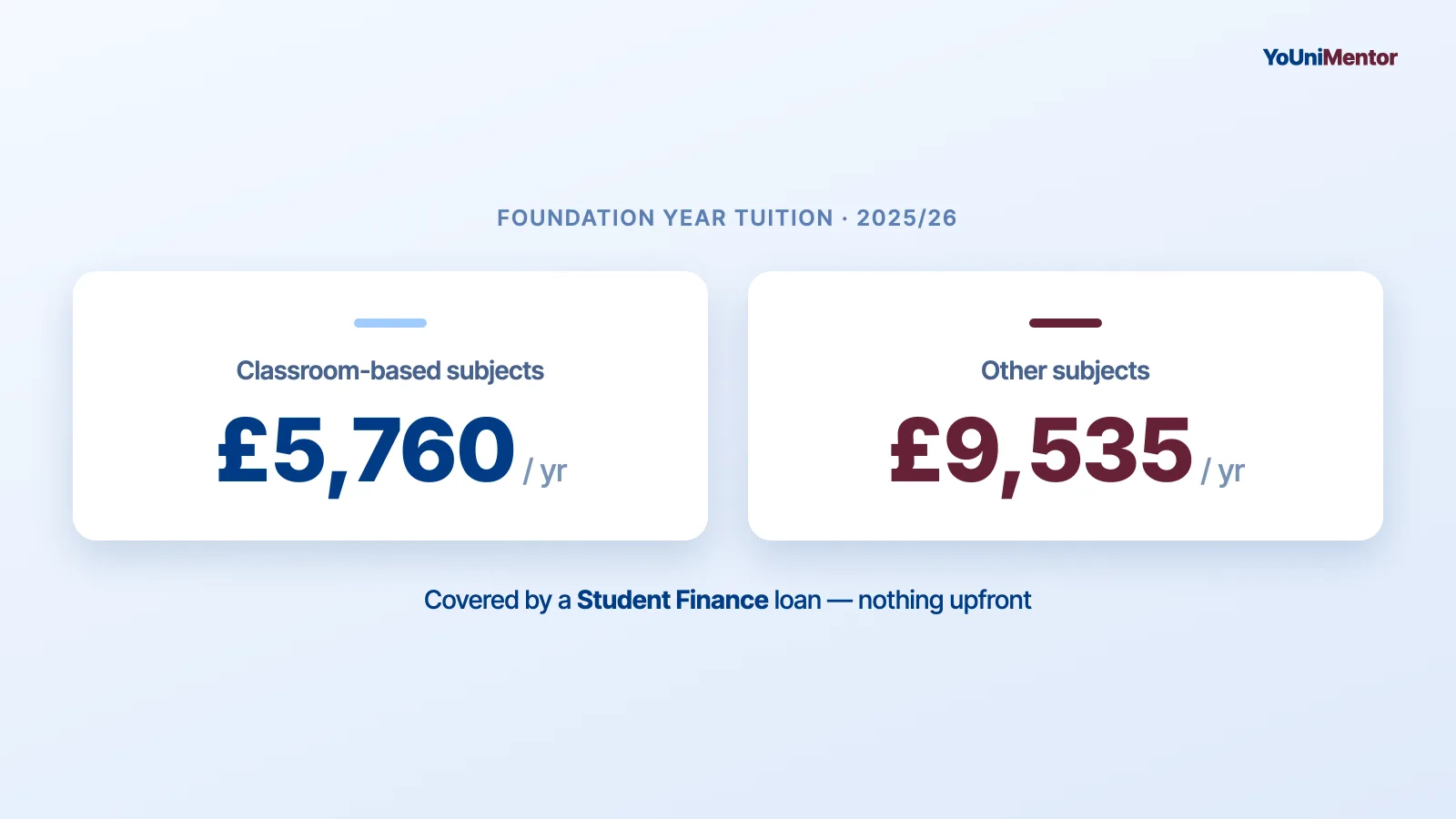
Since the 2025/26 academic year, foundation-year tuition fees in England depend on the subject:
- Classroom-based foundation years - business, humanities and social sciences - are capped at £5,760 a year.
- Other foundation years - for example lab- or studio-based subjects such as science and engineering - can be charged up to £9,535 a year.
Either way, you do not pay this upfront - it is covered by a Student Finance tuition fee loan paid directly to the university. (Figures are for 2025/26; check the latest rates for your start year.)
How Student Finance covers it
Because the foundation year is part of the degree, Student Finance England funds it like any other year, subject to the eligibility and residency rules:
- A tuition fee loan covers your fees in full, paid straight to the university - you never see a bill.
- A maintenance loan helps with living costs, paid in three instalments across the year (one per term) - not monthly.
- For courses starting on or after 1 August 2023 (Plan 5), you repay 9% of your income above £25,000 a year, only once you earn over that threshold, and any remaining balance is written off after 40 years.
Eligibility depends on your residency and immigration status, not your age - and many adults qualify without realising it, including people with settled and pre-settled status. Check where you stand on our Am I Eligible? page.
Not sure if a foundation year is right for you? Talk to a YoUni Mentor advisor - it is free, and they will tell you honestly whether it fits your situation.
Book a free consultationFrequently asked questions
What does it mean to do a foundation year?
You enrol as a full university student and study a preparatory "Year 0" at the start of your degree, before progressing into Year 1. You are a genuine student from day one, with access to Student Finance, and the foundation year and degree are one continuous programme.
Is a foundation year worth anything?
Yes - for adults without recent qualifications it is one of the most efficient routes into a UK degree. It counts as the start of your degree, has a high progression rate into Year 1, and is funded by Student Finance. On its own it is a progression year rather than a standalone qualification, so its value comes from continuing into the degree.
How much does a foundation year cost?
From 2025/26, classroom-based foundation years (business, humanities, social sciences) are capped at £5,760 a year, and other subjects can be charged up to £9,535 a year. You do not pay upfront - a Student Finance tuition fee loan covers it.
Is a foundation year equivalent to A-levels?
Not the same qualification - you do not earn A-level certificates or UCAS points. But it serves the same purpose as a route onto a degree, and for adults it is often a better fit: one focused year at university that leads into the degree, rather than two years of A-levels and a separate application.
Is a foundation year harder than A-levels?
Different rather than harder. It focuses on one subject at an introductory university level with strong support, instead of juggling three A-level subjects. Many adults find it more manageable, especially with the motivation they bring as mature learners.
Do I need A-levels to do a foundation year?
Usually not. Foundation years are designed for people without the standard entry requirements, and many universities consider relevant work experience and a personal statement instead - particularly for adult learners.
How long is a foundation year?
One year, full-time (some courses offer flexible or part-time study). It makes a standard three-year degree into a four-year programme.
Can I get Student Finance for a foundation year?
Yes - because it is part of the degree, it is funded like any other year, with a tuition fee loan and a maintenance loan, provided you meet the residency and eligibility rules. Eligibility depends on your status, not your age.
Is a foundation year the same as a foundation degree?
No. A foundation year is Year 0 of a bachelor's degree. A foundation degree is a separate qualification (about two-thirds of a bachelor's) that can stand alone or be topped up to a full degree.
