 Skip to content



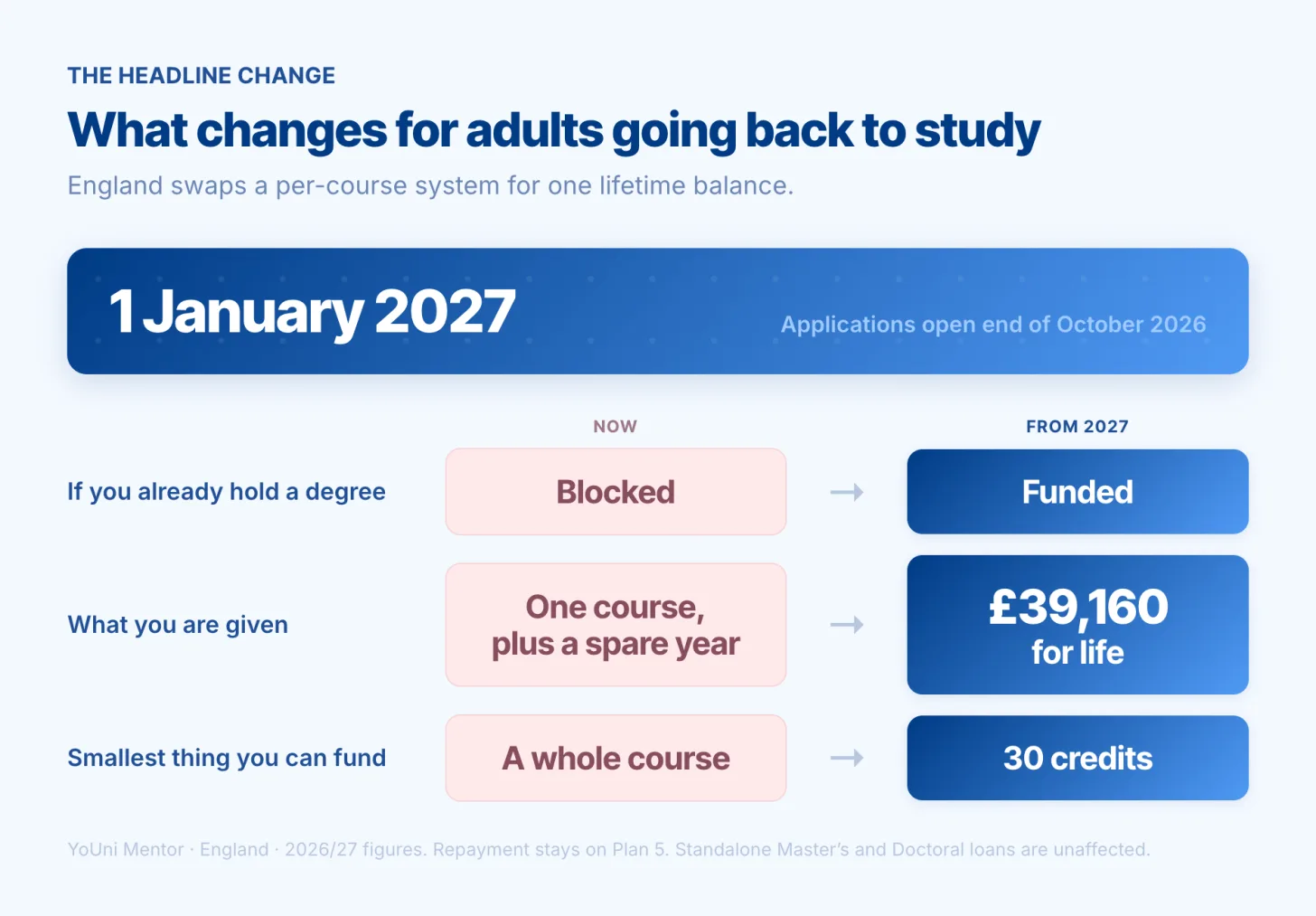
From 1 January 2027, student finance changes for adults who normally live in England. The Lifelong Learning Entitlement creates a single tuition fee loan allowance you can draw on across eligible courses over time. It replaces the existing higher education student finance system, and Advanced Learner Loans for eligible qualifications at levels 4, 5 and 6.
For anyone who has already studied, this is the change that matters. The rule that blocked you from funding a second qualification at the same level is going. Instead, how much you can borrow depends on what is left of your entitlement.
This guide answers that question, including two parts of the calculation that are not published on gov.uk.
- The Lifelong Learning Entitlement is worth four times the annual tuition fee cap. For 2026/27 that is £39,160.
- It applies to courses and modules starting on or after 1 January 2027. Applications open at the end of October 2026.
- If you have studied before using UK student finance, your balance is reduced. A typical three-year graduate has about £9,790 left. Study you paid for yourself does not reduce it.
- If you paid any of your own fees on a course that started between September 1998 and September 2012, your deduction is lower than the rate published on gov.uk.
- A degree completed abroad should not reduce your balance if it was wholly self-funded and drew no UK government tuition support.
- It is the student finance system for people who normally live in England. You can use it for eligible full courses elsewhere in the UK, but module funding is England-only.
On this page
- What the LLE is
- Is it replacing student loans?
- When it starts and when you can apply
- Who is eligible
- How much you have left if you have studied before
- If your degree is from outside the UK
- If you already have a degree
- If you are over 60
- What it covers
- Using it while working
- What you will repay
- What is not settled yet
- How to check your own balance
- Questions people ask
If you have studied before, start with the section on previous study.
What is the Lifelong Learning Entitlement?
The Lifelong Learning Entitlement is a single allowance of tuition fee loan funding worth £39,160 for 2026/27, which you can draw on across your working life instead of all at once.
The £39,160 comes from the maximum fee limit applied across 480 credits, which works out at four years of full-time tuition at £9,790 a year. Because it is pegged to the fee cap, it moves when the cap moves, and the government has confirmed that existing balances are uprated too.
The important point is that your entitlement is a cash balance, not a fixed number of years. Several guides describe it as “480 credits”, which can be misleading. How much that balance buys depends on the university, because the maximum a provider may charge per 120 credits varies with whether it holds an Access and Participation Plan and a Teaching Excellence Framework rating:
| What the provider holds | Maximum fee per 120 credits |
|---|---|
| An Access and Participation Plan and a TEF rating | £9,790 |
| An Access and Participation Plan only | £9,525 |
| A TEF rating only | £6,525 |
| Neither | £6,350 |
Your £39,160 is calculated at the top rate. At a provider charging lower fees, the same balance can cover more study. In the government’s own worked example, a four-year degree at a £6,525 provider uses £20,550 of the £39,160: three taught years at £6,525 plus a study abroad year at £975.
As gov.uk puts it: “A student could use their £39,160 to pay for more than 4 years of learning, depending on the cost of the course.”
Is the LLE replacing student loans?
It replaces two specific things: higher education student finance loans, and Advanced Learner Loans for qualifications at levels 4, 5 and 6.
It does not do away with student loans altogether. Standalone Postgraduate Master’s and Doctoral degrees stay on their own loan systems and are not funded through the LLE. Some postgraduate-level courses are, though, including PGCEs, postgraduate initial teacher training, integrated master’s degrees and postgraduate healthcare courses. So “postgraduate” on its own does not tell you which system you are in.
Courses that started before January 2027 stay on the rules they started under.
So if you are midway through a degree, nothing about your funding changes. If you start an eligible course from January 2027, you fall under the LLE rules.
When does the LLE start, and when can you apply?
Applications open at the end of October 2026, for courses and modules starting on or after 1 January 2027.
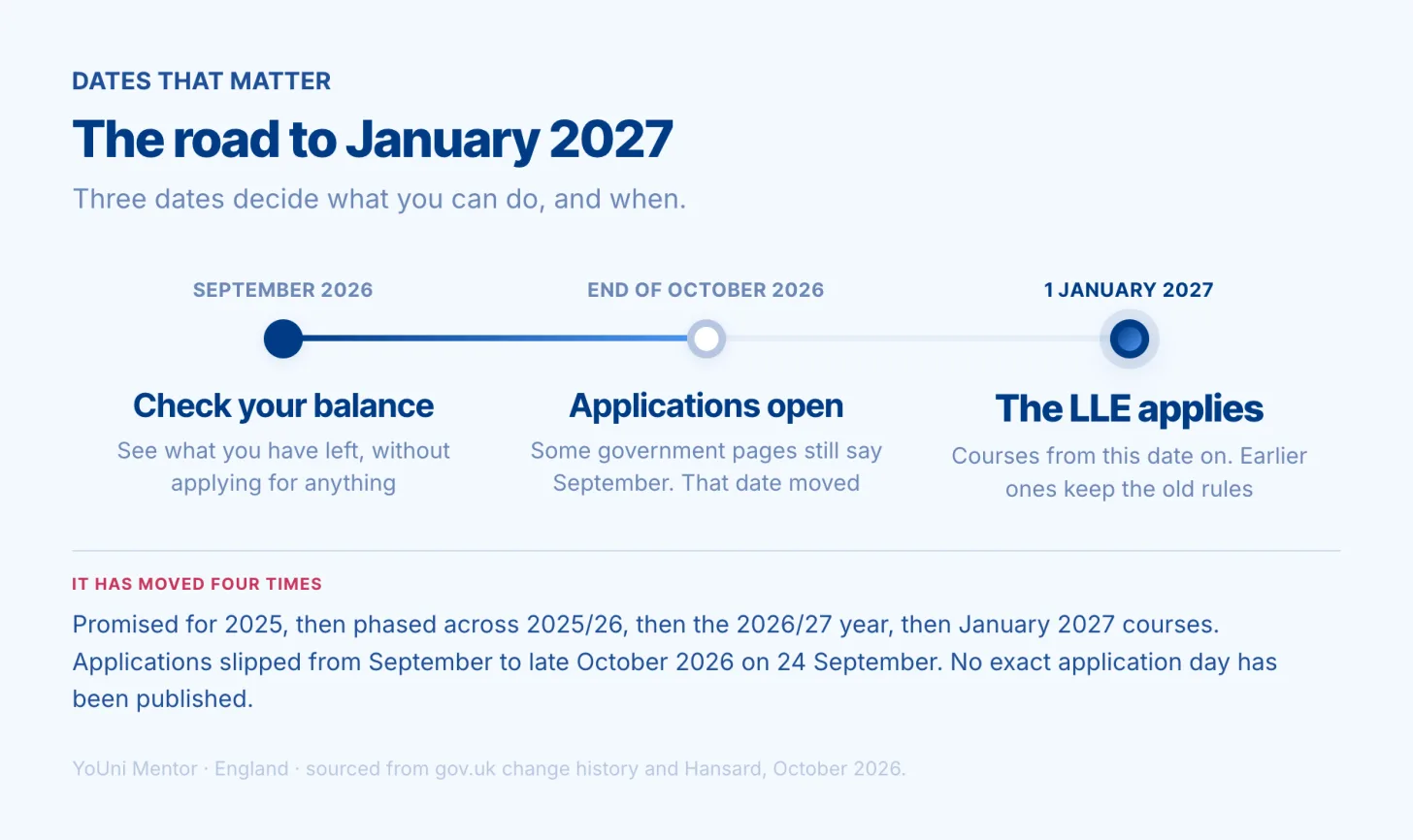
You will see September 2026 quoted in several places, including a Department for Education blog post that has never been corrected. Here is what happened: the application date moved from September to late October 2026, and gov.uk logged the change on 24 September. Some government pages were updated and some were not.
September 2026 did matter, though, for a different reason. From that month you can create a student finance account and get an estimate of how much tuition fee loan you have left, without applying for anything. If you have studied before, checking that estimate is one of the most useful things you can do before committing to a course.
There is one more date confusion worth knowing about. A few universities have said the change affects courses starting September 2027. They are describing their own intake rather than the national rule: if a university has no January 2027 start dates, September 2027 is when the switch happens there. The rule itself is 1 January 2027.
Who is eligible for the Lifelong Learning Entitlement?
Eligibility follows the existing student finance nationality and residency rules, and the test is where you normally live rather than where you study.
The existing eligibility categories carry across. British citizens, people with settled status, people with pre-settled status, refugees and people with humanitarian protection, and various family-member routes all appear in the regulations much as they do now. Two points are worth drawing out for the people we work with.
Pre-settled status no longer expires. The Home Office has extended pre-settled status expiry dates by five years and removed them from its systems altogether, and is converting eligible people to settled status without a second application. If you have been putting off a course because your status looked like it was running out, that particular worry is gone.
Ukraine scheme leave gets full support with no three-year residence test. The Ukraine Family Scheme, Homes for Ukraine, the Ukraine Extension Scheme and the Ukraine Permission Extension Scheme all qualify for full support, and the usual three-year ordinary residence requirement does not apply. You need to have been ordinarily resident in the UK since your leave was granted, and resident in England on the day your course starts. If your Ukraine scheme leave expires partway through, you keep your funding for the whole course as long as you hold some other lawful status, such as a student visa.
Pre-settled status on its own may mean tuition-fee-only funding, and it still depends on meeting the ordinary residence test. Full support including the Maintenance Loan can be available if you qualify through another route, such as migrant worker, self-employed or qualifying family member status. None of that changes under the LLE, and our guide to Student Finance with pre-settled or settled status goes through it properly.
The LLE is the system for people who normally live in England. If you live in Scotland, Wales or Northern Ireland, your own nation’s student finance body funds you and these rules do not apply.
Where you study is a separate question. For a full course you can study elsewhere in the UK, as English-funded students do now. Module funding is narrower: it is only available to students living in England at a provider registered with the Office for Students.
How much LLE will you have left if you have studied before?
Your entitlement is reduced by the tuition fee support the UK government has already paid on your behalf, which is why a typical three-year graduate has about £9,790 left.
The Student Loans Company calls this the Residual Entitlement Calculation. How it works depends almost entirely on when you studied.
If your course started on or after 1 September 2012
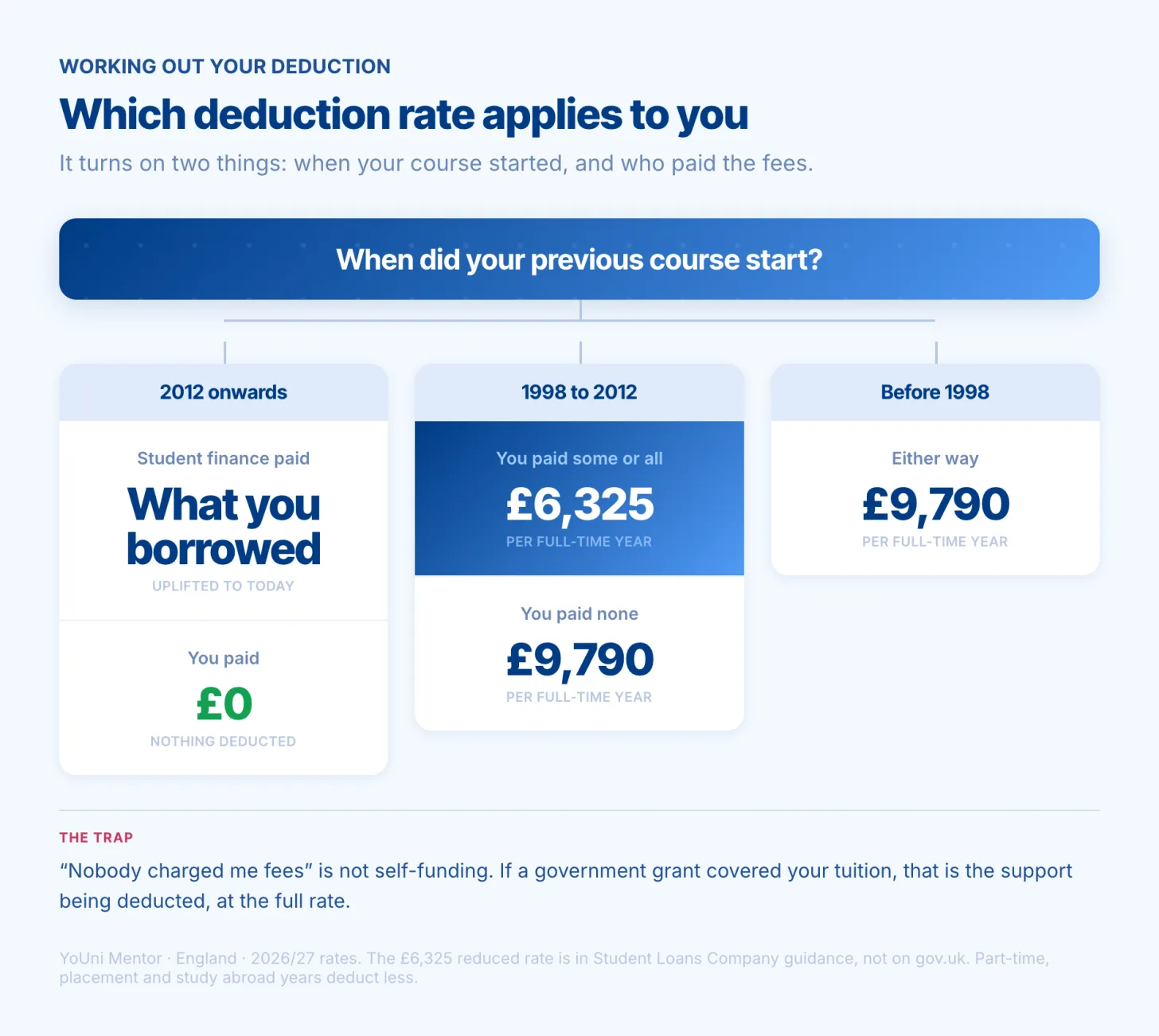
The actual amount of tuition fee loan or grant you received is deducted, uplifted to today’s fee levels.
The uplift matters. Someone who borrowed £9,250 a year for three years borrowed £27,750, but the deduction is calculated at today’s £9,790 cap, giving £29,370. Their residual entitlement is £9,790 – one year’s fees.
Maintenance loans and grants are never deducted. Only tuition support counts.
If your course started before 1 September 2012
Deductions are a flat rate per year of study, regardless of what you paid.
| Type of study year | Deducted per year |
|---|---|
| Full-time | £9,790 |
| Part-time | £4,895 |
| Work placement or sandwich year | £1,955 |
| Study abroad | £1,465 |
| Erasmus | £1,465 |
This is where people are caught out, because fees in that era were either small or non-existent. Someone who started a three-year degree in 1994 and paid nothing at all loses £29,370 and is left with £9,790 – the same residual as a graduate who borrowed £9,250 a year recently.
A less widely published rule: reduced deductions for some self-funders
If your course started on or after 1 September 1998 and before 1 September 2012, and you paid any part of your own tuition fees, your deduction is £6,325 a year rather than £9,790.
This sits in the Student Loans Company’s practitioner guidance rather than on gov.uk, which is why most guides work from the higher table only. The reduced rates are:
| Type of study year | Standard rate | Reduced rate if you self-funded |
|---|---|---|
| Full-time | £9,790 | £6,325 |
| Part-time | £4,895 | £3,162.50 |
| Work placement or sandwich year | £1,955 | £1,265 |
| Study abroad or Erasmus | £1,465 | £948.75 |
The logic is that providers were receiving direct course grants in that period, so the reduced rate is the full rate minus the £3,465 maximum tuition fee loan then available.
Over a three-year full-time degree, that is £10,395 more entitlement than the published table suggests. If you started between 1998 and 2012 and contributed anything towards your own fees, partially or in full, check your estimate carefully before you accept it. Study that began before 1 September 1998 attracts the full rate regardless.
One more thing about this category: the Student Loans Company identifies these years by customer self-declaration. What you tell them shapes the calculation, so it is worth getting right.
“Self-funded” means four different things
The term “self-funded” means different things under these rules, and the outcome depends on when you studied.
| Your situation | What happens |
|---|---|
| You paid your own fees, course started 2012 or later | No deduction at all. Full £39,160 |
| You paid some or all of your own fees, course started 1998-2012 | Reduced rate, £6,325 a year full-time |
| You paid your own fees, course started before September 1998 | Full rate, £9,790 a year |
| Nobody charged you fees, because government block grants covered them | Full deduction at today’s equivalent value |
The last two rows are where people go wrong. “I never paid a penny” feels like it should mean no deduction. It means the opposite: if public money covered your fees, that is exactly the support being deducted.
What is not deducted
Plenty of funding sits outside the calculation entirely:
- NHS fee support and social work bursaries
- Anything funded through the Apprenticeship Levy
- Employer funding, charitable grants and hardship funds
- University bursaries and scholarships
- All maintenance loans and grants
- Any qualification below level 4, other than a foundation year that is part of a degree
- Postgraduate study funded through postgraduate loans
- A year affected by compelling personal reasons such as serious illness or bereavement, which is added back to your balance
Two other rules to know
A part-year costs you a full year. The government’s own example takes someone who completed one year of a three-year degree started in 2008 plus part of the second, and deducts two full years. Dropping out partway through does not give you a partial deduction.
Advanced Learner Loans are deducted at face value. Unlike post-2012 higher education loans, they are not uplifted to today’s fees. A £3,000 Advanced Learner Loan reduces your entitlement by exactly £3,000.
Scottish SAAS funding is deducted at the pre-2012 flat rates whenever you took it. The Modular Acceleration Programme carries a single flat deduction of £2,447.50 however many modules you took.
What this looks like in practice
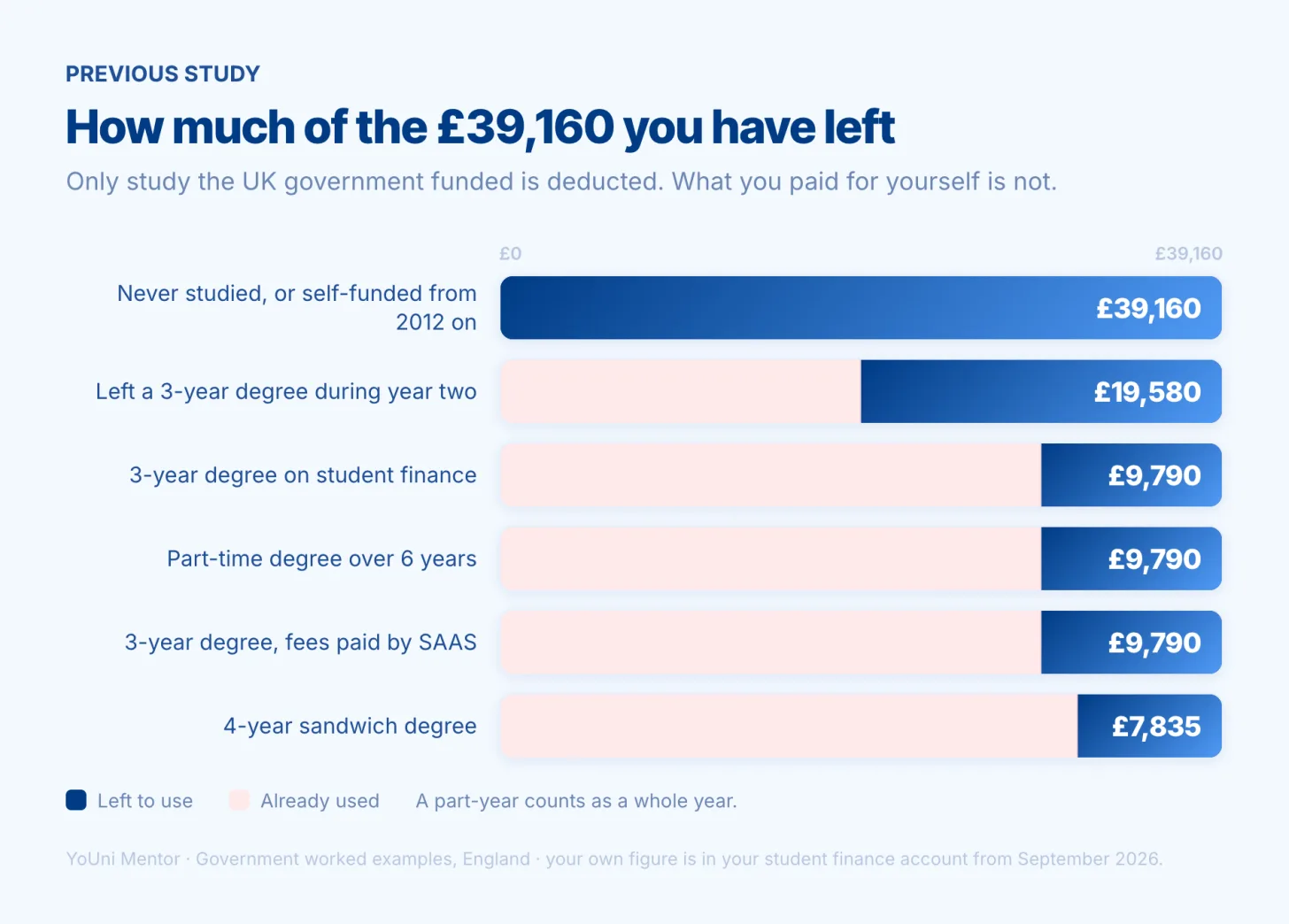
These are the government’s own worked examples, with the residual entitlement each produces:
| If you | Deduction | Left to use |
|---|---|---|
| Did a 3-year degree from 2018 on full student finance | £29,370 | £9,790 |
| Did a part-time degree over 6 years from 2017, self-funded, no loans | £0 | £39,160 |
| Did a 4-year sandwich degree from 2002 | £31,325 | £7,835 |
| Did a part-time degree over 6 years from 2001 | £29,370 | £9,790 |
| Started a 3-year degree in 2008 and left during year two | £19,580 | £19,580 |
| Had all fees paid by SAAS for a 3-year degree from 2020 | £29,370 | £9,790 |
What if your degree is from outside the UK?
Deductions are based on UK government tuition fee support you have actually received, not on qualifications you hold. So a degree earned and paid for abroad should not reduce your entitlement.
The regulations define “applicable tuition fee support” as support for tuition fees provided by the government administrations of England, Wales, Northern Ireland or Scotland. A degree from Ukraine, Romania, Poland, Bulgaria or Brazil, funded by you or your family, is not that. The Student Loans Company’s own FAQ states that self-financed overseas study does not result in deductions, while overseas study funded through UK student finance does.
What gov.uk does not do is spell this out in a single sentence. Study taken wholly abroad and wholly self-funded is not named in its residual entitlement guidance. So treat the above as a reasoned reading of the regulations rather than a published government statement, and check your own balance in your student finance account from September 2026 before you commit to anything.
How your overseas qualification is assessed by a university, and whether you need a UK ENIC Statement of Comparability, is a separate question from your LLE balance. We cover that in its own guide.
Can you use the LLE if you already have a degree?
Yes. The rule that stopped people funding a second qualification at the same or a lower level is removed for courses starting on or after 1 January 2027.
That rule was called the Equivalent or Lower Qualification restriction, and under the current system it blocks most people in that position, with exceptions for a small number of priority subjects. The Student Loans Company guidance is clear: those restrictions will not apply.
Instead, it comes down to how much entitlement you have left. If you hold a three-year degree funded by student finance, that is roughly £9,790, which will not pay for another full degree on its own. For some subjects there is additional entitlement on top, covered below.
One timing point worth knowing: the restriction only lifts for courses starting on or after 1 January 2027. Under the rules in force until then it still applies, so if you hold an equivalent-level qualification, a January 2027 start may fund you where an autumn 2026 one would not.
Second-degree funding has its own rules and its own arithmetic, and we cover it properly in a separate guide.
Can people over 60 get the Lifelong Learning Entitlement?
You must be under 60 on the first day of your course to get a tuition fee loan. At 60 or over you may still get a means-tested loan towards living costs, but not tuition.
Two details are easy to miss, and both work in your favour. If you qualify on day one, you keep that funding for the whole course even if you turn 60 partway through – the government’s example is someone aged 59 at the start of a three-year degree who turns 60 in November of the first year and carries on. And if you transfer to a different course after your 60th birthday, you keep your eligibility as long as you had it when you started.
What you cannot do is start a new course at 60 or over and get a tuition fee loan for it, even if you are already funded on another one.
If you are 57, 58 or 59, your course start date matters. There is no lower age limit, despite one government agency page implying a floor of 18.
What does the LLE cover?
The LLE covers qualifications at levels 4 to 6, which includes full degrees, foundation years that are part of a degree, Higher Technical Qualifications and some technical certificates, plus a small number of level 7 courses such as PGCEs.
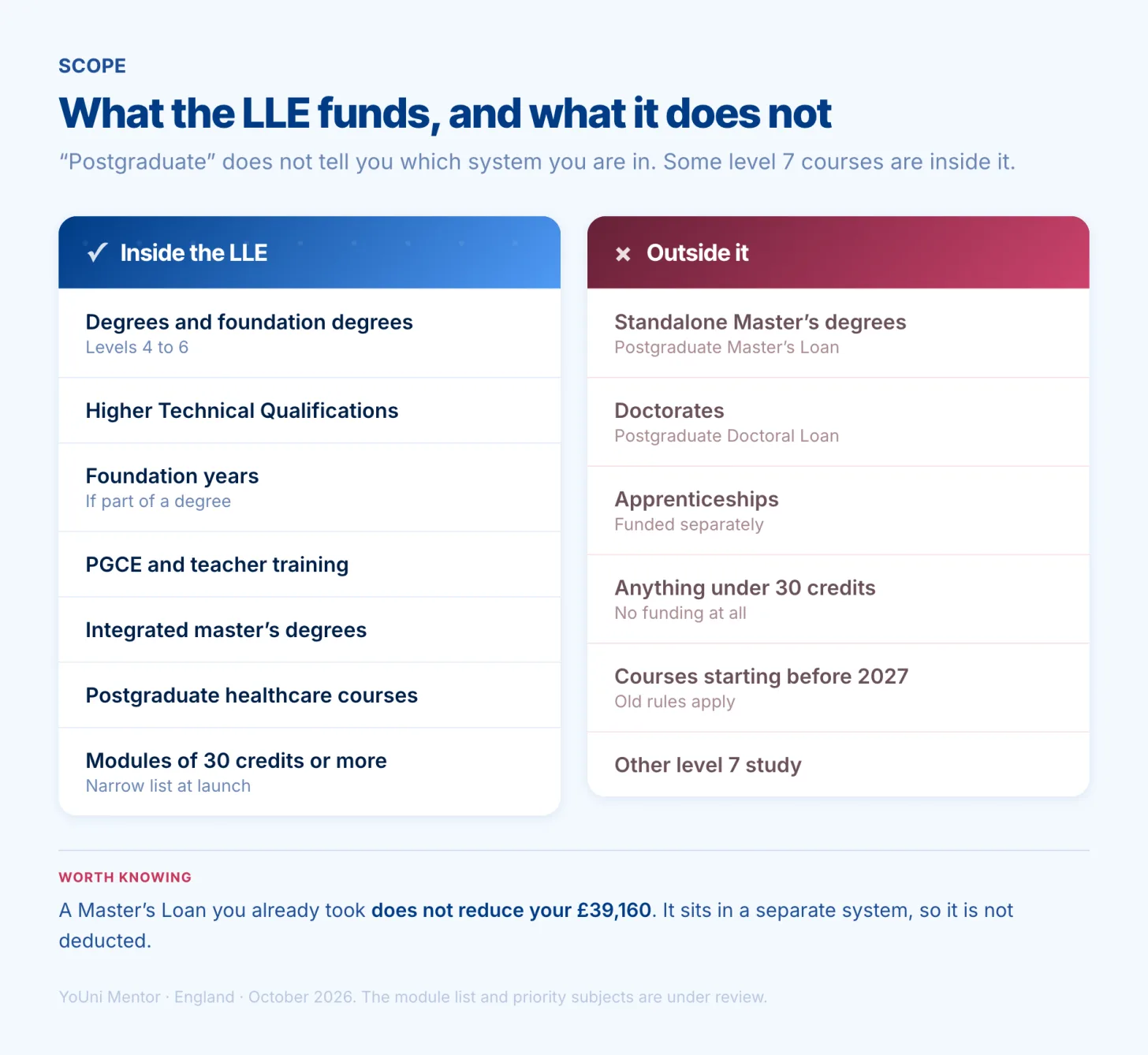
Study abroad years, work placements and Turing mobility are in scope. General Master’s degrees are not, and there has been public criticism of that.
Modules are the new element here, and there are several restrictions on what qualifies:
- A module must be worth at least 30 credits. Below that there is no funding at all.
- It must be part of an existing full course, not a standalone short course.
- Modules are levels 4 to 6 only. You will see one government site mention level 7 modules; the legislation and the Student Loans Company guidance do not support that.
- There is a 180-credit maximum in any single year.
- The range of modules is deliberately narrow at launch. The government has said it will “offer a narrower range of modules when the LLE launches, and gradually expand this when it is appropriate”.
So if you are interested in studying individual modules rather than a full course, check whether anything you want to study is in the first wave before building a plan around it.
Extra funding on top of your balance
Two forms of additional entitlement exist, and both start only once your ordinary LLE balance reaches £0.
Priority Additional Entitlement covers the remaining tuition fees for a defined list of subjects: medicine, dentistry, nursing, midwifery, the allied health professions, initial teacher training and social work. The government’s own example is a learner with £9,790 left who starts a three-year social work degree, spends that balance on year one, then draws Priority Additional Entitlement for the rest. It covers full courses only, not individual modules, and it comes with the usual maintenance support and repayment terms. The subject list is under review, so check it rather than assuming.
Special Additional Entitlement applies in two main situations. For long courses that are not priority subjects it adds up to two years of funding, which is 240 credits, or £19,580 at current rates: veterinary surgery, architecture, and bachelor’s or integrated master’s degrees provided in Scotland, all needing at least five full-time taught years. It also covers certain special periods within a course, meaning foundation years, study abroad, work placements and Turing scheme periods.
Can you use it while working?
Part-time and blended study qualify, and maintenance support reduces in proportion to how much you study.
The limits that matter to someone in a job:
- Maintenance is available for courses with in-person attendance. Distance learners normally cannot get a Maintenance Loan. The exception is if you cannot attend in person because of a disability or long-term illness. So if you were planning to study online around shift work, the tuition is funded and the living-cost support usually is not.
- Distance learning studied from outside England does not get a tuition fee loan either.
- Targeted grants such as the Childcare Grant and Parents’ Learning Allowance need at least 120 credits in the course year.
- Apprenticeships are funded separately and are outside the LLE.
- Maintenance loans are paid per term, in up to three instalments for the launch year.
Timetables vary by university and course – two days a week, evening blocks and blended study all exist, and what is available depends on the provider. Our guide to studying for a degree while working goes through how people fit it around a job.
What will you repay?
LLE loans follow Plan 5. You repay 9% of what you earn above £25,000 a year, and anything left is written off 40 years after the April you were first due to repay.
£25,000 a year is £2,083 a month or £480 a week. Below it you repay nothing. Interest is currently charged at 4.1% from the day the first payment is made.
If you already have an undergraduate loan and then use your remaining LLE entitlement, you make a single 9% repayment, not two. Repayments also stop if your salary drops below the threshold, and the Student Loans Company lists a further cancellation trigger for borrowers receiving disability-related benefits that render them permanently unfit to work.
What is not settled yet
Several parts of the LLE are still moving. As of October 2026:
- Maintenance is capped at £15,415 for a course year of up to 30 weeks, and what you get depends on where you live while studying, how many credits you take, how many weeks you study and your household income. gov.uk has not published an LLE breakdown by living situation, so treat any by-category table you see elsewhere as current-system figures rather than confirmed LLE ones.
- Maintenance when your ordinary tuition balance reaches £0 is less clear. The maintenance guidance says learners with a £0 tuition fee loan balance are not entitled to maintenance loans. Other gov.uk pages say maintenance continues alongside Priority and Special Additional Entitlement, and that it can continue after the ordinary balance is used up on certain longer degrees. The likely reading is that additional entitlement gives you a fresh balance, so the £0 rule stops applying, but the pages are worded as though they disagree. Go by your Notification of Entitlement.
- The priority subject list is under review and the government has said it may change to reflect skills gaps.
- Break points in degree programmes are going to be consulted on, with no date set.
- The regulations themselves are subject to amendment. Every chapter of the Student Loans Company’s guidance says so.
- No specific application date has been published beyond “end of October 2026”.
The LLE timetable has changed several times. The 2022 consultation promised it from 2025. In April 2024 that became phased delivery across 2025/26, and on Budget day in October 2024 it moved again to the 2026/27 academic year. In January 2025 the Education Secretary confirmed to Parliament that courses would start from January 2027. Applications were then set for September 2026, and moved to late October 2026 on 24 September. Treat the rules as reliable and the timetable as something to check.
How to check your own balance
From September 2026 you can create a student finance account and see an estimate of your remaining tuition fee loan entitlement. You do not need to apply for student finance to see it.
Do this while you are still choosing a course. If you studied in the 1998-2012 window and paid any of your own fees, compare what the estimate says against the reduced-rate table above – the deduction depends on a self-declaration, and it is easier to get right at the start than to correct later.
You can also run the current figures through our student finance calculator to see roughly what tuition and living-cost support look like under the system in force today.
Frequently asked questions
Is the LLE replacing student loans?
It replaces higher education student finance loans and Advanced Learner Loans at levels 4 to 6, for courses starting on or after 1 January 2027. Postgraduate Master’s and Doctoral loans are unaffected.
How much is the Lifelong Learning Entitlement?
Four times the annual tuition fee cap, which is £39,160 for 2026/27 based on a £9,790 cap. It is uprated when the cap changes.
Can I get student finance for a second degree under the LLE?
The restriction that blocked it is removed for courses starting on or after 1 January 2027. Whether your remaining entitlement is enough for another full degree is a separate question, since a typical three-year graduate has about £9,790 left. We cover second-degree funding in its own guide.
Does a degree from another country reduce my LLE?
It should not, because deductions are based on UK government tuition fee support you received rather than qualifications you hold. gov.uk does not state this explicitly, so check your balance in your student finance account before committing.
Can people over 60 get the Lifelong Learning Entitlement?
Not a tuition fee loan – you must be under 60 on the first day of your course. You may still qualify for a means-tested loan towards living costs. If you start before you turn 60 you keep your tuition funding for the whole course.
I studied in the 1990s and never paid tuition fees. How much do I have left?
Pre-2012 study is deducted at a flat £9,790 a year for full-time study, so a three-year degree leaves about £9,790 regardless of what you actually paid. If your course started on or after 1 September 1998 and you contributed anything towards your fees, the rate drops to £6,325 a year.
I already borrowed for a Master’s. Does that reduce my LLE?
No. A standalone Postgraduate Master’s Loan sits in a separate system and is not deducted from your £39,160. Only tuition support for the relevant undergraduate and level 4 to 6 study counts, plus the level 7 courses the LLE itself funds.
What happens if I dropped out?
A partial year counts as a full year. Someone who left during the second year of a three-year degree is deducted for two years. If you left for compelling personal reasons such as serious illness or bereavement, that period is added back.
Can I study online and get a maintenance loan?
Normally no, although tuition fee funding is available. The exception is if you cannot attend your course in person because of a disability or long-term illness, in which case you can apply. Distance learning studied from outside England does not get a tuition fee loan either.
What is the minimum I can study?
A module must be worth at least 30 credits and be part of an existing course. There is also a 180-credit maximum per year.
Does the LLE apply in Scotland, Wales or Northern Ireland?
The LLE is the student finance system for people who normally live in England, and Scotland, Wales and Northern Ireland each run their own. Where you study is a different question: you can use the LLE for eligible full courses at approved providers elsewhere in the UK. LLE-funded modules are the exception, and are limited to providers in the English regulatory system.
Where this comes from
This guide is built on the government’s own published guidance and the Student Loans Company’s practitioner documentation, checked on 1 October 2026:
- Lifelong learning entitlement: what it is and how it will work (GOV.UK, updated 24 September 2026)
- How much LLE you could get (GOV.UK, 15 April 2026) – the deduction rules and worked examples
- Student finance for courses starting on or after 1 January 2027 (GOV.UK)
- Maintenance loans for living costs in the LLE (GOV.UK)
- Student Loans Company LLE practitioner guidance: tuition fee loan entitlement, residency and courses chapters – the source of the reduced pre-2012 deduction rates
- The Lifelong Learning (Fee Limits) Regulations 2026 (SI 2026/856)
Figures are correct as of October 2026 and are pegged to 2026/27 fee rates. Student finance rules change, so check gov.uk before you make a decision based on a number in this guide.
Thinking about studying in 2027?
Book a free consultation