 Skip to content



If you have pre-settled or settled status under the EU Settlement Scheme and live in England, there is a good chance you qualify for UK Student Finance - and if you work in the UK, that usually means your fees are covered, with support for living costs too. Pre-settled status is where people get confused most, and that confusion often stops them applying when they would actually qualify. This guide walks through where you really stand: the residence test in plain English, what settled and pre-settled each give you, and the four routes that can make a pre-settled student eligible for the Maintenance Loan.
This guide focuses on EU, EEA and Swiss nationals with EUSS status - pre-settled and settled. Refugee status, Humanitarian Protection and Irish citizens are touched on too, for comparison, but they are not the main focus. If you are on a Ukraine scheme, the rules are different and more generous, so this is not the right guide for you.
YoUni Mentor advisors check eligibility for adults in these categories every working day. Everything below reflects the rules for courses starting in the 2026/27 academic year in England, as published by Student Finance England (SFE).
This guide covers Student Finance England; the rules differ in Scotland, Wales and Northern Ireland. It is general information, not immigration advice - your entitlement is always assessed individually by SFE.
The quick answer
| Your status | Tuition Fee Loan | Maintenance (living costs) Loan |
|---|---|---|
| Settled status / Indefinite Leave to Remain (3 years' UK residence) | Yes | Yes |
| Pre-settled + 3 years' residence | Yes | Usually no - see the worker routes below |
| Pre-settled + working in the UK (migrant worker) | Yes | Yes |
| Pre-settled + self-employed in the UK | Yes | Yes |
| Pre-settled + family member of an EEA worker | Yes | Yes |
| Refugee status / Humanitarian Protection | Yes | Yes - no 3-year wait |
The part most people get wrong: if you have pre-settled status and you work in the UK, you can usually get support with living costs as well, not just your fees. (If you are on a Ukraine scheme, different rules apply.)
What you can get
You can borrow two things, assessed together in one application:
- a Tuition Fee Loan that pays your course fees in full - it goes straight to the university, so you never handle the money and pay nothing upfront;
- a Maintenance Loan that helps with your living costs, paid to you in three instalments across the year, one per term. How much you get depends on your household income.
You only begin repaying after you finish your course and once you earn above a set salary. From then on you pay back a small, fixed share of what you earn above that level - nothing on the income below it - and anything still left is written off after 40 years. If your earnings stay below the threshold, you repay nothing at all.
The exact 2026/27 amounts - including how the Maintenance Loan reduces at higher household incomes, and the extra grants for parents - are published on gov.uk. They are set for the academic year and reviewed annually, so always check the current figures there before relying on them.
Home fees vs international fees
There are two separate things to sort out, and people often mix them up.
The first is the fee the university charges you. Universities charge either home fees (the lower, capped rate) or international fees (much higher, with no loan to cover them). The second is the Student Finance you can borrow. These are decided by different people: the university sets your fee status, and Student Finance England decides your loans.
The good news is that settled status, pre-settled status (with the residence conditions) and refugee status all normally count as home fee status in England. The one thing to watch: a university's system can wrongly flag a non-UK passport as international. If you are quoted international fees, do not accept it at face value - it is usually a mistake that can be put right with the correct evidence, and we sort this out for students regularly.
The residence test in plain English
Almost every category requires you to be ordinarily resident in the right place. Two things have to be true:
- You live in England now - normally and lawfully, as your home (not as a visitor), on the first day of the first academic year of your course.
- You have been resident for the three years before that day - in the UK for settled status; for pre-settled status holders, those three years can be in the UK, EEA, Switzerland or Gibraltar.
"Ordinarily resident" simply means this is where your normal life is - where you live, work and keep your home. Short trips abroad do not break it. (Refugee status and Humanitarian Protection skip the three-year wait - see below.)
Settled status: usually assessed like a UK citizen for Student Finance
If you hold settled status under the EU Settlement Scheme and have lived in the UK for three years, you qualify for both loans - tuition and living costs - on the same terms as a British citizen.
One thing to be aware of, because we see this mistake: settled status on its own is not automatic approval. The three-year residence rule still applies, and SFE will ask for your address history and evidence. If you only received settled status recently but have lived in the UK for years, you are usually fine - the clock counts your time in the UK, not the date on your status.
Pre-settled status: read this section carefully
This is the status people misunderstand most, and getting it wrong can mean missing out on funding you were entitled to all along.
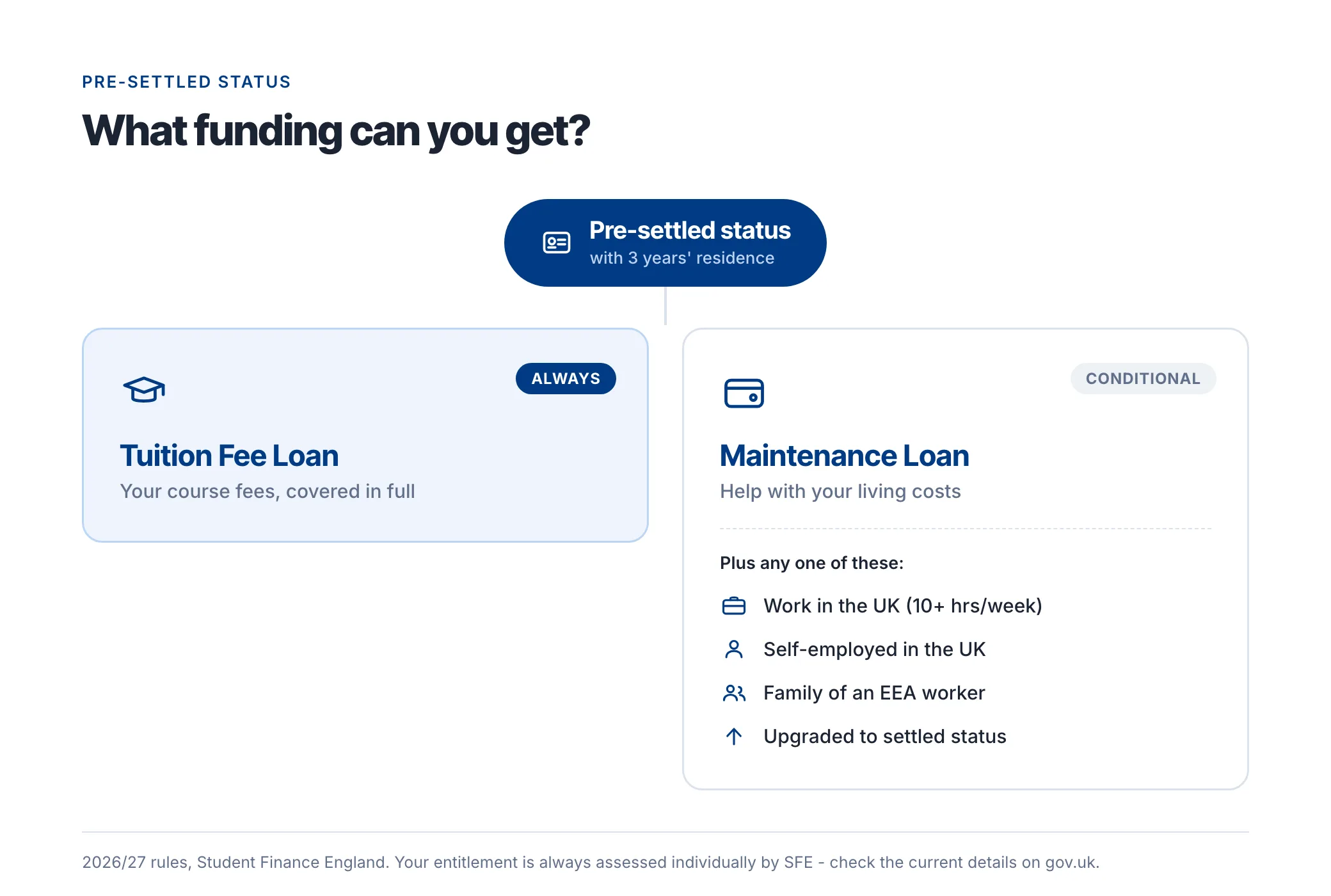
On its own, pre-settled status (plus three years' residence in the UK, EEA, Switzerland or Gibraltar) qualifies you for the Tuition Fee Loan. Your fees are fully covered and you pay nothing upfront. On its own, though, it does not include the Maintenance Loan for living costs.
But there are four routes that can make you eligible for support with living costs as well. Any one of them is enough:
Route 1 - you work in the UK (the "migrant worker" route)
If you are an EU, EEA or Swiss national with pre-settled status and you do real paid work in the UK - usually around 10 or more hours a week, backed up by your contract, payslips and P60 - you can qualify as a migrant worker. That means you get both loans: tuition and living costs.
There is no minimum length of time you must have worked first. What matters is that the work is genuine and that you keep it going:
- The work has to be real and regular - SFE will ask for evidence.
- You need to stay in work throughout the course. If you stop, or your hours drop substantially mid-course, your living-costs entitlement can be reassessed. Most of our pre-settled students study on flexible timetables - such as two days a week, evening or blended study - precisely so that a job and study fit together.
Route 2 - you are self-employed in the UK
Registered, active self-employment that earns you a genuine income counts the same way as a job. Keep your registration, invoices and tax returns - that is your evidence.
Route 3 - you are a family member of someone in Route 1 or 2
If your spouse, partner or parent is an EEA or Swiss national who qualifies as a migrant worker or is self-employed in the UK, you can get full support as their family member - even if you do not work yourself.
There are also less common family routes - for example, where your child is a British citizen - and these get complicated quickly. If you think one might apply to you, do not rule yourself out: get it checked.
Route 4 - your status upgrades to settled
Since April 2026, the Home Office automatically upgrades eligible pre-settled holders to settled status, by cross-referencing 30 months of tax or benefit records within the last 60. Once you hold settled status, both loans apply from the next academic year. If you are close to five years in the UK, check your status before assuming anything - it may already have changed.
The bottom line: "pre-settled means tuition only" is the most common mistake we correct. If you work in the UK - as most of our applicants do - you will most likely qualify for living-costs support as well. The sensible move is to have your own situation checked rather than assume.
What happens if your status changes mid-course?
A degree takes three or four years, and statuses do not stand still. The two situations pre-settled students ask about:
You upgrade from pre-settled to settled during the course. This can only help you. Let SFE know when it happens, and from the next academic year you are assessed as settled - which can add the Maintenance Loan if you did not already have it.
Your pre-settled status is coming up to its expiry date. The Home Office now extends pre-settled status automatically before it runs out, and the April 2026 automation upgrades eligible holders straight to settled. The one thing that matters for your funding is that there is no gap. So check your eVisa account each year and keep your contact details with the Home Office up to date - a status that lapses because of an old email address is exactly the kind of thing that stalls funding.
The thread running through all of this: your funding follows your immigration status, so keep that status in good order. Checking your eVisa account once or twice a year can prevent avoidable funding delays.
Studying while keeping the Maintenance Loan: the practical pattern
On the worker route, your living-costs loan depends on staying genuinely employed through the course - which sounds hard to combine with a full-time degree until you see how our students actually do it. Some universities that work with adult learners offer full-time degrees on flexible timetables, such as two days a week, evening blocks or blended study, so that a job and a degree can sit side by side. The checklist we give worker-route students:
To see what that looks like in numbers, try our student finance calculator.
To see what that looks like in numbers, try our student finance calculator.
- Keep a regular working pattern of around 10 or more hours a week - being consistent matters as much as the exact number.
- Keep every payslip and contract change from the day you apply; SFE can ask for evidence at any reassessment.
- If you change jobs, try not to leave a long gap between them, and keep the paperwork from both.
- Self-employed? Keep invoicing and file your tax returns on time - the paper trail is your proof.
Managed properly, the worker route is stable - you just need to keep your evidence in order, and thousands of EU students in England manage it every year.
Refugee status and Humanitarian Protection
If the Home Office has granted you refugee status, you and your immediate family members qualify for both loans immediately - no three-year wait. The same applies to Humanitarian Protection holders, with one extra condition: the three-year residence rule is waived, but you must be ordinarily resident in England when the course starts.
Two practical notes from our casework:
- People still waiting for an asylum decision are not yet eligible for Student Finance - eligibility begins when status is granted. Some universities offer sanctuary scholarships in the meantime; ask before paying anything.
- Refugee status also carries home fee status - never accept an international fee quote without having it checked.
What could make you NOT eligible
A few things can block funding, whatever your status:
- A status that does not qualify on its own. Work visas (such as the Skilled Worker visa), student visas and visitor visas carry no Student Finance entitlement by themselves - the qualifying statuses are the ones above. Eligibility often arrives later, with Indefinite Leave to Remain.
- A residence shortfall. Less than three years' qualifying residence where the rule applies, or living in England only as a visitor.
- A previous degree. Student Finance normally funds your first qualification. There are real exceptions - subjects like nursing, midwifery, allied health and teaching are funded even as a second degree. And if your degree is from abroad, it is worth getting checked, because the assessment is more nuanced than a simple yes or no.
Prior study you have forgotten about, and the type of course, can also affect funding. None of this is ever the final word, though: statuses upgrade, residence builds up, and the list of exceptions is longer than most people expect. That is why we check before anyone walks away.
Your three possible outcomes
When we assess someone in these categories, the result is almost always one of three:
| Outcome | Typical profile | What it means |
|---|---|---|
| Eligible now - fees and living costs | Settled + 3 years; pre-settled + working; refugee | Apply now - tuition and living costs both covered |
| Eligible now - fees covered, living costs conditional | Pre-settled, not currently working | Fees fully covered; starting genuine work of around 10+ hours a week before the course and keeping it going can make you eligible for the living-costs loan |
| Not yet | Recent arrival on a non-qualifying visa; under 3 years' residence | Not yet eligible, but not necessarily a permanent no - residence builds up, statuses upgrade, and we tell you the exact date and condition that changes your answer |
Can you get pre-settled status now?
This question usually means one of two things, so here are both answers. If you are an EU citizen who was living in the UK by 31 December 2020 and never applied to the EU Settlement Scheme, late applications are still possible with reasonable grounds - worth sorting out before any university application, because your funding depends on it. If you are asking whether coming to the UK to study would give you pre-settled status: no - studying here does not create EUSS eligibility. The scheme is based on living in the UK before Brexit, or on joining a qualifying family member.
How to apply, and the evidence that decides it
Student Finance applications for 2026/27 are open at gov.uk - and you can apply before you have a confirmed university place, then update the course later. For these statuses, the strength of your evidence often decides how smoothly the application is processed:
- Status evidence - your eVisa share code (settled, pre-settled) or Home Office letters (refugee status, Humanitarian Protection).
- Residence evidence - your address history for the last three years (more if asked): tenancy agreements, council tax, bank statements, GP registration.
- Worker-route evidence (pre-settled) - employment contract, recent payslips, P60 or P45; for the self-employed, your HMRC registration and tax returns.
- Household income details - for the Maintenance Loan assessment. If you are 25 or over, that means your income and your partner's - your parents' income is never counted.
Straightforward applications are processed in a few weeks; cases with status or residence evidence take longer. Apply early, reply to every SFE request quickly - a slow response to document requests is one of the most common reasons funding arrives late - and never ignore a letter.
A difficult case that worked out

"I had a difficult case, and previous agencies led me to a dead end. YoUni Mentor took the time to understand my situation and found a way to make it work. Now I'm studying in London on the exact course I wanted."
Status-based eligibility is exactly where cases get called "difficult" - and exactly where the right preparation changes the outcome. YoUni Mentor brings over 16 years of advising experience to these applications, and the service is free for students: we assess your status and residence position, prepare the evidence with you, and handle the university side in parallel. See how it works.
Check your exact eligibility with a YoUni Mentor advisor - free, no obligation. Tell us your status and how long you have been in the UK, and we will tell you which outcome applies to you and what steps, if any, could improve your eligibility before you apply.
Check your eligibilityFrequently asked questions
Can I get student finance with pre-settled status?
Yes - with three years' residence in the UK, EEA, Switzerland or Gibraltar, pre-settled status qualifies you for the Tuition Fee Loan. If you also work in the UK (around 10+ hours a week of genuine employment, or real self-employment), you can usually get the Maintenance Loan too.
Can I get a maintenance loan with pre-settled status?
Often, yes - through the worker routes. The Maintenance Loan is not part of the basic pre-settled entitlement, but qualifying as a migrant worker, being self-employed, or being the family member of an EEA worker each makes you eligible for it. Keeping the work going during the course is what matters.
Are Irish citizens eligible for UK student finance?
Yes. Under the Common Travel Area, an Irish citizen with three years' residence in the UK or Ireland is treated like a UK national for student finance in England - full tuition and living-costs support, with no EU Settlement Scheme status needed.
Can Ukrainians get student finance in the UK?
Yes, and under more generous rules - no three-year wait, plus home fees. The Ukraine schemes have their own conditions, so it is worth checking your own situation with an advisor.
Does student finance cover a foundation year?
Yes - a foundation year that is part of a degree is funded like any other year of the course. Our foundation year guide explains it.
Is this the same in Scotland, Wales and Northern Ireland?
No - this guide covers Student Finance England. The other UK nations run their own schemes, with similar categories but different amounts and rules.
Rules summarised from gov.uk and Student Finance England guidance for the 2026/27 academic year, verified against the House of Commons Library and UKCISA. Last updated: June 2026. Figures and rules can change between academic years - always confirm current amounts and conditions on gov.uk. Your entitlement is assessed individually by SFE.
