 Skip to content



Changing career at 30 or 40 is not only possible in the UK - it is increasingly normal, and for many people a degree is the most reliable route into the new field. Around a third of UK undergraduates are mature students, and the sectors with the strongest demand - healthcare, teaching, engineering, technology - either require a degree or strongly prefer one. The part most people do not know: as a working adult you can study for that degree without quitting your job, and without paying tuition upfront.
This guide gives you the honest picture: which careers are actually in demand in the UK right now, what you can realistically retrain as, how the degree route works when you have no A-levels, and how working adults afford it without giving up their income.
This guide focuses mainly on England, where most YoUni Mentor students apply. Student finance rules differ in Scotland, Wales and Northern Ireland.
Is 40 too late for a career change?
No - and the data is unusually clear on this.
Government figures show graduates in the UK have an employment rate of 87.6%, against 68% for non-graduates, and a median salary of £42,000 against £30,500 (DfE Graduate Labour Market Statistics, 2024). Those are descriptive figures, not a guarantee - but the more interesting finding for anyone over 30 comes from the Institute for Fiscal Studies: the earnings effect of a degree grows after age 30, rather than fading. A degree is not a young person's asset that depreciates with age. The skills, discipline and work history you bring at 35 or 45 compound with it.
There is a practical advantage too. By 40 you usually know what you do not want - which is precisely the clarity most 18-year-old students lack. Mature students choose courses for a defined career outcome, and universities know it: admissions teams treat relevant work experience as evidence in your favour, often in place of formal qualifications.
What 40 does change is the route. Two years of A-levels at a sixth-form college makes little sense mid-career. The realistic routes for adults - foundation years, Access courses, work-experience entry - are faster, and built for people who are already working and cannot put their life on hold for three years of full-time, Monday-to-Friday study.
What is the best career to start in your 40s?
The honest answer is to follow the demand. The strongest careers to move into now are the ones where the UK has a real, measured shortage of people - because that is where employers compete for candidates and where a recognised qualification opens the door fastest. Here is what the 2026 data actually shows:
| Field | Why it is in demand (2026) | Degree route |
|---|---|---|
| Nursing | Around 22,500 unfilled NHS nursing posts in England; the NHS plans 170,000 more nurses by 2036/37 | BSc Nursing, or a nursing degree apprenticeship |
| Allied health (physiotherapy, occupational therapy, radiography) | NHS aims to add 71,000 allied health professionals by 2036/37 | Subject-specific BSc |
| Teaching (physics, computing, maths, languages) | Secondary teacher training ran about 11% below target for 2025/26; physics filled only around 71% of places | Degree, then teacher training - bursaries up to £29,000 in shortage subjects |
| Software, data and cyber security | 76% of UK IT firms reported struggling to fill tech roles in 2025 | Degree usual for data and AI roles; faster routes exist for software |
| Engineering (civil, mechanical, electrical) | An estimated shortfall of 37,000-59,000 engineers a year | Accredited engineering degree |
| Clean energy and green roles | The clean-energy workforce is set to nearly double, to around 860,000, by 2030 | Degree for the professional and engineering tier |
| Social work | A funded "Step Up to Social Work" route for career-changers, with a bursary of around £22,000 | Social work degree, or a 14-month postgraduate route |
For the regulated professions on that list - nursing, social work and teaching - a degree is not optional, it is the legal entry ticket. You cannot register as a nurse without an approved nursing degree; "social worker" is a protected title that requires a social work qualification; and to teach in most state schools you usually need a degree and Qualified Teacher Status. For the rest - software, engineering, accounting, management - a degree is not always mandatory, but for someone arriving without a track record in the field it is the clearest, fastest way to be taken seriously.

What can I retrain as at 40 in the UK?
Realistically, almost anything outside a handful of professions with very long training pipelines. The practical questions are how long the retraining takes and how you fund it. In the UK the main routes are:
- A full degree (3 years, or 4 with a foundation year) - the route into regulated professions (nursing, social work, teaching) and the strongest general signal for management and professional roles. Funded by Student Finance, with timetables that can fit around work.
- A degree with a foundation year - the same as above, for people without A-levels or recent study. The foundation year rebuilds academic skills before Year 1.
- An Access to Higher Education Diploma - a one-year college course that qualifies you to apply for a degree afterwards.
- Professional certifications - accounting (AAT/ACCA), project management (PRINCE2/APM), IT certifications. Faster and cheaper, but they tend to extend an existing career rather than open a brand-new profession.
- Degree apprenticeships - earn while you train, but you need an employer willing to sponsor you, which usually means staying close to your current field.
The rule of thumb: the bigger the jump between your current field and the new one, the more a degree does the heavy lifting - it gives you the qualification, the recent learning and the credibility an employer can actually check. But knowing the route is one thing; structuring a change this big is another, which is where one popular framework keeps coming up online.
What is the "30-30-30 rule" for career change?
The 30-30-30 rule splits a career change into three 30-day blocks: thirty days researching the new field, thirty days building skills and contacts in it, thirty days actively applying. Different coaches phrase it differently, but the core idea is the same - structure the change instead of drifting through it.
Our honest view, after working with hundreds of adult career-changers: the 30-30-30 rule works for a job change within your existing field. It is too short for a genuine profession change. Nobody becomes a nurse, a teacher, a software developer or an accountant in ninety days. What the rule gets right is the first block - structured research before you commit. Spend that month seriously: talk to people in the target profession, check the real entry requirements, and find out what qualification the job adverts actually ask for. If the answer is "a degree", the next step is choosing your route into one - not another ninety-day sprint.
Which jobs are growing - and which are declining?
The direction of the UK jobs market is not hard to read - the official data points consistently one way.
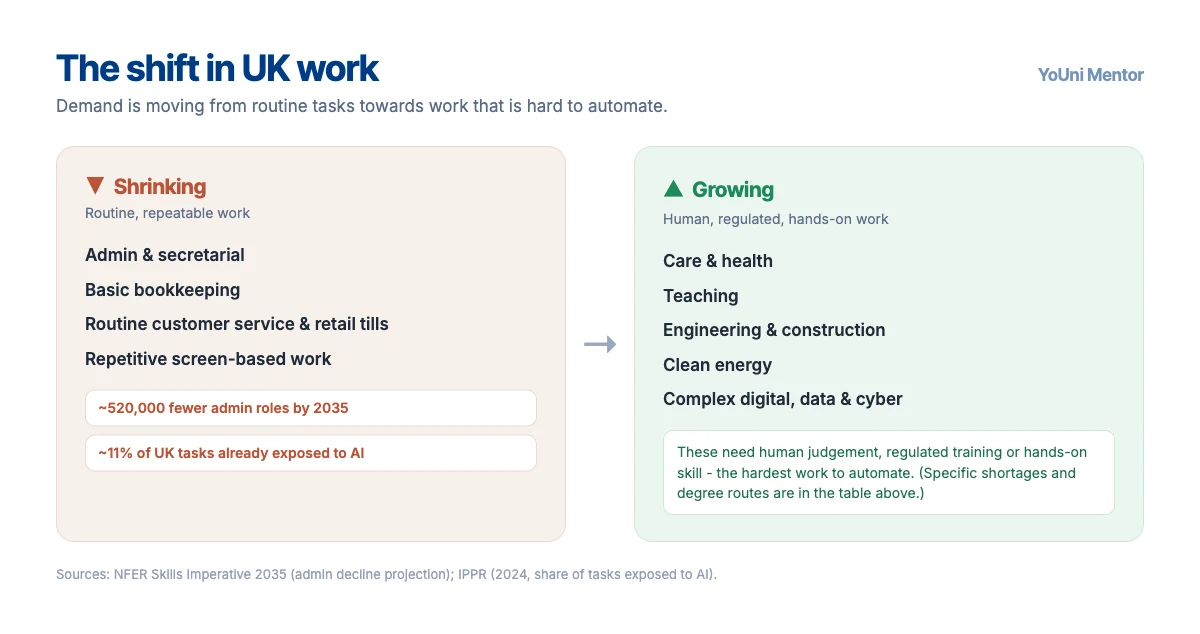
Growing: as the table above shows, healthcare, teaching, engineering, clean energy and digital roles all have measurable, sustained shortfalls. These are not cyclical blips; they are driven by an ageing population, the move to clean energy, and a digital skills gap that has stayed open for years.
Under pressure: routine administrative and secretarial work, basic bookkeeping, retail checkout and bank-branch roles, and increasingly any job built on repeatable screen-work that software can absorb. The NFER projects around 520,000 fewer elementary administrative jobs by 2035, and the IPPR found that roughly 11% of UK work tasks are already exposed to today's AI tools.
The uncomfortable but useful insight: the declining list is where many working adults currently sit, and the growing list is dominated by professions that need a degree. That is not a coincidence - roles built on human judgement, regulated training and face-to-face skill are both harder to automate and harder to enter without a formal qualification.
The degree route: how it works for a career-changer
Here is what most people in their 30s and 40s do not realise: you do not need A-levels to start a UK degree. Universities assess adults on a different basis - relevant work experience, motivation and a personal statement - and for those who need an academic run-up, the degree with a foundation year exists precisely for this. Our complete foundation year guide explains how it works.
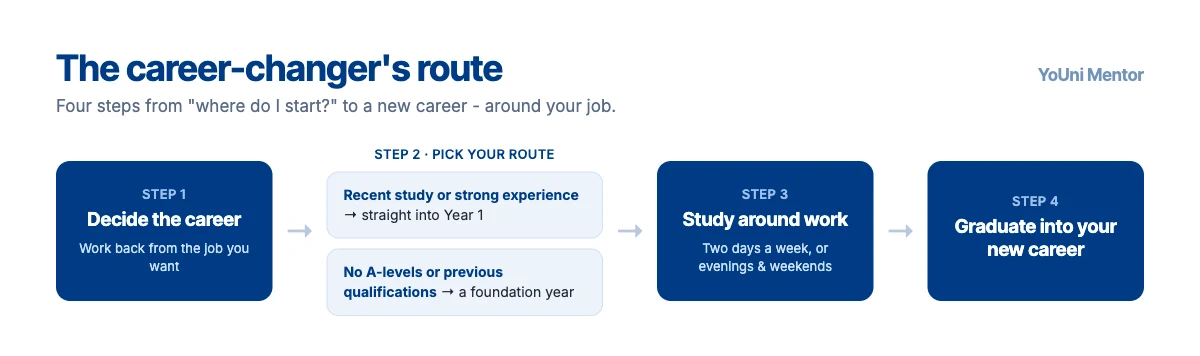
The route looks like this:
- Choose the career first, then the degree. Work backwards from job adverts in your target field - the degree is a means, not the goal.
- Apply to a degree with or without a foundation year. With recent study or strong relevant experience, you may enter Year 1 directly. Without it, a four-year degree with a built-in foundation year gives you a supported first year, funded by Student Finance like any other.
- Pick a timetable that fits work. Some universities offer flexible timetables - such as two days a week, evening blocks or blended study - designed for students who keep working. The exact schedule depends on the university and course.
- Sort funding in parallel. Student Finance applications run alongside the university application, so the money is in place when the course starts.
One thing to check before you start: Student Finance normally funds your first degree only. If you already hold a degree - including one from another country - the rules are more nuanced, and some subjects (nursing, allied health, teaching) are funded even as a second degree. If that is your situation, it is worth getting your exact position checked rather than assuming you do not qualify.
How do working adults afford a career-change degree?
You do not need savings to do this. Student Finance is there as an option, not an obligation - but for most working adults it is exactly what makes a mid-career degree possible, because the system is built so you pay nothing upfront:
- A tuition fee loan covers the full course fee - up to £9,790 a year for 2026/27 - paid directly to the university. There is no upper age limit on the tuition fee loan.
- A maintenance loan helps with living costs, paid in three instalments across the year - one per term. The amount depends on household income; for students aged 25 or over, that means your own and your partner's income, not your parents'. (If you are 60 or over when the course starts, the maintenance amount is more limited.)
- Repayment only starts when you earn over £25,000 a year (the 2026/27 threshold) - you repay 9% of income above it, and anything left after 40 years is written off. Earn less, pay nothing.
One thing to keep an eye on: the government has consulted on introducing minimum eligibility requirements - such as minimum grades - to qualify for student finance in England. No such rule is in force as of mid-2026, but it is worth checking the current position when you apply.
Eligibility depends on your residency and immigration status - many adults with settled status, pre-settled status, refugee status, humanitarian protection or similar immigration statuses qualify without realising it. Check where you stand here.
Our student finance calculator gives you a rough figure in about a minute.
Real career change, real student
"I'm over 40 and two years into my degree. I have a mortgage now, a career direction - I actually feel settled here for the first time. Couldn't have done it without you guys, thank you."
That is how most of our students do it - stay in work, study around it, and move into the new career step by step. Helping working adults do exactly that is what YoUni Mentor is for, and it is free: we help you choose the right course, find universities that will accept your background, and sort the application with you. See how it works.
See which degree fits your career goal - book a free YoUni Mentor consultation. An advisor will tell you honestly which route makes sense for your situation.
Book a free consultationFrequently asked questions
Is 40 too late to change careers in the UK?
No. Around a third of UK undergraduates are mature students, and IFS research shows the earnings effect of a degree grows after age 30. Sectors like healthcare, teaching and social work actively value the life experience a 40-year-old brings.
What is the best career to change to at 40?
Follow the demand. The fields with measured UK shortages in 2026 are nursing and allied health, teaching in shortage subjects, software and data, engineering, clean energy and social work. Several require a degree by law or regulation.
Can I change career at 40 with no degree and no A-levels?
Yes. UK universities assess adults on work experience and motivation, not just school grades. A degree with a foundation year is designed for exactly this - a supported first year that leads into the full degree, with no A-levels required.
What is the 30-30-30 rule for career change?
A framework that splits a career change into three 30-day blocks: research, skill-building, applying. It suits job changes within your field; a genuine profession change usually needs structured retraining, which the 90-day format cannot deliver.
Can I study for a degree while working full-time?
Yes. Some universities offer flexible timetables - such as two days a week, evening blocks or blended study - though the exact schedule depends on the university and course. Many YoUni Mentor students keep working throughout their degree.
How do I afford a degree at 40?
In England, a tuition fee loan covers the full fee with no upper age limit, and a maintenance loan paid each term helps with living costs. You repay 9% of income above £25,000 only once you earn over that threshold (2026/27).
Which jobs are growing in the UK?
Health and social care, teaching, engineering, clean energy and digital and data roles all have strong, structural demand. Routine administrative, secretarial and retail roles face the most automation pressure.
