 Skip to content



If you already spend part of your working week wrestling a spreadsheet into an answer - pulling numbers together, spotting what changed, explaining to someone why - you are closer to a data analyst's job than you might think. It is one of the more open careers to move into as an adult: there is no upper age limit, and you can start without A-levels. A degree in a data, computing or numerate subject is the broadest foundation - it can take you deepest into the field and keep the most options open later - and for a first degree, Student Finance covers the fees with nothing to pay upfront.
This guide focuses mainly on England. The career itself is much the same across the UK, but Student Finance, Skills Bootcamps and apprenticeship funding differ in Scotland, Wales and Northern Ireland.
What a data analyst does (and how it differs from a data scientist)
A data analyst collects, cleans and interprets data to answer business questions and help people make decisions. The everyday tools are SQL for pulling data out of databases, spreadsheets like Excel or Google Sheets, a dashboard or business-intelligence tool such as Power BI, Tableau or Looker, and increasingly some Python. Much of the job is turning messy data into a clear chart or a straight answer that a non-technical colleague can act on.
People mix this up with a data scientist, but they are different jobs. A data scientist goes further into statistics, machine learning and predictive modelling, and usually needs a stronger quantitative or postgraduate background; a data analyst is the business-and-reporting role, lighter on the heavy modelling and typically the more accessible entry point of the two. (One note on titles: the National Careers Service files this work under a "Data analyst-statistician" profile that leans toward statistician roles, so read its qualification and salary figures with that in mind.)
Do you need a degree to become a data analyst?
Not by law. Data analyst is not a regulated or licensed profession, so there is no qualification you are legally required to hold. Employers may weigh a mix of things - qualifications, technical skills, previous experience, business knowledge and examples of applied work - and the balance varies from employer to employer. But a degree is one of the strongest ways to build the skill and the portfolio they look for: it gives you broad, structured grounding - statistics, databases, programming, how to reason with data - it is the kind of foundation that can carry into data science, analytics engineering and management later, and for a first degree it is funded. It is the route we know best, and for many of the adults we work with it is the one that opens the most doors.
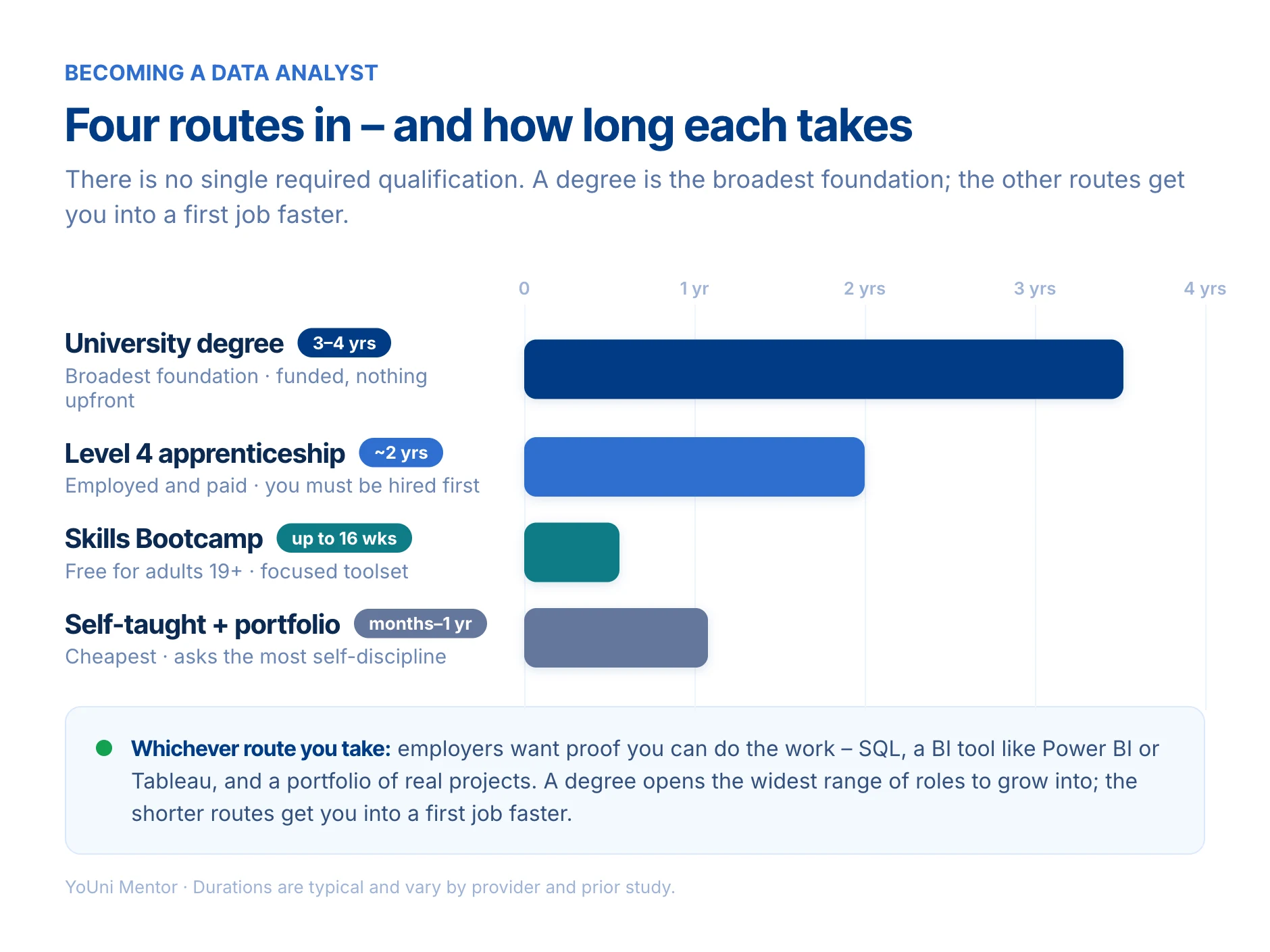
There is no single required qualification - there are four real ways in. A degree is the broadest, most transferable foundation and the route we help with; a Level 4 apprenticeship, a Skills Bootcamp or self-teaching can get you into a first job faster, but they teach a narrower toolset.
It is not the only way in, though, and an honest guide covers all four routes:
- A university degree - the broadest foundation. A degree in a numerate or relevant subject - data science, computer science, mathematics, statistics, economics, or any subject with a strong quantitative component - gives you broad, structured grounding and plenty of room to progress, and it is particularly worth it if you later want to move into data science, advanced statistics or postgraduate study. A first degree is funded (see below), and adults without A-levels can start through a foundation year. It takes longer than the routes below, but it keeps the most future options open.
- A Level 4 apprenticeship - earn while you learn. The Data Analyst apprenticeship (the current standard is a Level 4 higher apprenticeship, typically 24 months plus the end-point assessment) lets you work in a paid role while the employer and government fund the training. It does not award a degree. You have to be hired onto one first: employers set their own entry requirements, places are competitive, and you cannot simply enrol.
- A Skills Bootcamp - short, focused training. Government-funded Skills Bootcamps in data analytics are free for eligible adults aged 19 and over and typically last up to 16 weeks, covering tools such as Excel, SQL, Power BI and data visualisation. Entry requirements vary by provider, and on completion you are normally offered an employer interview, though that is not a guaranteed job. They are a genuine quick way in, but they teach a focused toolset rather than the full grounding a degree gives.
- Self-taught, plus a portfolio. Many analysts build the core skills themselves - SQL, spreadsheets, a BI tool such as Power BI or Tableau, and some Python - and a portfolio of real projects, then apply directly. Vendor certificates such as Microsoft Power BI or Google Data Analytics can back up a portfolio. It is the cheapest route in money terms and the one that asks the most self-discipline.
Whichever route you take, employers want to see that you can do the work. A degree gives the broadest foundation and the widest range of roles to grow into; the other routes can get you into a first job faster. The right one depends on your time, your money and how far you want to go.
What skills do data analysts need?
Employers usually look for a mix of technical and communication skills:
- spreadsheets, particularly Excel;
- SQL and database querying;
- data cleaning and quality-checking;
- a visualisation or dashboard tool such as Power BI or Tableau;
- some basic statistics;
- clear written and spoken communication;
- the ability to take a business question and turn data into a useful recommendation.
Some roles also ask for Python or R. The exact tools vary by employer and sector, so compare current vacancies in the field you want to enter - and whatever your study route, build a couple of projects that show how you cleaned the data, chose a method, made a visualisation and explained the result.
Can you become a data analyst without A-levels?
Yes - A-levels are not the only way in. But "no A-levels needed" is not the same as "no entry requirements", and each route sets its own bar: apprenticeship requirements are set by the employer (some ask for A-levels or equivalent, others weight maths and digital skills), bootcamp providers range from open-to-beginners to selection tests, and the self-taught route asks for no formal qualifications but real self-discipline.
For the degree route without A-levels, the usual way in is a degree with an integrated foundation year - an extra "year zero" that brings you up to degree level and leads straight into the full degree, and one our partner universities offer. Some universities also accept other Level 3 qualifications or relevant experience, and if you trained abroad a UK ENIC assessment can help show how your existing qualification compares (more below). Each has its own entry criteria, so check the specific course rather than assuming.
Student Finance and the ELQ rule
This section matters most for the degree route, and it splits on whether you already hold a degree.
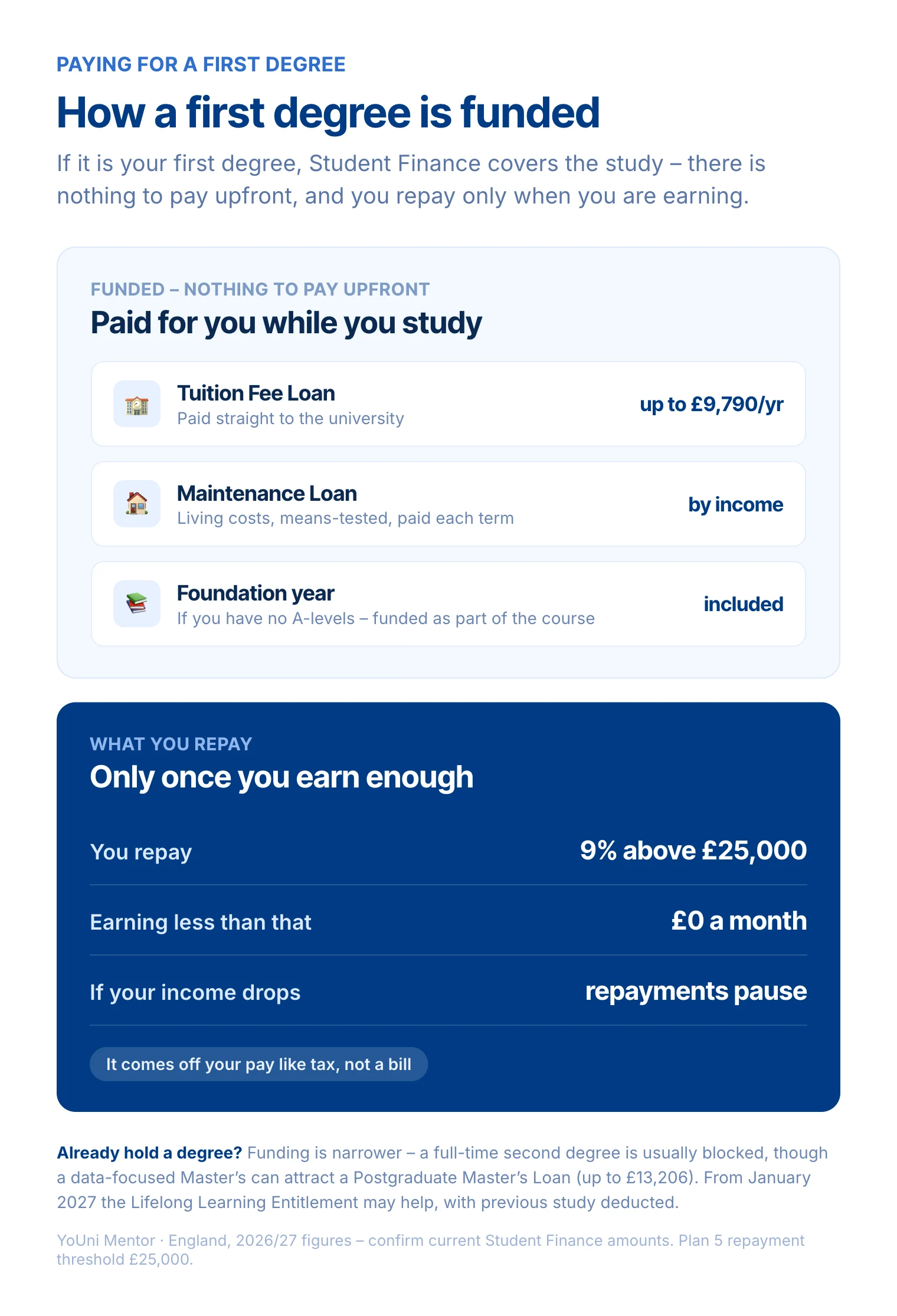
If this is your first degree - where most of the adults we work with are - a data, computing or maths degree at an eligible provider is normally fundable, subject to the usual residency and eligibility rules. For 2026/27 an eligible full-time student can apply for a Tuition Fee Loan of up to £9,790, paid directly to the university so there is nothing to pay upfront, plus a means-tested Maintenance Loan for living costs each term (the amount depends on household income and where you live). Under Plan 5 you currently repay 9% of what you earn above £25,000 a year; thresholds can change.
A full-time second degree is usually blocked, and there is a common misunderstanding about the computer-science exception - it is real, but it only covers part-time study, not a full-time second bachelor's. The next few paragraphs set out exactly what you can and cannot fund.
If you already hold a degree at the same level - the picture changes because of the ELQ rule (Equivalent or Lower Qualification). Student Finance normally will not fund a second qualification at the same level as one you already have.
Here data has a narrow but genuine advantage. gov.uk lists limited exceptions where an existing graduate can still get some funding, and computer science and mathematical sciences are on that list. But the exception is specific: it applies to a part-time honours degree, a joint honours degree or an integrated master's in those subjects - not to a full-time second bachelor's degree - and it is described as limited funding. It also depends on how the course is officially classified, not its prospectus name: a course marketed as "data analytics" only counts if it sits under computer science or mathematical sciences in the university's coding. So treat it as "may qualify, confirm first" - ask our team for the course classification and get an individual assessment from Student Finance England before relying on it. For a first-time undergraduate none of this bites - a first degree is funded either way.
If you already hold a first degree and want the graduate route, there is a strong, fundable option that builds on what you have: a Postgraduate Master's Loan (up to £13,206 for 2026/27) can go towards a data-focused Master's, including data science conversion MScs, and it is a separate scheme from the undergraduate ELQ rule. It is one combined contribution towards fees and living costs, so it may not cover both in full - and you normally cannot get it if you already hold a master's or higher, with the usual age and residency conditions.
From 1 January 2027 the Lifelong Learning Entitlement launches, and for courses starting on or after that date it lets some people seek funding even for study at the same or a lower level than they already hold. It draws on a lifetime Tuition Fee Loan entitlement (gov.uk gives a total of £39,160), and previous government-funded study is deducted from it - so someone already funded for a three-year degree may have only about one year's worth left, not a whole second degree. Eligibility also depends on the course, your previous study, residency and age (you must be under 60 on the first day of the course to apply for a Tuition Fee Loan under the new system). If a previous degree currently blocks you, that date is worth watching - but check your remaining entitlement rather than assuming a full second course is funded.
Our student finance calculator will estimate what you could borrow.
How long it takes, and what it costs
There is no single answer - it depends entirely on which route you take, and the cost differs as much as the time.
- Skills Bootcamp: up to 16 weeks of training; the time to then secure a suitable role varies. Free for eligible adults aged 19 and over.
- Self-taught, plus a portfolio: several months to a year of part-time study to build the skills and a project portfolio. The cost is your time, plus any online courses you choose.
- Level 4 apprenticeship: typically 24 months while employed and paid, once an employer has taken you on - the employer and government fund the training.
- Degree route: three years full-time, or four with a foundation year for those without A-levels; part-time study extends the calendar but fits around a job. A first degree is funded by Student Finance - the Tuition Fee Loan covers fees up to £9,790 a year (2026/27) with nothing upfront, repaid only once you earn over £25,000 a year.
If your route runs through an overseas qualification, a UK ENIC Statement of Comparability currently costs £69.60 (including the electronic statement), with a target of around 15 working days - though a university may accept other evidence, so ask what it needs before you pay. So the timescale is yours to choose: a bootcamp or self-study can get you into an entry-level role in months, an apprenticeship in about two years while you earn, and a degree takes longer but gives the broadest foundation and the most room to grow - funded, with nothing to pay upfront.
What data analysts earn
Entry pay varies by employer, location and the exact role, so treat these as market indicators rather than guarantees. Prospects puts many entry-level roles at around £23,000 to £25,000, with some larger graduate schemes near £30,000; Indeed's self-reported average for a junior data analyst is around £28,000 (mid-2026). A realistic starting band is therefore roughly £24,000 to £30,000 a year, a little higher in London.
Pay rises with experience. ITJobsWatch, from live job adverts, reports a UK data analyst median of £45,000 in mid-2026 - but that is an all-experience vacancy median, not a starting salary, and established analysts commonly sit in the £30,000s to £40,000s. (The National Careers Service quotes up to £65,000, but that profile skews toward statistician roles.) Salary sources use different samples and methods, so check current figures before relying on them.
Where we come in
If a data, computing or numerate degree is the right foundation for you, this is exactly what we help with. We work with partner universities across England, and depending on the course there are full-time, part-time, evening and weekend options, with a foundation year for people without standard entry qualifications. We look at the course content, not just its title, help you choose a course and campus that fit your life, get your application and documents ready, and guide you through the Student Finance application so it is under way in good time. If you already hold an overseas degree, we help you work out what evidence the university needs. The decision on funding always rests with Student Finance England.
We will also be honest with you. If a Skills Bootcamp or an apprenticeship is genuinely the better first step for your situation, we will say so. Our own part is the university route, and it is free for students - your tuition and other study costs are separate, and covered by Student Finance if you are eligible. We have been advising adults into UK universities since 2009 - over 16 years of guiding people through exactly this kind of decision.
Frequently asked questions
Do I need a degree to become a data analyst in the UK?
Not by law - it is not a regulated profession, so there is no mandatory qualification. A degree gives the broadest, most transferable foundation and it is the route we help with; for a first degree it is funded, with nothing to pay upfront. You can also get in through a government-funded Skills Bootcamp, a Level 4 Data Analyst apprenticeship, or by teaching yourself the core skills and building a portfolio - faster routes into a first role, though they teach a narrower toolset than a degree's fuller grounding.
What is the difference between a data analyst and a data scientist?
A data analyst handles business reporting and insight - SQL, dashboards, spreadsheets, some Python. A data scientist goes further into statistics, machine learning and modelling, and usually needs a stronger quantitative or postgraduate background. Data analyst is the more accessible entry point of the two.
How much does a junior data analyst earn in the UK?
Roughly £24,000 to £30,000 a year to start, depending on employer and location - Prospects puts many entry roles at £23,000 to £25,000, and Indeed's self-reported junior average is around £28,000 (mid-2026). With experience this rises: ITJobsWatch puts the all-experience UK vacancy median at £45,000, and senior or London roles pay more. These figures use different samples and move over time, so check current data before relying on them.
Can I get Student Finance for a data or computer science degree if I already have a degree?
Sometimes, but it is narrower than people expect. The Equivalent or Lower Qualification (ELQ) rule normally blocks funding for a second degree, and an overseas degree counts. Computer science and mathematical sciences are on the gov.uk list of limited exceptions - but that applies to a part-time honours degree, a joint honours degree or an integrated master's in those subjects, not a full-time second bachelor's, and only if the course is officially classified under them. Confirm the classification with the university and get an individual assessment from Student Finance England. There is also the Postgraduate Master's Loan for a data-focused Master's. From 1 January 2027 the Lifelong Learning Entitlement lets some people fund further study, though previous funded study is deducted from the lifetime entitlement.
Are there free or funded ways for adults to train as a data analyst?
Yes. A first degree carries no upfront cost thanks to the Tuition Fee Loan. Government-funded Skills Bootcamps in data analytics are free for eligible adults aged 19 and over, run up to 16 weeks, and normally offer an employer interview at the end (not a guaranteed job). A Level 4 Data Analyst apprenticeship is also free to the learner and pays a wage while you learn, once an employer takes you on.
I trained abroad - how do I get my qualifications recognised in the UK?
Use UK ENIC, the UK's national recognition body, delivered by Ecctis. Its Statement of Comparability shows how your overseas qualification compares to the UK framework, and currently costs £69.60 (including the electronic statement), with a target of around 15 working days. A university may accept other evidence, so check what it asks for before you pay - the university, not UK ENIC, makes the admissions decision. If you are looking at a degree with us, we can help you work out what your qualification maps to and which route fits before you pay for anything.
Ready to look at your route? One free call, about 20 minutes, and you will know where you stand - whether a funded data, computing or numerate degree fits you, what you would study, and which Student Finance routes you may be eligible for.
Book a free consultation