 Skip to content



Maybe you have worked in support, care or teaching and found the part you cared about most was the human one. Becoming a psychologist is a way to make that the whole job rather than a corner of it. It is an open route for adults - no upper age limit, and no A-levels needed to begin - but it is worth being honest from the first line: it is a long, competitive road, built on a degree, with no short cut. This guide shows you the actual stages, the flexible ways in for adults, and how the funding works at each stage.
This guide focuses on England. The training bodies described here apply UK-wide, but the Student Finance rules and NHS pay differ in Scotland, Wales and Northern Ireland.
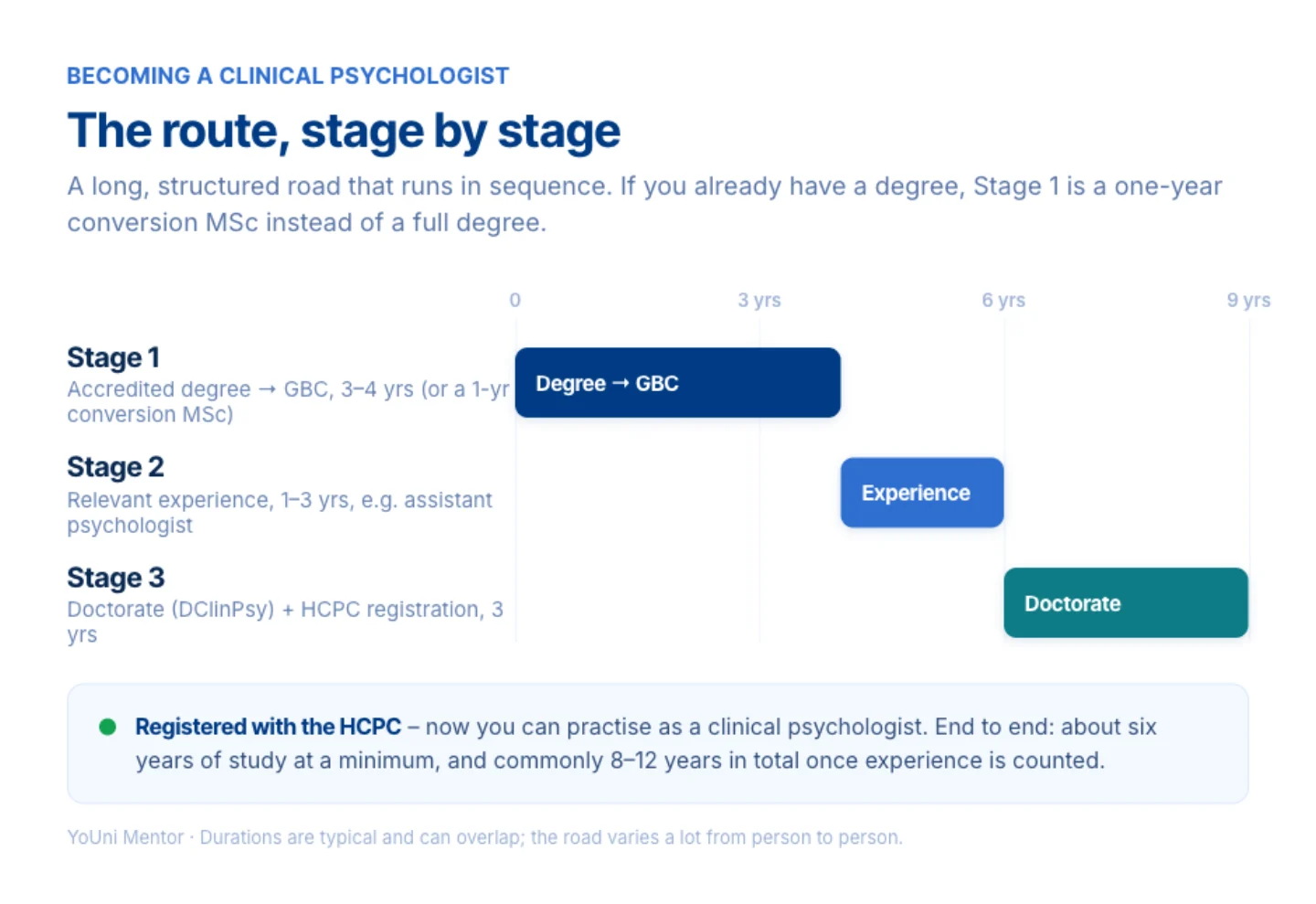
- Stage 1 - an accredited psychology degree (or a one-year conversion MSc if you already have a degree) to gain Graduate Basis for Chartered Membership.
- Stage 2 - relevant experience, often as an assistant psychologist, to become a competitive applicant.
- Stage 3 - a professional doctorate (for clinical psychology, the DClinPsy) and registration with the HCPC.
Psychologist, therapist, counsellor - what the word actually means
"Psychologist" sounds like one job, but it is an umbrella, and one detail catches people out: the word "psychologist" on its own is not a protected title in the UK. What the law protects are the specific practitioner titles - clinical psychologist, and counselling, educational, forensic, health, occupational, and sport and exercise psychologist. To use one of those you must be registered with the Health and Care Professions Council (HCPC). The specialism you choose shapes the training, and the one most career-changers ask about is clinical psychology, so this guide uses that route as its main example.
Two organisations play different roles here, and it is worth not confusing them. The HCPC is the legal regulator: it holds the register and controls those protected titles. The British Psychological Society (BPS) is the profession's membership body: it accredits psychology degrees and conversion courses, grants Graduate Basis for Chartered Membership (the usual academic gateway to professional training), and awards Chartered status.
Put simply, BPS accreditation is what makes a course count towards the profession; HCPC registration is what lets you practise under a protected title. A counsellor or psychotherapist follows a different, separately regulated route.
How you qualify: the three usual stages
The clinical psychology route has three broad stages. It helps to see all three before you start, because the first is the part adults can begin straight away. Other psychology specialisms follow their own accredited training, but the overall shape is similar.
- Graduate Basis for Chartered Membership (GBC). You earn it with a BPS-accredited psychology degree - usually a three-year BSc, or four years with a foundation year - passed at 2:2 or above, including the empirical research project. If you already hold a degree in another subject, a BPS-accredited conversion course (usually a one-year MSc) can give you the same GBC, provided the programme is accredited and you meet its requirements.
- A postgraduate professional qualification in your specialism. For clinical, counselling and educational psychology this is a three-year full-time professional doctorate, such as the Doctorate in Clinical Psychology (DClinPsy). Counselling psychology also has an independent BPS qualification route, and the other specialisms each have their own accredited Master's plus supervised practice.
- Registration with the HCPC. This is what legally lets you use the protected title and practise, and the accredited training leads into it.
Be realistic about the competition: clinical psychology training is heavily oversubscribed, and nationally only around one in five applicants gains an NHS-funded place in a given year (the ratio varies a lot between universities). Most people spend one to three years first in relevant paid roles, commonly as an assistant psychologist, to become competitive, and those posts are themselves scarce. Experience does not guarantee a place, but it is a big part of becoming a serious applicant - so plan for that stepping-stone stage rather than expecting to move straight from a degree into the doctorate.
Your starting point decides your first move
That first stage splits in two. If you do not yet have a degree - where many of the adults we work with begin - your route is the accredited BSc, funded by undergraduate Student Finance, with a foundation year as the way in without A-levels. If you already have a degree in any subject, you take the one-year conversion MSc instead.
A previous bachelor's degree does not stop you applying; the thing to watch is funding, not admission. If you already hold a Master's degree, or an equivalent or higher qualification, a university may still admit you to a conversion course, but you would not normally qualify for another Postgraduate Master's Loan. The two routes are funded differently, which is the next section.
A degree earned abroad adds one step. UK ENIC, the national agency for recognising international qualifications, can map it to UK levels with a Statement of Comparability, useful for a university application. But recognition is not GBC, and it is not registration: a foreign psychology degree still has to be assessed by the BPS for Graduate Basis, and if you already qualified as a psychologist abroad, the HCPC has its own international registration route to apply through. A UK ENIC statement alone does not grant any of these, so check what the university, BPS or HCPC actually needs before paying for one. We can help you work out which applies to you.
You do not need A-levels
A-levels are not the only route onto a psychology degree, and universities are used to admitting adults without them. An integrated foundation year - a "with Foundation Year" BSc, usually four years in total - accepts a lower tariff and is a common way in for adults from non-traditional backgrounds, and an Access to Higher Education Diploma in a science or psychology subject is a Level 3 qualification made for adults and accepted in place of A-levels.
Most psychology degrees also expect GCSE Maths, and usually English, at grade C/4 or equivalent, and some ask for a science subject; mature-entry schemes are often flexible about how you meet that. Entry requirements differ by university and course, so check the specific one rather than assuming every foundation year has the same conditions.
Student Finance, the ELQ rule and what it means for a second degree
What you can get depends on whether you already hold a degree.
If this is your first degree, you may be eligible for undergraduate Student Finance like any first higher-education qualification: an eligible Tuition Fee Loan, paid directly to the university, covers the fees with nothing upfront, and a means-tested Maintenance Loan is paid each term towards living costs. Eligibility and the amounts depend on your residency, household income, the course and the provider.
If you already have a degree, the rule to know is ELQ - Equivalent or Lower Qualification. For full-time study, Student Finance normally will not fund a second degree at the same level as one you already hold, and a completed overseas degree counts too. Psychology is not among the subjects exempted for full-time study, so a full-time second psychology degree usually cannot draw standard undergraduate funding.
But one nuance matters, and it is a real one: psychology is currently on the Student Loans Company's list of part-time ELQ exceptions, so some existing graduates may qualify for part-time Student Finance for an eligible part-time psychology degree. It is not automatic - it depends on the exact course's subject classification and intensity (part-time study normally has to be at least 25% of a full-time course), plus the usual residency and personal eligibility. Confirm the specific course with Student Finance England before relying on it. For an audience studying around work, that part-time door is worth knowing.
Most existing graduates take the accredited conversion course instead. Because it is a postgraduate Master's funded by the Master's Loan, a separate system from the ELQ rule, a prior degree does not stand in the way (unless you already hold a Master's, as above). The later clinical doctorate is usually a salaried NHS training post rather than something you fund yourself - though NHS-funded places normally come with fee-status and right-to-work conditions worth checking early.
One date changes the picture for anyone currently blocked. For courses starting on or after 1 January 2027, England replaces the current system with the Lifelong Learning Entitlement (LLE), with applications opening in September 2026. It lifts the ELQ restriction and lets some people fund study at the same or a lower level, including a second undergraduate degree. But it does not mean a free second degree for everyone: the LLE works as a lifetime Tuition Fee Loan entitlement, currently worth £39,160 (about four years of funding), and any previous government-funded tuition is normally deducted from it. Someone who has already had funding for a three-year degree may have only about a year of entitlement left. From September 2026 you can see an estimate of what you have in your student finance account, so if a previous degree is your obstacle, weigh that remaining balance against the cost of a full degree - and against the shorter conversion route - before counting on it.
You can check your own numbers with our student finance calculator.
What it costs, and how long it takes
On cost: for an eligible student, a first psychology degree has no upfront tuition cost - the Tuition Fee Loan (up to £9,790 a year full-time in 2026/27) is paid straight to the university, and a Maintenance Loan (roughly £6,853 to £13,762, higher away from home or in London) is paid each term towards living costs. A conversion MSc carries tuition that varies by university, commonly around £8,000 to £12,000 for the year, met by the Postgraduate Master's Loan (up to £13,206 in 2026/27) - though that single loan is one contribution towards both fees and living costs, not fees alone, so it may not cover everything. Repayment (Plan 5, for courses started from August 2023) is 9% only on what you earn above £25,000 a year, and nothing below that.
To check what you would actually repay, try our repayment calculator.The early stages are loan-funded - the degree by a Tuition Fee Loan, or the conversion MSc by a Postgraduate Master's Loan. And the clinical doctorate is usually a salaried NHS post (Band 6, from £39,959): you are paid to train, not charged for it.
The catch to check early: NHS-funded doctorate places normally require Home fee status and the right to work in the UK.
On timing: About four years to GBC with a foundation year and a three-year BSc, or a single conversion year if you already have a degree; then usually one to three years building experience; then the three-year doctorate and HCPC registration. End to end, that is about six years of study at a minimum, and commonly eight to twelve years in total once the near-essential pre-doctorate experience is counted. Studying the early stages part-time, in the evening or at weekends stretches the calendar but keeps you earning.
What psychologists earn
NHS psychology pay follows the Agenda for Change bands. Early stepping-stone roles such as an assistant psychologist are commonly advertised at Band 4, starting at £28,392 (April 2026 rates), though banding can vary by role. NHS-funded trainees on the clinical doctorate normally begin at Band 6, from £39,959, so you earn while you train. On qualifying, a newly qualified clinical psychologist is commonly at Band 7: £49,387, rising to £56,515 with experience. Experienced psychologists can progress to Band 8a (£57,528 to £64,750) and, less often, above.
Two things to keep in view. The 8-band salaries sit years past qualification and are reached by competitive application, not automatically - so treat Band 7 as the realistic qualified figure and the 8-band numbers as later-career. These are also NHS figures; private-practice and academic pay varies widely. Pay scales are reviewed yearly, so check the current rates when you plan.
Where we come in
The first stage - the accredited degree - is exactly what we do. We work with partner universities across England that offer BPS-accredited psychology degrees, including routes with a foundation year for people without standard entry qualifications and part-time and evening options for people studying around a job. We help you choose the right course, get your application and documents ready, and guide you through the Student Finance application early, though the decision itself rests with Student Finance England. If you already hold a degree and a conversion course suits you better, we will tell you that. Our application support is free to students; tuition and any later professional costs are separate.
There are boundaries: the later doctorate and HCPC registration run through the NHS and the regulator, not through us. What we do well is get the foundation right - the accredited, funded degree that everything after it is built on.
Frequently asked questions
Do I need a degree to become a psychologist in the UK?
Yes. There is no non-degree route. You need a BPS-accredited psychology degree, or an accredited conversion course if you already hold a different degree, to gain Graduate Basis for Chartered Membership (GBC), then a postgraduate professional qualification, then HCPC registration to use a protected title and practise.
Is "psychologist" a protected title in the UK?
The word "psychologist" on its own is not protected - anyone can use it. What is protected are the specific practitioner titles, such as clinical psychologist, counselling psychologist, educational psychologist and forensic psychologist. To use one of those you must be registered with the Health and Care Professions Council (HCPC), which means completing approved training first.
Can I retrain as a psychologist at 40 with no A-levels?
Yes. You can start an accredited psychology degree through an integrated foundation year (about four years in total) or an Access to Higher Education Diploma, and universities welcome applicants over 21 from non-traditional backgrounds. There is no upper age limit, as long as you meet the course requirements.
I already have a degree in another subject - do I have to start again?
No. You take a one-year BPS-accredited conversion MSc, which can give you the same GBC. Because it is a postgraduate course funded by the Postgraduate Master's Loan, a prior bachelor's degree does not block the funding the way the undergraduate ELQ rule can - though if you already hold a Master's or higher, that can affect Master's Loan eligibility.
Can I get Student Finance for a second psychology degree if I already have a degree?
For a full-time second psychology degree, usually not - psychology is not exempt from the Equivalent or Lower Qualification (ELQ) rule. But it is on the Student Loans Company's part-time ELQ exception list, so an eligible part-time psychology degree can be funded (subject to the course's classification and intensity, and your own eligibility). Most graduates instead use the conversion course, funded by the Master's Loan. From January 2027 the Lifelong Learning Entitlement lifts the ELQ bar, though it works as a lifetime loan limit with previous funding deducted, so check what you have left.
How much does a psychologist earn in the UK?
In the NHS, a newly qualified clinical psychologist is typically on Agenda for Change Band 7, around £49,387 to £56,515 (April 2026 rates). Earlier stepping-stone roles such as assistant psychologist are commonly Band 4, from £28,392. Senior psychologists can reach Band 8a (£57,528 to £64,750) and above, but that is later in a career. Check the latest Agenda for Change figures when planning.
How long does it take to become a clinical psychologist?
Realistically about six years of study at a minimum, and commonly eight to twelve years overall: a three-year accredited degree (or one-year conversion for existing graduates), usually one to three years of relevant experience, then the three-year professional doctorate and HCPC registration. The doctorate is very competitive - roughly one applicant in five is accepted nationally.
Ready to look at your route? One free call, about 20 minutes, and you will have a clear picture: whether a funded psychology degree or a conversion course fits you, what you would study, and which funding options you may be eligible for.
Book a free consultation