 Skip to content



To become a qualified teacher in England you normally need Qualified Teacher Status (QTS). If you already have a bachelor's degree, you can usually gain QTS through postgraduate teacher training in about nine months. If you don't have a degree, you can take an undergraduate course that leads to QTS or, where it's available, a teacher degree apprenticeship.
Some academies and independent schools can employ teachers without QTS, but most schools prefer it - and QTS gives you the qualified-teacher pay range and structured early-career support.
This guide explains the main routes, the entry requirements, the funding, how long training takes, and what to check before you apply.
This guide focuses on becoming a teacher in England. Qualifications and registration work differently in Wales, Scotland and Northern Ireland - there's a short note on that near the end.
The quick answer: your route in plain English
- Choose your route based on whether you already have a degree - postgraduate teacher training if you do; an undergraduate course leading to QTS (or a teacher degree apprenticeship, where available) if you don't.
- Check the academic requirements - normally GCSEs in English and maths (or accepted equivalents), plus science for primary teaching, and a bachelor's degree for the postgraduate routes.
- Decide primary or secondary - and, for secondary, the subject you want to teach.
- Check funding - the main option we help with is student finance; if you have settled or pre-settled status you may qualify (our guide explains it). Some subjects also carry tax-free bursaries, and salaried routes pay you instead.
- Complete your training and school placements, then gain QTS - training normally includes placements in at least two schools before you begin your early-career induction.
Do you need a degree to be a teacher?
To teach in state-maintained primary, secondary and special schools in England you need Qualified Teacher Status (QTS), and QTS requires a bachelor's degree in any subject (Get Into Teaching). If you don't have a degree yet, you can gain one with QTS built in, so a degree is part of the route rather than a barrier.
Two things worth knowing:
- Academies and independent schools can legally employ teachers without QTS, though most still prefer it. The strict requirement applies to maintained schools.
- A PGCE is not the same as QTS. The PGCE is an extra academic qualification many trainees earn alongside QTS - but it's QTS you need to teach in a maintained school.
How to get QTS in England: the main routes
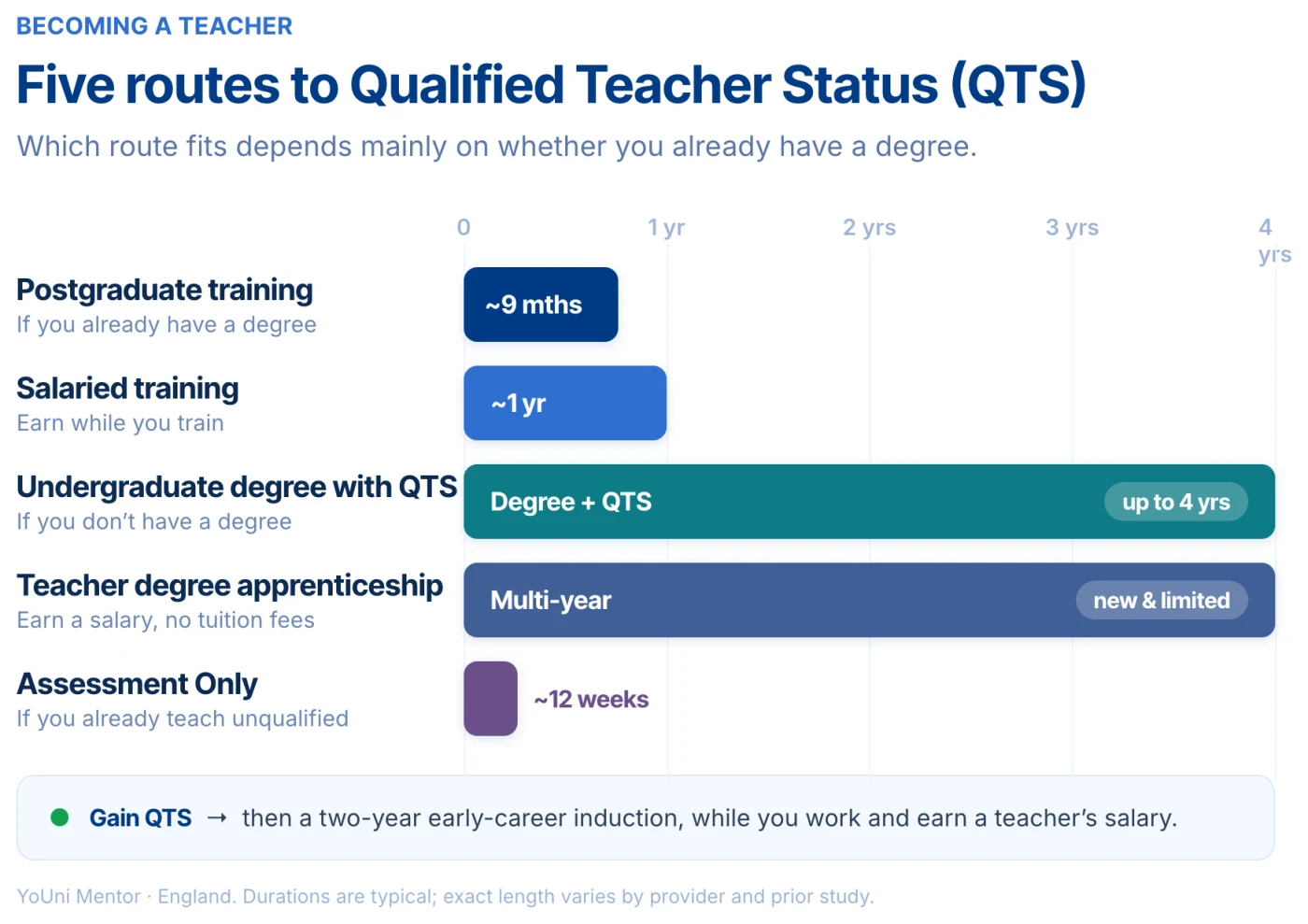
1. Postgraduate teacher training - if you already have a degree. The main route for career-changers who already hold a degree. It usually takes about nine months full-time (or 18-24 months part-time) and can be university-led or school-led (such as School Direct or a SCITT).
2. Salaried training - earn while you train. On a School Direct salaried route or a postgraduate teaching apprenticeship, a school employs and pays you while you train. These places are limited and competitive, and some salaried courses may still charge training or qualification fees, so check the individual course carefully.
3. Undergraduate degree with QTS - if you don't have a degree. A full-time bachelor's degree that includes QTS takes up to four years, and you finish qualified to teach.
4. Teacher degree apprenticeship - a new and currently limited route. This lets you work in a school, earn a salary and complete a bachelor's degree with QTS, with no tuition fees. Availability is still limited and depends on participating schools and providers. For 2026/27, government grant support is focused on up to 150 secondary maths trainees, with other subjects being added over time (Get Into Teaching), so check the live course listings rather than assuming the route is available in every subject or area.
5. Assessment Only - if you already work as an unqualified teacher. If you're already teaching without QTS and can show you meet the Teachers' Standards, you can be assessed for QTS rather than retrained. You normally need to already hold a degree and the required GCSEs, and to have worked in at least two schools; the assessment itself can take up to 12 weeks (Get Into Teaching).
Entry requirements - and what if you don't have A-levels
Whatever the route, you'll normally need:
- GCSEs at grade 4/C or above in English and maths - plus science for primary. If you don't have them, providers may accept a recognised equivalency test, and some of the university programmes we work with offer entry through a foundation year. Where English isn't your first language, some universities accept recognised English-language qualifications as proof of English for admission - though the QTS route still expects GCSE-level English and maths, so confirm how a specific provider treats this.
- A bachelor's degree for the postgraduate routes. The minimum class is set by the training provider - some accept a 2:2, others ask for a 2:1.
A-levels are not the only route in. If you don't have a degree yet, the undergraduate-with-QTS route is the main way in, and universities accept equivalent Level 3 qualifications. Some undergraduate education or teaching degrees may include a built-in foundation year to bring you up to degree level first, though availability and progression requirements vary by university - our foundation year guide explains how it works.
If your degree is in a different subject from the one you want to teach, your training provider may recommend or require a Subject Knowledge Enhancement (SKE) course to strengthen your subject knowledge. SKE courses aren't offered for every subject, and the provider decides whether one is appropriate; eligible trainees can receive an SKE bursary of around £175 a week while they study.
Becoming a teacher as a mature student or career-changer
Adults come into teaching from a wide range of working backgrounds. Your previous experience can count in your favour if it has given you relevant subject knowledge, communication skills, or experience with children and young people - though training providers still assess every application individually. There is no upper age limit to train, as long as you meet the entry requirements.
Can you become a teacher in England with overseas qualifications?
Yes - but the route depends on your situation, and two situations are very different.
You have an overseas degree but aren't yet a teacher
You can train in England, but you'll usually need a statement of comparability from UK ENIC showing how your degree (and school qualifications) compare with UK requirements. Some providers ask for it during the application (Get Into Teaching).
You are already qualified as a teacher abroad
If you completed recognised teacher training in a country outside the UK, you may be eligible to teach in England for up to four years without QTS under the four-year rule. Some settings are excluded, and after that period you will normally need QTS to continue teaching in schools where it is required. Depending on where and how you qualified, you may also be able to apply for QTS directly (through the "Apply for QTS in England" service) or through the Assessment Only route (gov.uk).
You'll also need immigration permission: non-UK citizens need a status that allows them to study or work in England, and fee-paying and salaried routes can carry different sponsorship requirements - worth checking early.
How to pay for it
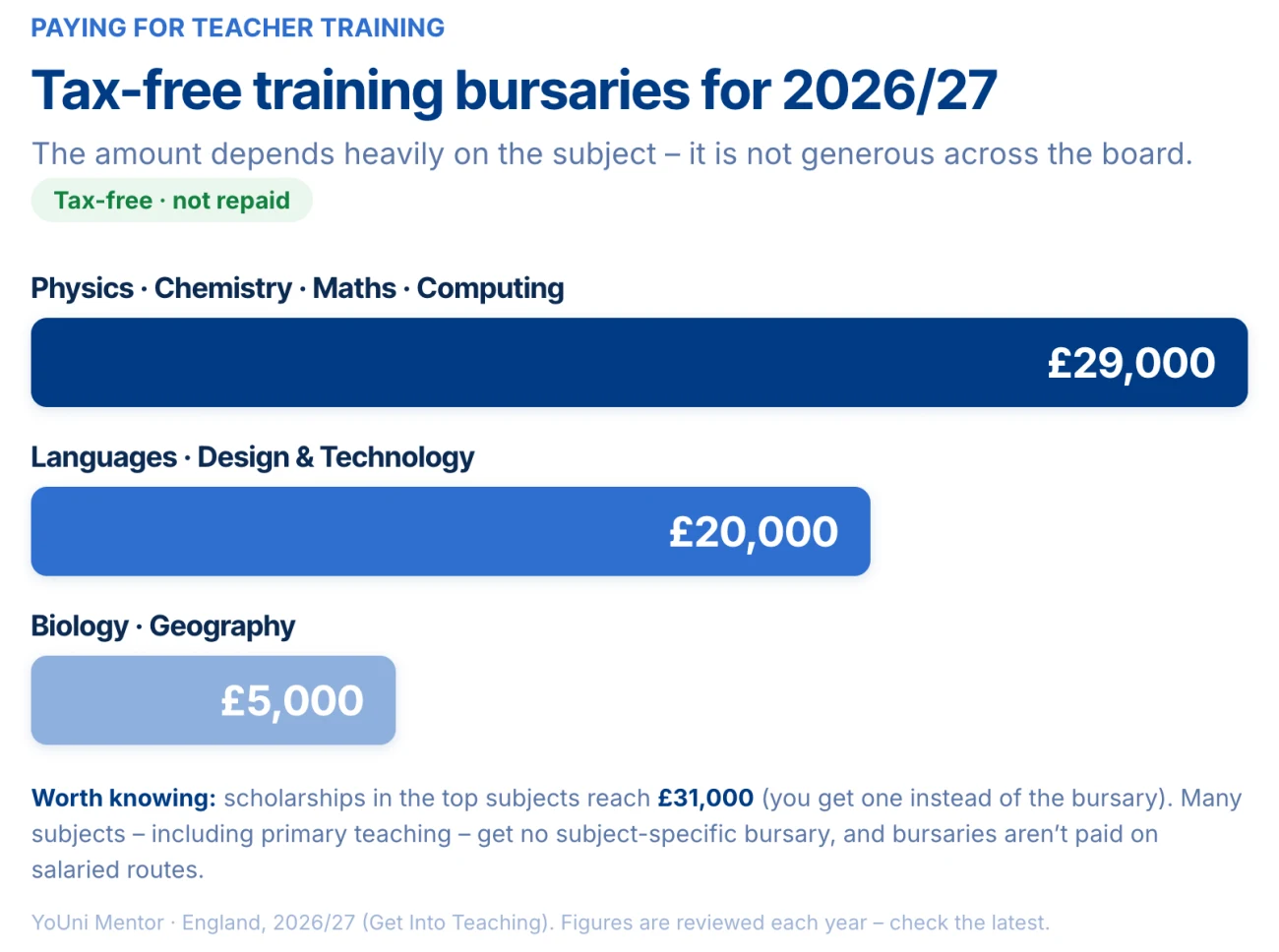
Funding for teacher training can be substantial, but it depends heavily on the subject, the course type and your personal eligibility - it is not generous across the board.
1. Tax-free training bursaries and scholarships. For training that starts in 2026/27, the largest bursaries go to shortage subjects (Get Into Teaching):
| Subject (2026/27) | Bursary | Scholarship (instead of bursary) |
|---|---|---|
| Physics, Chemistry, Maths, Computing | £29,000 | £31,000 (physics, chemistry, computing) |
| Languages, Design & Technology | £20,000 | £22,000 (French, German, Spanish) |
| Biology, Geography | £5,000 | - |
How they work: a bursary is normally awarded automatically if you and your course are eligible, while a scholarship needs a separate application to the subject body - and you can't receive both. Many subjects, including primary teaching, do not currently attract a subject-specific training bursary, and bursaries aren't paid on salaried routes.
2. Student finance. On a fee-based postgraduate course you can apply for a tuition fee loan and a maintenance loan, and a bursary or scholarship can be received on top. On salaried routes you earn a wage instead and aren't eligible for student finance. Whether you qualify for student finance depends on your residency and immigration status - if you have pre-settled or settled status, our guide explains the rules, and you can check whether you qualify with the Am I Eligible? checker. If you're aged 60 or over when your course starts, you may still qualify for living-cost support, but the maximum available is lower than the standard maintenance loan.
If you already hold a degree, you may still qualify for student finance for eligible postgraduate teacher training - previous study doesn't automatically rule you out, but funding is never guaranteed, so confirm your eligibility before you rely on it.
Bursary, salary and student finance figures here are for England. Funding rules differ in Scotland, Wales and Northern Ireland.
What you'll earn as a teacher
Teaching has a clear, published pay structure. Until 31 August 2026, the minimum starting salary on the main teacher pay range is £32,916 outside London; in Inner London, the current main pay range is £40,317 to £62,496 (Get Into Teaching). The government has accepted a 3.5% increase from September 2026, followed by a further 3% from September 2027, so these figures will rise - the final updated amounts will be set out in the next School Teachers' Pay and Conditions Document (Education Hub).
Beyond salary, teachers are members of the Teachers' Pension Scheme. School holidays are a real benefit, though teaching also involves planning, marking and preparation beyond classroom hours.
How long does it take?
- Postgraduate route (if you already have a degree): about nine months full-time; 18-24 months part-time.
- Undergraduate degree with QTS (no degree yet): up to four years.
- Teacher degree apprenticeship: a multi-year route (currently limited, with availability depending on participating schools, subjects and providers), finishing with a degree and QTS.
- Assessment Only (already teaching unqualified): up to about 12 weeks of assessment rather than a full course.
What happens after you gain QTS?
Gaining QTS isn't quite the finish line. After you secure your first teaching post, you normally begin a two-year induction as an early career teacher (ECT) - the term that replaced "NQT". During induction you get structured training, mentoring and a reduced timetable (a 10% reduction in year one and 5% in year two) while earning a teacher's salary (Get Into Teaching).
What if you want to teach elsewhere in the UK?
The routes above lead to QTS in England. Wales, Scotland and Northern Ireland have their own teacher-registration systems (with bodies such as the Education Workforce Council in Wales, the GTCS in Scotland and the GTCNI in Northern Ireland), so if you want to teach there, check that nation's requirements before choosing a course.
Your next step
Teaching can be a strong route for adults who want a stable, respected career with real purpose - but with several routes and a lot of subject-by-subject detail, choosing well matters.
YoUni Mentor can help eligible applicants explore education-related degree courses available through our university partners, and review your qualifications, previous study and Student Finance position. Not every education degree leads to QTS, so we will always explain the qualification and possible next steps before you apply. School-led teacher training, salaried routes and teaching apprenticeships are applied for separately through the relevant provider or employer, and we can direct you to official information about those.
If you're eligible and ready to apply, we can guide you through the application and Student Finance process. See how it works.
Thinking about training to teach? Get free, honest advice on your route and funding.
Book a free consultationFrequently asked questions
What is the difference between QTS and a PGCE?
QTS (Qualified Teacher Status) is the status you need to teach in maintained schools in England. A PGCE is an academic qualification many trainees earn alongside QTS - useful and portable, but it is QTS, not the PGCE, that lets you teach.
Can I teach in England without QTS?
In maintained schools you normally need QTS. Academies and independent schools can employ teachers without it, though most prefer it. Qualified teachers from abroad can also work for up to four years without QTS.
Can I become a teacher with an overseas degree?
Yes. You can train with an overseas degree, but you'll usually need a UK ENIC statement of comparability confirming it's equivalent to a UK bachelor's degree.
Can an overseas-qualified teacher work in England?
Yes. Eligible teachers who completed recognised teacher training outside the UK may be able to teach in England for up to four years without QTS. Depending on where and how you qualified, you may also be able to apply for QTS directly or through the Assessment Only route.
Do I need school experience before applying for teacher training?
No. You do not normally need classroom experience to apply for teacher training in England. However, spending time in a school can strengthen your application and help you decide whether teaching is right for you. Some competitive salaried routes may expect previous school or teaching experience.
Can I get teacher-training funding if I already have a degree?
You may still qualify for student finance for eligible postgraduate teacher training, and bursaries are open to those who already hold a degree. Funding is never guaranteed, so check your position.
Can I become a teacher without A-levels?
Yes. If you don't have a degree, an undergraduate course leading to QTS accepts equivalent Level 3 qualifications, and some degrees include a built-in foundation year. Entry requirements are set by the provider.
How long does teacher training take?
About nine months if you already have a degree; up to four years for an undergraduate degree with QTS. After qualifying, you complete a two-year early-career induction while working.
