 Skip to content



To work as a social worker in England, you normally need to complete a Social Work England-approved qualification and then register with Social Work England. "Social worker" is a protected title, which means you cannot practise or use the title in England unless you are registered.
For most people that means a social work degree - a three-year undergraduate degree, or a two-year Master's if you already hold a degree in another subject. There are also competitive, funded graduate programmes designed for some career-changers, as well as degree apprenticeships that let you earn while you train.
You do not always need A-levels or an existing degree to start. This guide covers the routes, entry requirements, funding and how long it realistically takes.
This guide focuses on becoming a social worker in England, where you register with Social Work England. Wales, Scotland and Northern Ireland have their own regulators and rules - there's a short note on that near the end.
The quick answer: your route in plain English
- Choose a route that leads to a Social Work England-approved qualification - an undergraduate degree, a postgraduate Master's, a funded graduate programme (Step Up to Social Work or Approach Social Work), or a degree apprenticeship.
- Meet the entry requirements - or get there first through a foundation year if you don't yet have the qualifications.
- Check and apply for funding - student finance, plus the Social Work Bursary or a programme-specific bursary, if you are eligible.
- Complete the qualification - academic study plus at least 200 days of supervised practice.
- Register with Social Work England and begin your first role - many employers support newly qualified social workers through the 12-month Assessed and Supported Year in Employment (the ASYE).
Do you need a degree to be a social worker?
Yes - a social work qualification is a legal requirement. To practise you must be registered with Social Work England, the regulator, and to register you must hold a social work qualification it has approved. "Social worker" is a protected title: using it without being registered is against the law. In practice that qualification is a degree - studied full-time, part-time, through a Master's, or through an apprenticeship. There is no route to the register that skips the qualification.
Social work training routes
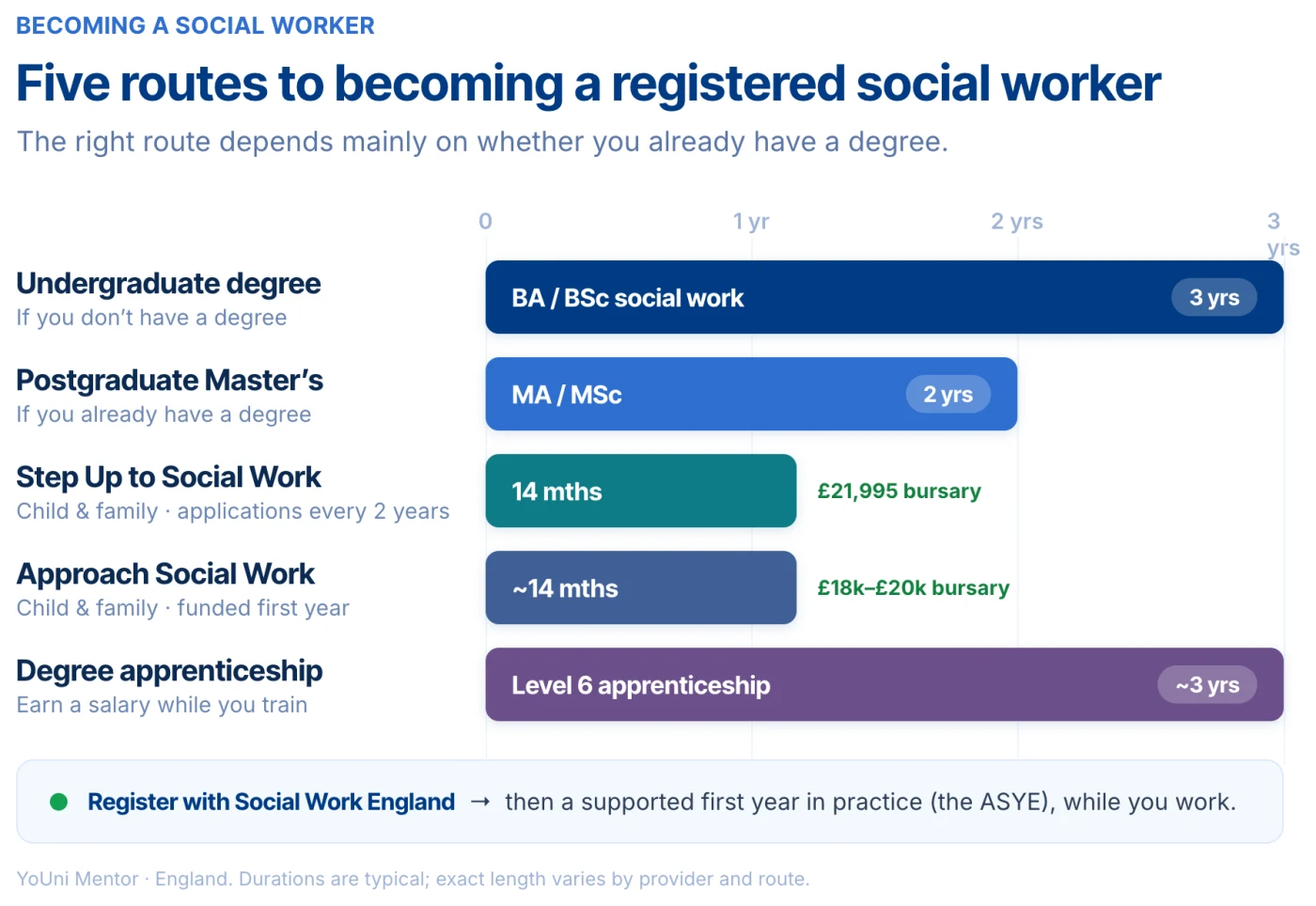
The right route depends mainly on whether you already have a degree and whether you can afford to study without a salary.
1. Undergraduate social work degree. The standard route if you don't already have a degree. A Social Work England-approved BA or BSc takes three years full-time (longer part-time), combining academic study with supervised placements.
2. Postgraduate Master's - if you already have a degree. An approved social work Master's (MA/MSc) usually takes two years full-time. A common route for graduates changing career.
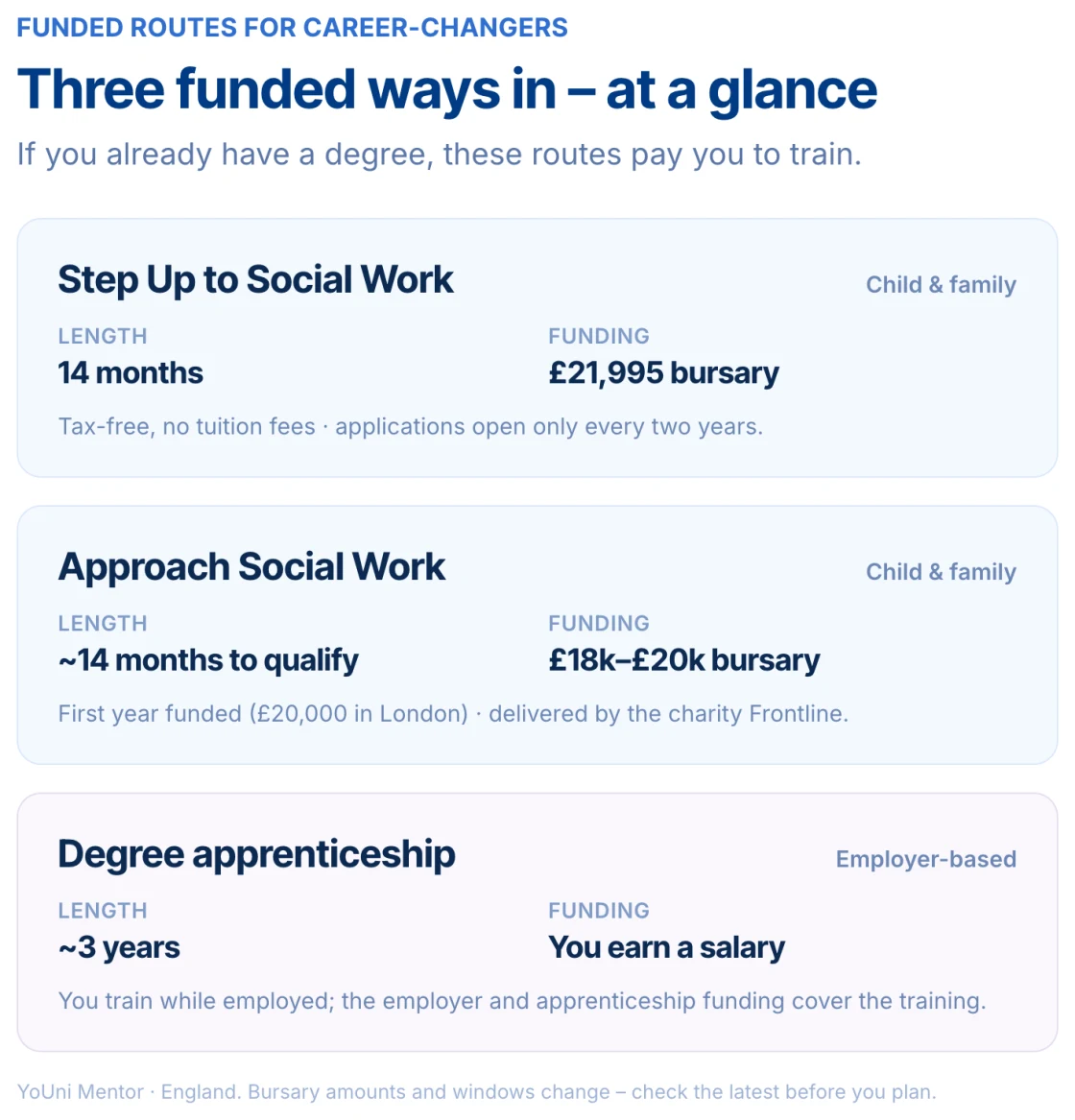
3. Step Up to Social Work. A competitive, government-funded route into child and family social work for graduates. It takes 14 months, has no tuition fees, and currently offers a £21,995 tax-free bursary (support-for-social-workers.education.gov.uk). Applicants normally need at least a 2:2 degree and six months of relevant paid or voluntary experience. Applications usually open only once every two years - the next window is expected to open in early 2027 for training starting in 2028 - so it isn't a route you can start at any time.
4. Approach Social Work - funded graduate training. A competitive programme (delivered by the charity Frontline) for graduates who want to work in child and family social work. You can qualify with a postgraduate diploma and become eligible to register with Social Work England after around 14 months; the wider programme can run for up to three years and may lead to a Master's. The first year is funded through a tax-free bursary (currently £18,000, or £20,000 in London), with later salary arrangements depending on securing a post (support-for-social-workers.education.gov.uk).
5. Social work degree apprenticeship. If you need to keep earning, a Level 6 apprenticeship lets you train while employed in a relevant role - it typically takes around three years, and you finish qualified and ready to register. You must first secure an apprenticeship position with an employer.
How much placement experience is included?
Every Social Work England-approved qualifying course must include at least 200 days of practice learning, including up to 30 skills days (Social Work England). You gain supervised experience across different practice settings alongside your academic study.
Placements are an essential part of the qualification and can involve substantial travel and periods of full-time attendance, so check the course timetable carefully if you also have work or caring responsibilities.
Social work entry requirements
Entry requirements depend on the route and provider:
- Undergraduate degree. Universities normally ask for Level 3 qualifications such as A-levels, a BTEC or an Access to Higher Education Diploma. GCSE or equivalent requirements vary.
- Postgraduate course. You need an undergraduate degree. Some universities ask for a 2:1, while others accept a 2:2, particularly with relevant experience.
- Step Up to Social Work. The current minimum is a 2:2 degree (in any subject other than social work), GCSE English or an accepted equivalent, and six months of relevant experience.
- Approach Social Work. The current minimum is a 2:2 degree and GCSE English or an approved equivalent. Previous social-work experience is not compulsory.
- Degree apprenticeship. You must secure an apprenticeship position with an employer and meet that employer's and training provider's requirements.
Whichever route you choose, the selection process may include an interview, references, health and conduct checks and an Enhanced DBS check.
A-levels are not the only route in. If you left school without them, the undergraduate degree accepts equivalent Level 3 qualifications. A common and often more accessible starting point for adults is a health and social care route - such as an Access to Higher Education Diploma in health and social care, or a degree with a built-in foundation year - which leads onto a full social work degree. If a foundation year is new to you, our foundation year guide explains how it works.
Becoming a social worker as a career-changer
Adults enter social work from many different professional and personal backgrounds. There is no general upper age limit, but you must meet the academic, suitability, health and conduct requirements of your chosen route, and every application is assessed individually. A previous degree is an advantage - it opens the postgraduate Master's, Step Up and Approach Social Work routes.
Are you already qualified as a social worker abroad?
If you completed your social work training outside the UK, you may not need to retrain from the beginning. You can apply to Social Work England through its overseas applicant process, where your education, training and professional experience are assessed against its requirements (Social Work England). You may need to provide detailed course documents, evidence of practice experience, identity documents and evidence of English-language ability.
This is different from having an overseas degree in another subject. If your overseas degree is not a qualifying social work qualification, you would normally need to complete an approved English social work course before registering.
How to fund your social work training
Funding works differently depending on the route:
- Undergraduate degree. Eligible students can apply for a Tuition Fee Loan and Maintenance Loan through Student Finance England. Your entitlement depends on factors including residency and immigration status, previous study, household income and personal circumstances - if you have pre-settled or settled status, our guide explains the rules.
- Postgraduate Master's. You may be able to apply for a Postgraduate Master's Loan - one loan that helps with both fees and living costs. (A postgraduate diploma usually doesn't qualify for it.)
- The Social Work Bursary. Eligible students may be nominated for extra, non-repayable support through the NHS Business Services Authority - paid in the final two years of the undergraduate route, with a separate postgraduate version. Places are capped and universities rank eligible students, so it isn't guaranteed, and a postgraduate bursary can affect your Master's Loan eligibility.
- Funded graduate programmes. Step Up to Social Work and Approach Social Work have their own funding arrangements (above).
- Degree apprenticeship. You are employed and paid a salary, while the employer and apprenticeship funding cover the training costs.
Already have a degree? Your previous study doesn't necessarily prevent you from retraining in social work, but what you can get depends on whether you choose an undergraduate degree, a postgraduate course or a funded programme - so check your individual entitlement before you accept a place.
Funding rules here are for England and differ in Scotland, Wales and Northern Ireland.
How much do social workers earn?
Social worker salaries vary because local authorities and other employers set their own pay scales. The National Careers Service gives an indicative range of around £32,000 for a starting salary to £48,000 for an experienced social worker (National Careers Service). Actual pay depends on the employer, area, responsibilities and type of social work. Social workers are employed by local authorities, NHS organisations, charities and other services, and vacancies and starting salaries vary by location and specialism.
How long does it take?
- Undergraduate degree: three years (four with a foundation year).
- Postgraduate Master's (if you already have a degree): two years.
- Step Up to Social Work / Approach Social Work: around 14 months to qualify (Approach's wider programme can run up to three years).
- Degree apprenticeship: around three years, while you earn.
After qualifying and registering, many newly qualified social workers complete the ASYE - a supported 12-month programme provided by their employer, done while working and earning a salary. It is not an additional year of university study.
What is the ASYE?
The Assessed and Supported Year in Employment is a structured 12-month programme of supervision, support and assessment during your first year in practice. It is recommended and widely used, but not a legal requirement for registration - so whether you complete it depends on your employer. Registration with Social Work England is the mandatory part; the ASYE is the supported first year on top.
What if you want to work elsewhere in the UK?
The routes above lead to registration with Social Work England. Wales, Scotland and Northern Ireland have their own regulators - Social Care Wales, the Scottish Social Services Council and the Northern Ireland Social Care Council - so if you want to work there, check that nation's registration requirements before choosing a course.
Your next step
Social work can be a strong route for adults who want a stable, respected career with real purpose - but with several routes and different funding for each, choosing well matters.
A YoUni Mentor advisor can review your qualifications and previous study, then explain which university social work courses available through our partners may suit your circumstances.
If you're eligible for a course offered through one of our university partners, we can guide you through the application and help you understand the relevant Student Finance and bursary processes. See how it works.
Thinking about training as a social worker? Get free, honest advice on your route and funding.
Book a free consultationFrequently asked questions
Do you need a degree to be a social worker in the UK?
Yes. You must hold a social work qualification approved by Social Work England - which is a degree-level qualification - and register with Social Work England before you can practise. "Social worker" is a protected title.
What is the difference between a social worker and a care worker?
A social worker is a registered professional who assesses needs, safeguards people and coordinates support, and must hold an approved qualification and register with Social Work England. A care worker provides day-to-day care and support and does not need a social work qualification or registration.
Is the ASYE compulsory for newly qualified social workers?
No. The ASYE is not a legal requirement for registration, but many employers expect or strongly encourage it. It provides structured supervision, support and assessment during your first year in practice.
Is Step Up to Social Work open every year?
No. Step Up usually accepts applications only once every two years, so timing matters - check the current window before you plan around it.
Can I become a social worker without A-levels?
Yes. A-levels are not the only route in - the undergraduate degree accepts equivalent Level 3 qualifications such as a BTEC or Access to HE Diploma, and some degrees include a built-in foundation year. Entry requirements vary by university.
Can I get social work funding if I already have a degree?
Possibly - your previous study doesn't automatically rule you out, but what you can get depends on whether you take an undergraduate degree, a postgraduate Master's or a funded programme. Check your individual entitlement before accepting a place.
Can an overseas-qualified social worker work in England?
If you qualified in social work abroad, you apply to Social Work England through its overseas applicant process, which assesses your qualification, training and experience - you may not need to retrain from scratch. An overseas degree in another subject is different, and would normally mean completing an approved English course.
How many placement days are included in a social work degree?
At least 200 days of practice learning (including up to 30 skills days), across different settings, alongside your academic study.
