 Skip to content


To become a nurse in the UK, you need to complete a nursing programme approved by the Nursing and Midwifery Council (NMC), then register with the NMC.
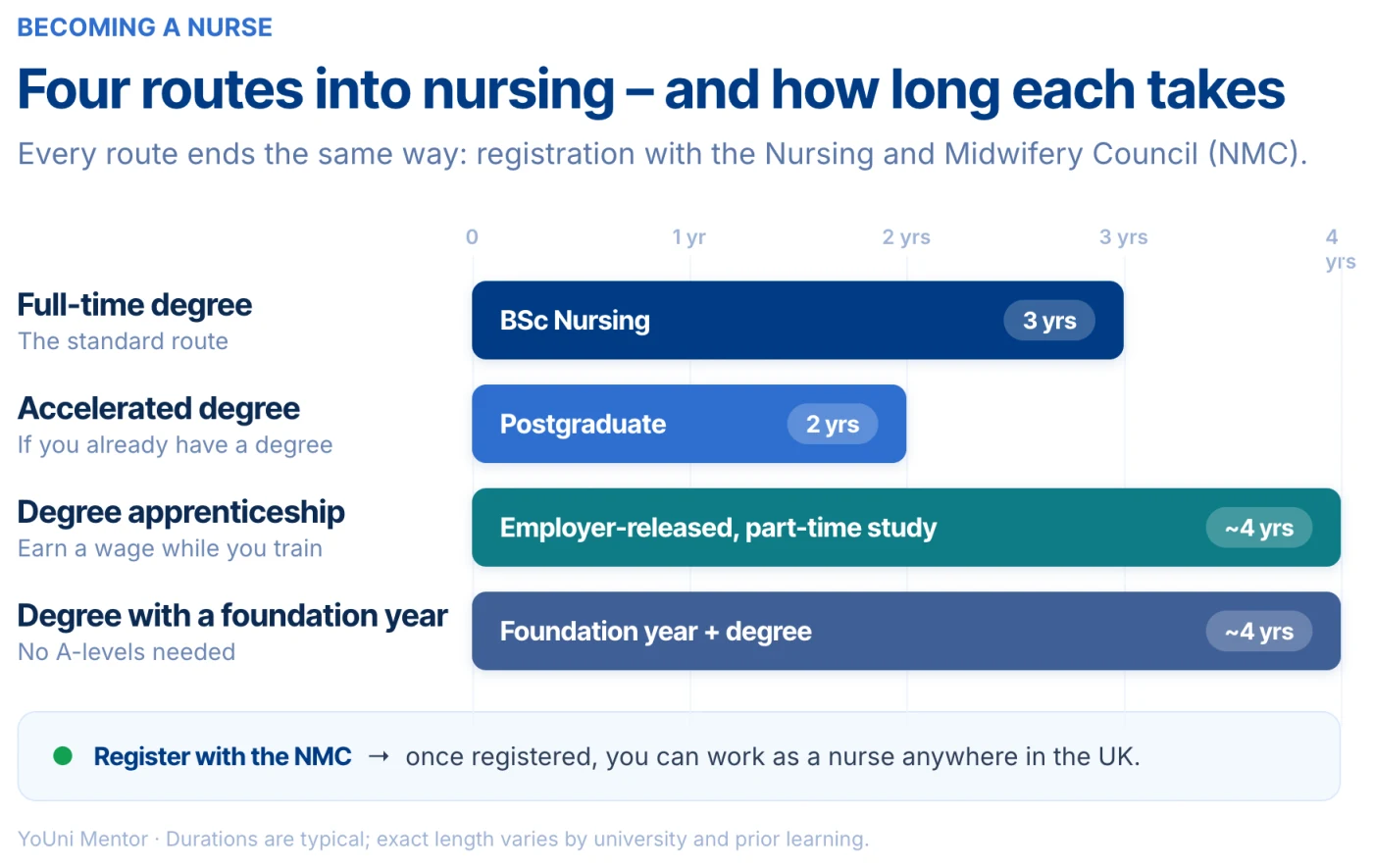
For most people, that means a three-year nursing degree. But if you are applying as an adult, there may be more than one route: a full-time degree, an accelerated course if you already have a degree, or a Registered Nurse Degree Apprenticeship where you earn while you train.
You do not always need A-levels to start the journey. Many adult learners use an Access to Higher Education Diploma or a foundation year to meet the entry requirements first.
This guide explains the main routes into nursing, how funding works, what qualifications you may need, and how long it can realistically take.
The quick answer: your route in plain English
- Choose a nursing course approved by the NMC - a BSc nursing degree, a two-year accelerated course if you already hold a degree, or a Registered Nurse Degree Apprenticeship.
- Meet the entry requirements - or get there first through an Access to Higher Education Diploma or a foundation year if you do not have A-levels.
- Check and apply for funding - student finance, and on the degree route, the NHS Learning Support Fund if you are eligible.
- Complete the course - broadly, time is split between studying and supervised clinical placements, though the exact structure varies from one university to another.
- Register with the NMC - once registered, you can work as a nurse across the UK.
Do you need a degree to be a nurse?
Yes. To work as a registered nurse in the UK you must be registered with the Nursing and Midwifery Council (NMC) - the body that regulates nurses - and to register you must first complete a nursing programme that the NMC has approved, and meet its requirements of good health and good character. In practice that programme is a degree, whether you study it full-time, part-time, or through an apprenticeship. In the UK there is no shortcut to registered nursing that skips the nursing qualification itself.
(There are healthcare roles you can do without a nursing degree - such as a healthcare assistant or a nursing associate - and some of those can become a stepping stone into nursing, which we cover below.)
The routes into nursing
There is more than one way in, and the right one depends on your circumstances - especially whether you can afford to study full-time or need to keep earning.
1. Full-time nursing degree. The standard route. An NMC-approved nursing degree takes three years full-time (four years for a dual-field degree). You spend around half your time studying at university and half on supervised clinical placements in real healthcare settings, so you are gaining hands-on experience throughout.
2. Accelerated (two-year) degree - if you already have a degree. If you already hold a first degree in another subject, many universities offer a shortened two-year postgraduate nursing course. This is a common career-changer route, and - importantly - the fact that you already have a degree does not lock you out of funding (see below).
3. Registered Nurse Degree Apprenticeship (RNDA). If you cannot afford to stop working, this is the route to look at. You secure a position as an apprentice with a healthcare employer who releases you to study at university part-time, so you earn a wage while you train. An RNDA usually takes around four years, though it can be shorter if your prior experience is formally recognised. You typically need level 3 qualifications plus maths and English to start.
4. Nursing associate top-up. A nursing associate is a separate, registered role - not a nurse, but a recognised healthcare professional. If you train as a nursing associate first, you can later "top up" to become a registered nurse, and that prior training can shorten the apprenticeship route. It is a slower path, but it lets you enter healthcare sooner and build up as you go.
Entry requirements - and what if you don't have A-levels
Entry requirements vary by university, but a typical nursing degree asks for around five GCSEs at grade 4/C or above (including English, maths and a science) plus two or three A-levels or an equivalent qualification - such as a BTEC, a T-Level, or an Access to Higher Education Diploma.
That last part matters most for adults. A-levels are not the only route into nursing. If you left school without them, some nursing degrees may include a built-in foundation year - an extra first year that helps you meet the academic level needed for the degree. You apply for one course and progress through to the nursing degree, as long as you meet the progression requirements.
If a foundation year is new to you, our guide on what a foundation year is explains how it works.
Becoming a nurse as a mature student or career-changer
This is the reassurance most adults are looking for, so here it is plainly: there is no upper age limit to train as a nurse, as long as you meet the course, health, character and entry requirements. Universities actively value the life experience mature students bring, and nursing has one of the highest proportions of mature entrants of any degree.
And is it too late at 40 or 50? No. What matters is meeting the entry requirements and being able to do the course, not your age.
How to pay for a nursing degree
Nursing students on the university degree route may be able to access funding that is not available for many other degrees, because there are two sources of support stacked on top of each other.
1. Standard student finance. Like any eligible student, you can take a tuition fee loan (covering your course fees) and a maintenance loan (towards living costs, paid in three instalments across the year - once per term). Whether you qualify depends on your residency and immigration status, not your age or income. If you have pre-settled or settled status, the rules are often more generous than people expect - our guide to student finance with pre-settled or settled status explains it, and you can check your own position with the Am I Eligible? checker.
2. The NHS Learning Support Fund (LSF). On top of student finance, most nursing students on a pre-registration degree in England can claim extra grants from the NHS Learning Support Fund - money you do not repay. It is worth knowing the limits: you cannot claim it if you train through the earn-as-you-go apprenticeship (you are paid a wage instead), and it does not apply during a foundation year - it starts once you are on the degree itself. For the 2025/26 academic year it includes (NHS Business Services Authority):
| NHS Learning Support Fund (2025/26) | Amount | Repayable? |
|---|---|---|
| Training Grant (eligible students on the degree route) | £5,000 a year | No |
| Specialist Subject Payment (e.g. mental health, learning disability nursing) | £1,000 a year | No |
| Parental Support (if you have a dependent child) | £2,000 a year | No |
| Travel & Dual Accommodation Expenses (for placements) | Claimed back | No |
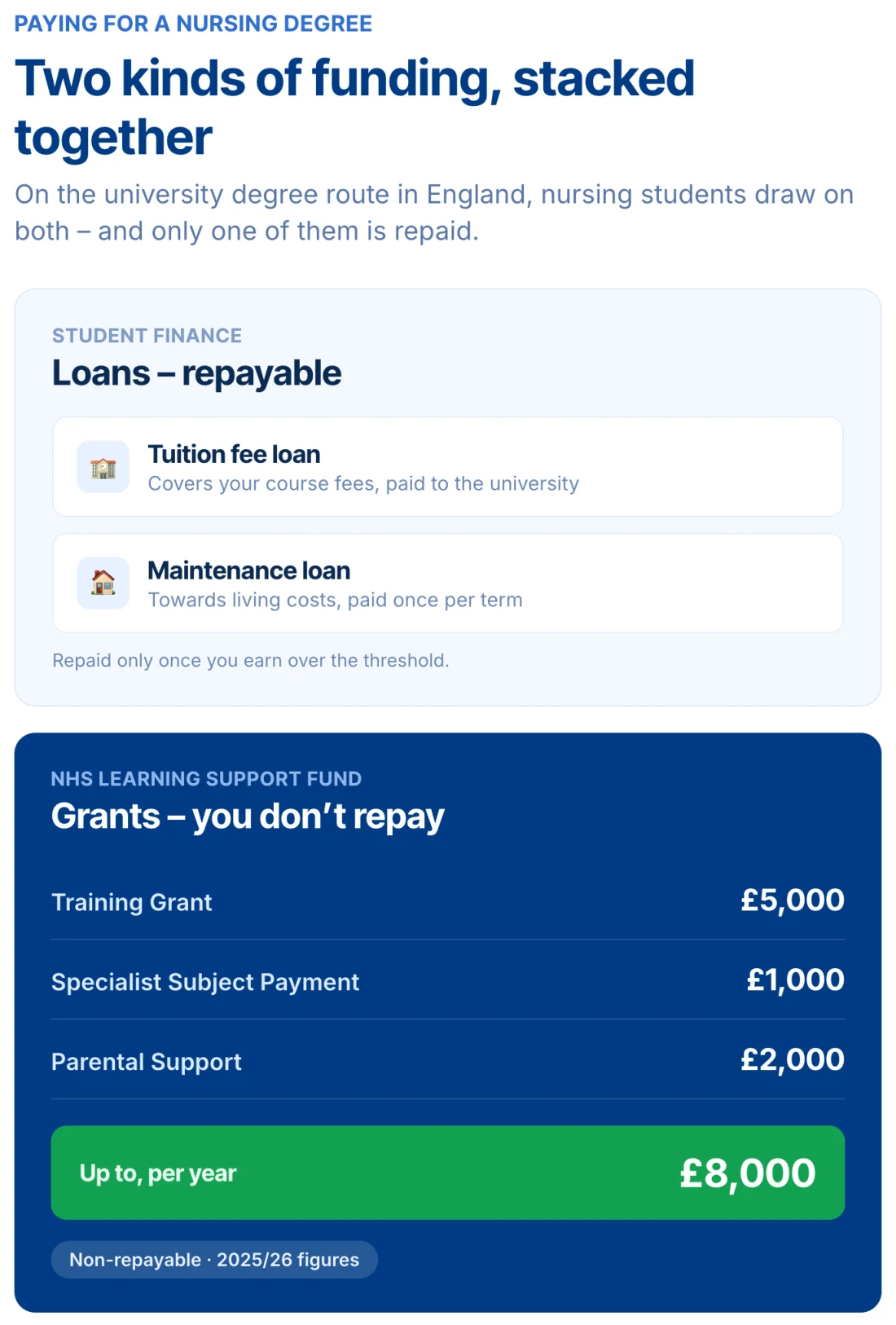
So an eligible parent training in mental health nursing could receive £8,000 a year in non-repayable grants on top of their student loans. These are 2025/26 figures - always confirm the current amounts and eligibility on the NHS Learning Support Fund pages before you rely on them.
Student finance and the NHS Learning Support Fund figures here are for England. Funding rules differ in Scotland, Wales and Northern Ireland.
What you'll earn as a nurse
Nursing is a career with a clear, published pay structure. A newly qualified nurse who has registered with the NMC starts on NHS Band 5, which is £32,073 a year under the 2026/27 Agenda for Change pay scales, rising to around £39,043 with a few years' experience (NHS Health Careers). Pay then progresses further as you specialise or move into senior and advanced practice roles. It is not the highest-paid graduate career, but it is a structured NHS career, with published pay bands and demand in many parts of the UK.
Pay is only part of the picture. NHS nurses are members of the NHS Pension Scheme and may receive extra pay for working nights, weekends and public holidays, known as unsocial hours payments. Annual leave also increases with length of service. Beyond the package, nursing is meaningful work, which is a large part of why many adults move into it later in life.
How long does it take?
- Full-time degree: three years (four for a dual-field degree).
- Accelerated degree (if you already have a degree): two years.
- Degree apprenticeship: usually around four years, while you earn.
- Degree with a built-in foundation year (no A-levels needed): around four years in total.
So from a standing start without A-levels, a realistic timeline is about four years; if you already have a degree, it can be as little as two.
Where you can study with us
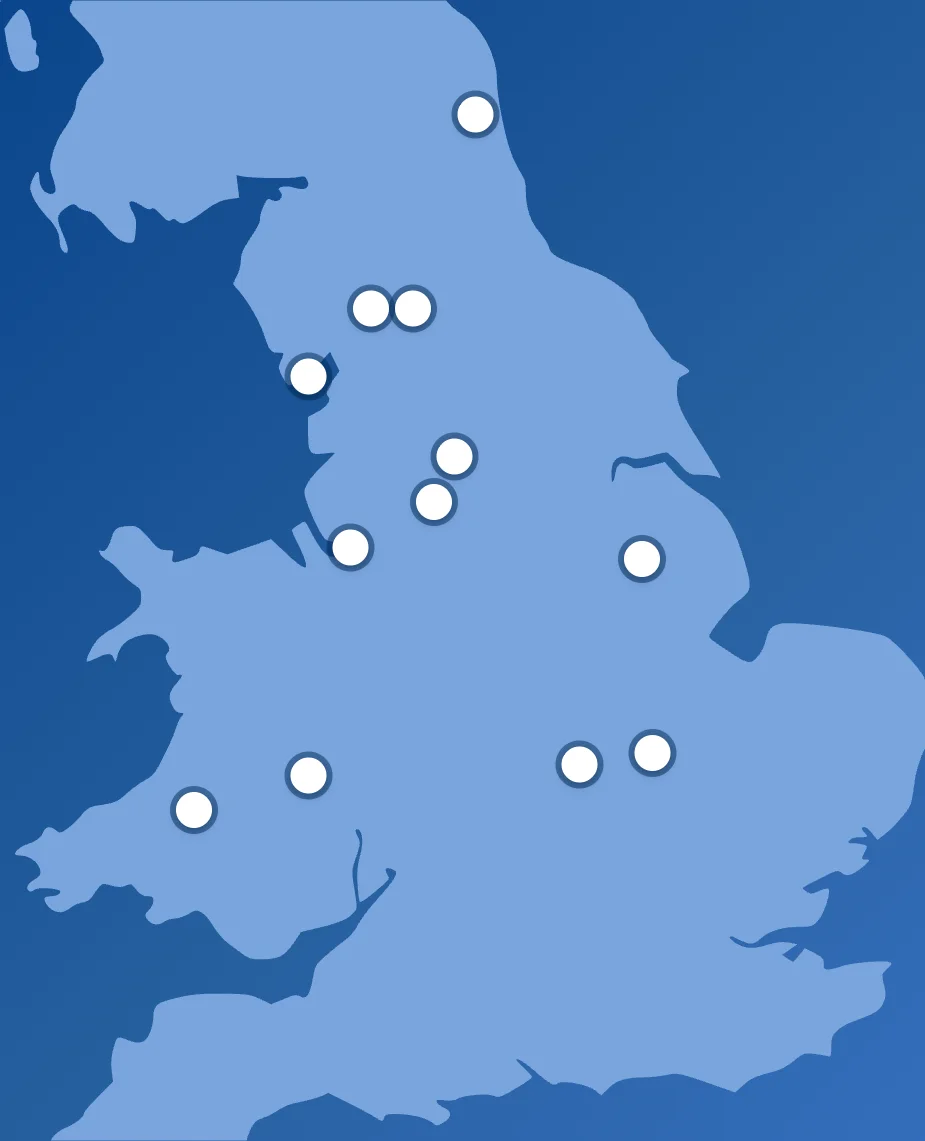
YoUni Mentor works with universities across England and Wales, so wherever you are, there is likely an option within reach - whether you want to study close to home or somewhere new. An advisor can match you to the universities that offer nursing and fit your situation.
Your next step
Nursing can be a strong route for adults who want a stable, respected career - but the right path depends on your background.
Your route may be different depending on your qualifications, work experience, immigration or residency status, previous study, and whether you need to keep working while you train.
A YoUni Mentor advisor can look at your situation for free and help you understand which route may fit: a full-time nursing degree, a degree with a built-in foundation year, or a degree apprenticeship.
If you are eligible and ready to apply, we can guide you through the university application, Student Finance process and NHS funding options. See how it works.
Thinking about training as a nurse? Get free, honest advice on your route and funding.
Talk to an advisorFrequently asked questions
Do you need a degree to be a nurse in the UK?
Yes. You must complete a nursing programme approved by the Nursing and Midwifery Council (NMC) and register with the NMC. That programme is a degree - studied full-time, part-time, or through an apprenticeship.
How long does it take to become a nurse?
Three years for a full-time degree, two years if you already hold a degree, or around four years through a degree apprenticeship. A degree with a built-in foundation year takes around four years in total.
Can you become a nurse as a mature student?
Yes - there is no upper age limit, as long as you meet the course, health, character and entry requirements. Nursing has one of the highest proportions of mature students of any degree, and universities value the experience adults bring.
Can I become a nurse without A-levels?
Yes. A-levels are not always the only route into nursing. Some universities accept equivalent qualifications, such as an Access to Higher Education Diploma, and some nursing degrees may include a built-in foundation year. Entry requirements vary, so the right route depends on your qualifications and the university.
Can I get student finance for nursing if I already have a degree?
Yes. Nursing is an exception to the "first degree only" rule: full student finance is available for a nursing course in England even if you already hold a degree, provided the course started on or after 1 August 2017.
Do nursing students get extra funding?
Yes. On top of the standard tuition and maintenance loans, most nursing students on a pre-registration degree in England can claim the NHS Learning Support Fund - a non-repayable grant of £5,000 a year, with extra payments for specialist subjects and for students with children. It does not apply if you train through the paid apprenticeship route.
How much do newly qualified nurses earn?
A newly qualified nurse starts on NHS Band 5, which is £32,073 a year under the 2026/27 Agenda for Change pay scales, rising with experience.
Can I train to be a nurse while working?
Yes - through a Registered Nurse Degree Apprenticeship, where an employer releases you to study part-time and you earn a wage throughout your training.
