 Skip to content



If you have watched the legal world from the outside for a while - as a paralegal, or in a job alongside the law - and decided you want the qualified role rather than the one that assists it, this is for you. Becoming a solicitor as an adult is more open than most people assume: there is no upper age limit, and you do not need A-levels, or even a law degree, to start. It does have real steps and real costs, though, so here is how it actually works.
This guide is about qualifying in England and Wales. Scotland and Northern Ireland have separate systems - there is a short note on those near the end.
- A degree in any subject (or an equivalent Level 6 qualification or experience) - it does not have to be law
- A pass in both stages of the Solicitors Qualifying Examination (SQE)
- Two years of qualifying work experience
- To meet the Solicitors Regulation Authority's (SRA) character and suitability requirements
Because your degree can be in anything, the starting line splits in two. If you already have a degree, you usually do not need to start again with a law degree. If you do not, the most straightforward route is an LLB law degree, which you can study through one of our partner universities - though it is not the only way in.
Solicitor, barrister or "lawyer" - which do you mean?
"Lawyer" is a general term, not a protected title, so anyone can use it. "Solicitor" and "barrister" are protected titles that only qualified, authorised professionals may use.
A solicitor advises clients and runs cases day to day, usually from a law firm - property, wills, family, business, disputes - and can represent people in the lower courts. A barrister usually specialises in courtroom advocacy and expert legal opinions, and is often instructed through a solicitor, though Public Access barristers can also take instructions directly from the public. Most people changing career take the solicitor route, so that is what this guide follows.
How you qualify: the SQE route
Most people starting now qualify through the SQE. The SRA requires four things:
- A degree in any subject, or an equivalent Level 6 qualification (or experience assessed as equivalent).
- Passing both parts of the SQE - SQE1 (legal knowledge, sat as multiple-choice exams) and SQE2 (practical skills such as client interviewing, advocacy and legal writing).
- Two years of qualifying work experience, full-time or the equivalent.
- Meeting the SRA's character and suitability requirements.
The older LPC-and-training-contract route is closed to new starters. Only people who had already begun qualifying study before September 2021 can still use it, and even then only until it fully closes in 2032. If you are starting fresh, the SQE is your route.
Because that degree can be in any subject, you do not need a law degree to become a solicitor - which splits the starting line in two.
Your starting point decides your first move
If you don't yet have a degree - where most of the people we work with begin - your main options are an LLB law degree followed by the SQE, another eligible degree followed by SQE preparation, or a solicitor apprenticeship (below). If you want to study law at university, an LLB is the most direct academic route, and a first degree can be funded by Student Finance (eligibility below).
If you already have a degree - in any subject, including one earned abroad - you usually do not need another undergraduate degree. You can prepare for the SQE directly and sit the exams, then complete your two years of experience. Non-law graduates commonly take a law conversion course first - often a conversion Master's such as an MA Law (some, like the MA Law (SQE1), build in SQE1 preparation) - to cover the legal knowledge the assessments test.
Because it is a full Master's, that route can attract a Postgraduate Master's Loan, which a standalone prep course cannot. It also sidesteps a funding problem: Student Finance normally will not fund a second degree at the same level (the ELQ rule), and law is not an exempt subject - so for most graduates the SQE route is both faster and cheaper than a fresh LLB. If your degree was awarded outside the UK, it is worth a quick chat with us first: we can help you work out what it is equivalent to here and which route makes sense for you before you commit to anything.
A third route is a solicitor apprenticeship: a law firm employs you, you study alongside the job, and the training and assessment are funded through the apprenticeship system rather than charged to you. It usually takes around five to six years from a standing start, places are competitive, and you have to secure an apprenticeship with a participating employer first - but you earn while you train and pay no tuition.
Can you study law without A-levels?
Yes. A-levels are not the only way onto a law degree. The usual route for adults without recent qualifications is a degree with an integrated foundation year - an extra first year that brings you up to degree level and leads into the LLB, and one our partner universities offer. Some universities also accept other equivalent Level 3 qualifications or relevant experience.
A foundation year is not automatic entry to the full degree - you still have to meet the course's conditions - but it is the standard way in for adults starting from scratch.
What counts as qualifying work experience?
This is the part people find most confusing. Qualifying work experience (QWE) must involve providing legal services and give you the chance to develop the competences a solicitor needs. It can be gained before, during or after your SQE studies, and split across up to four organisations.
Earlier work as a paralegal, in a law clinic, or in another legal-services role can count - but not automatically: each period has to be confirmed by an authorised solicitor or the firm's compliance officer. For a career-changer, that flexibility helps: experience you already have may count towards the two years.
What it costs, and what Student Finance covers
If your route is a law degree, an eligible full-time student in England can apply for a Tuition Fee Loan of up to £9,790 for 2026/27. Your university sets the actual fee, and eligibility depends on your residency, any previous study, and the course and provider - nothing is paid upfront. A means-tested Maintenance Loan helps with living costs each term, based on your household income and where you live.
A foundation year is funded too, and for a classroom-based subject like law the foundation-year fee is capped lower - currently up to £5,760. Under Plan 5 you repay 9% of what you earn above £25,000 a year - nothing on income below that, and repayments pause automatically if your income drops. Our student loan repayment calculator shows what you would actually repay.
The SQE has its own exam fees on top: currently £4,908 for both stages (£1,934 for SQE1, £2,974 for SQE2), rising to about £5,092 from September 2026. Most people also pay for a preparation course.
Standalone prep courses are usually self-funded - but a Master's that includes SQE preparation (such as the University of Law's MA Law (SQE1)) can attract a Postgraduate Master's Loan, though the SQE exam fees themselves stay separate.
Second-degree funding, and the 2027 change
If you already hold a degree, the ELQ rule normally blocks Student Finance for a second one at the same level. Law is not on the exempt list, so an existing graduate generally cannot get a loan for a fresh LLB - another reason the SQE-direct route usually makes more sense.
From January 2027, the Lifelong Learning Entitlement (LLE) changes this, but not as simply as "the second-degree rule disappears". It gives each person a lifetime funding entitlement - currently around four years of tuition, a total of about £39,160 - and previous government-funded study is deducted from it. So someone who has already had funding for a three-year degree will not automatically get a whole second LLB funded. If you already have a degree, check your remaining entitlement before you accept a law-degree place. (This is an undergraduate change; the postgraduate Master's Loan is a separate system.)
To put numbers on it, use our student finance calculator.
How long it takes
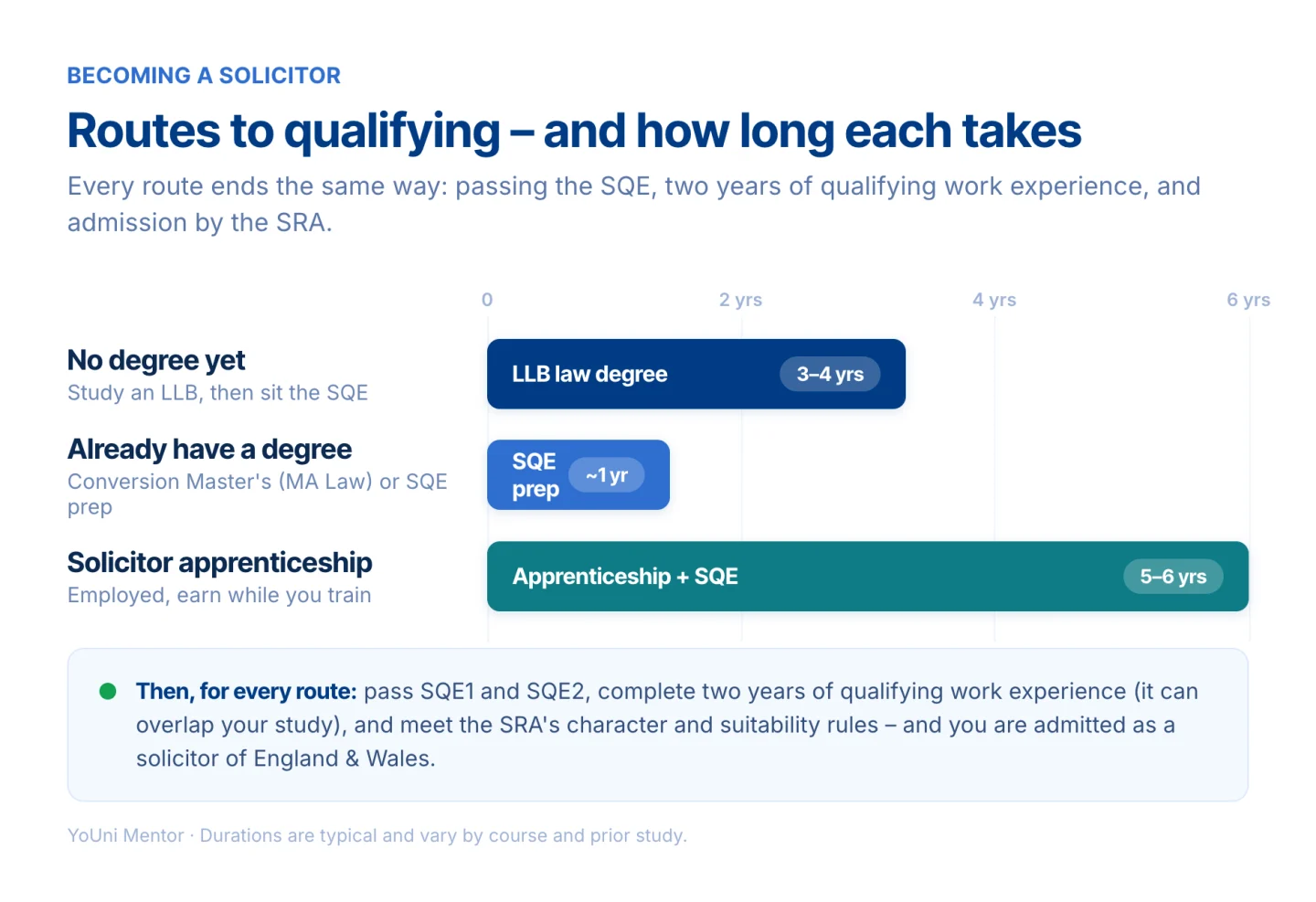
There is no single figure - it depends on where you start and whether you study around a job:
| Starting point | Typical route |
|---|---|
| No degree | A three-year LLB (four with a foundation year), then SQE preparation and the exams |
| Existing degree | A conversion Master's (e.g. MA Law) or SQE preparation, the exams, and two years of qualifying work experience |
| Solicitor apprenticeship | Around five to six years while employed |
The two years of QWE can overlap your study and SQE preparation, so the total calendar time varies a lot. The biggest variable is usually how quickly you find the right legal experience, not the length of the course itself. Studying part-time, in the evening or at weekends stretches the timeline but keeps you earning.
How much do solicitors earn?
Solicitor pay varies widely by employer, location and area of law. The National Careers Service gives an indicative range of around £30,000 for a starter to £80,000 for an experienced solicitor.
Pay during qualifying work experience varies too: the Law Society publishes a recommended minimum for trainees (roughly £24,000 outside London and £28,000 in London - check the current figure, as it is reviewed each year), though firms are not legally required to follow it. Some large City and international firms pay well above these numbers, but they are a small slice of the profession and not representative - a better guide is real vacancies in the area of law and the location where you expect to work.
Where we come in
If your route is a law degree, this is exactly what we do. We work with the University of Law, a specialist legal-education provider and one of our partner universities, which runs the LLB full-time and with foundation-year options for applicants who meet the entry requirements. And if you need to study around a job, other partner universities run law degrees on flexible timetables, some across about two days a week and with evening options.
We help you choose the right course and campus, get your application and documents ready, and guide you through the Student Finance application early - though the decision itself rests with Student Finance England, which assesses everyone individually. If you already hold a degree and the SQE route suits you better, we will tell you that. Our application support is free for students; course fees, SQE fees and any preparation costs are separate.
What if you want to qualify in Scotland or Northern Ireland?
The SQE route leads to admission as a solicitor of England and Wales. Scotland and Northern Ireland run their own separate education, training and admission systems, so if you plan to practise there, check the Law Society of Scotland or the Law Society of Northern Ireland before you choose a course.
Frequently asked questions
Can I become a solicitor without a law degree?
Yes. You need a degree in any subject (or an equivalent Level 6 qualification), then the SQE and two years of qualifying work experience. A law conversion course - often a conversion Master's such as an MA Law - helps non-law graduates prepare, but the SRA does not require it.
Is it too late to become a solicitor at 40?
No - there is no upper age limit, and firms value the experience a career-changer brings. It is a real commitment of time and money, so go in clear-eyed, but age itself is not the barrier.
Do I need A-levels?
No. A degree with an integrated foundation year is the usual way for adults to get onto a law degree without A-levels, and some universities also accept other equivalent Level 3 qualifications or relevant experience. How you got onto the degree does not affect your eligibility to qualify afterwards.
Can I get Student Finance for a law degree if I already have a degree?
Usually not - Student Finance normally funds only your first degree, and law is not an exempt subject. The upside is that you generally do not need another degree, because the SQE accepts any degree. From January 2027 the Lifelong Learning Entitlement changes second-degree funding, but previous study is deducted from a lifetime limit, so check your remaining entitlement rather than assuming a full second degree is covered.
How much does it cost to qualify?
The SQE exam fees are £4,908 for both stages (rising to about £5,092 from September 2026), plus a preparation course. If you study a law degree first, Student Finance can cover the degree fees (subject to eligibility); the SQE is paid separately, or funded by your employer on an apprenticeship.
Ready to look at your route? One free call, about 20 minutes, and we will talk through whether a funded law degree through our partners fits, or whether the SQE route makes more sense.
Book a free consultation