 Skip to content



"Accountant" is not a protected title, and people reach the profession by more than one route - what actually carries weight is a recognised professional qualification (AAT, ACCA, CIMA or the ICAEW's ACA), which proves your competence and, at chartered level, gives you a protected professional title. That changes the whole picture if you are coming to this later in life, working below your ability, or holding a degree from another country that never opened the doors you hoped for. There is no upper age limit, no A-levels required to start, and for many people the first step is a qualification you can study around a full-time job. Here is how it actually works.
This guide focuses on England. The professional qualifications (AAT, ACCA, CIMA and ICAEW) are UK-wide, but the Student Finance rules and salary ranges below are England-specific; funding rules differ in Scotland, Wales and Northern Ireland.
- You do not need a degree to become an accountant - but for many of the people we work with, a university accounting or finance degree is the route that makes the most sense, and the one we help with.
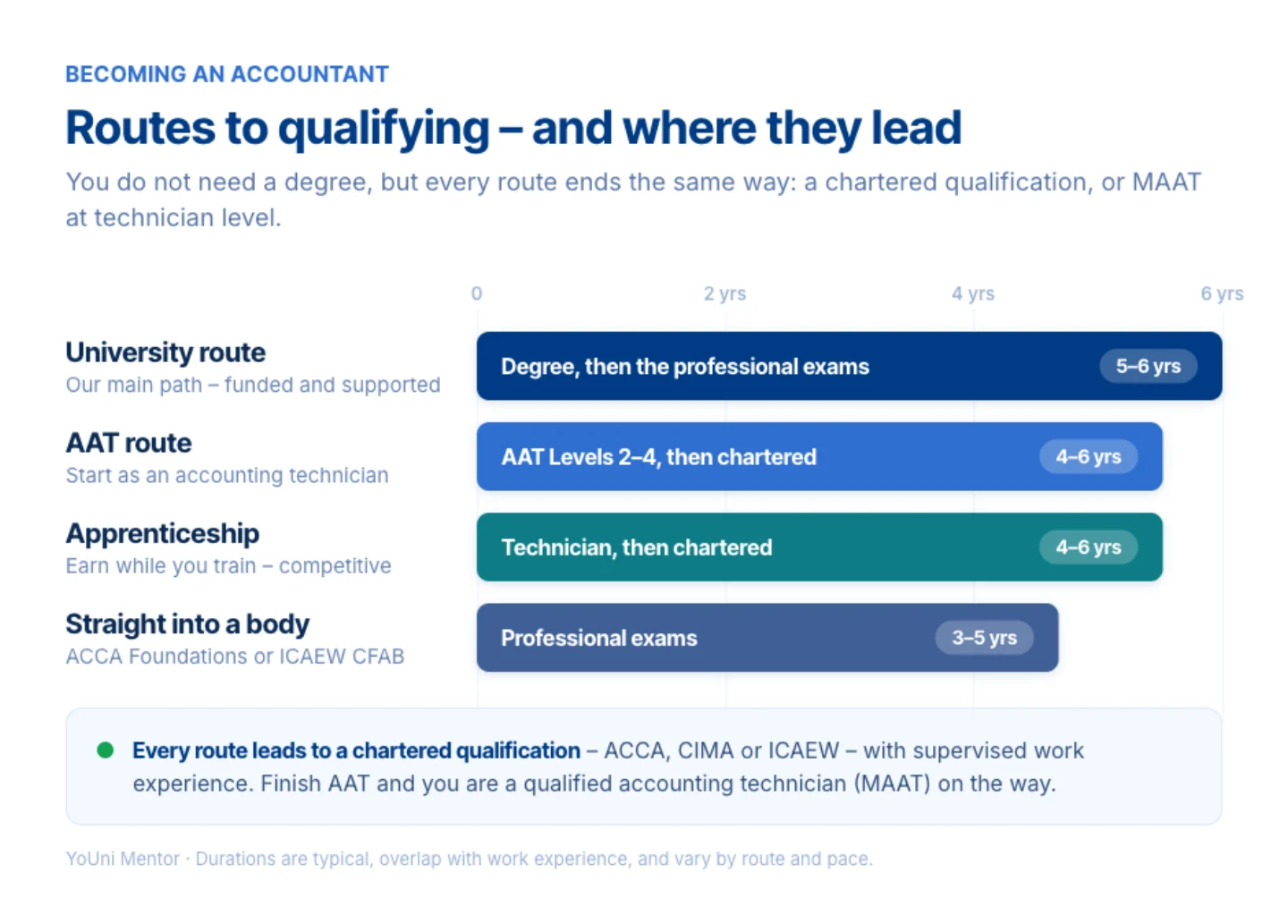
- The two main routes both end at a professional qualification: a degree, then the professional exams, or qualify professionally through AAT and a chartered body (ACCA, CIMA or ICAEW).
- There is no upper age limit, and you do not need A-levels to start.
What "accountant" actually means here
Two words get used loosely, and the difference matters for planning your route. An accounting technician handles the practical finance work: bookkeeping, preparing accounts, payroll, tax and reporting. The usual way in is the AAT qualification; completing it makes you eligible to apply for full AAT membership (the letters MAAT after your name), which also asks for relevant work experience. It is a real job in its own right and the normal first rung for a career-changer.
A chartered accountant has gone further and completed the requirements of a chartered body: ACCA (chartered certified accountant), CIMA (chartered management accountant), or the ICAEW/ACA (chartered accountant). You can hold an accounting job without being chartered, but chartered status is a protected professional title and tends to open the more senior, specialist and regulated work. This is the level most career-changers aim for, and you reach it by building on the technician stage.
No single government regulator owns the plain word "accountant"; the profession is defined by these qualifications, not by a degree.
Do you need a degree to become an accountant?
No. A degree is one route in, not a requirement, and the professional bodies say so plainly. ACCA states: "You don't need a university degree to build a successful career in accountancy." ICAEW confirms "you do not need to hold a degree" to register as a student for the ACA.
But "not required" is not the same as "not worth it": for many of the people we work with, a university degree is still the route worth choosing, and it is the one we help you with. Knowing you have options just means you can pick the path that fits your situation, not that you should rule a degree out. There are two main routes for a working adult, and they end in the same place.
Route A - qualify professionally, no degree needed. This is the main career-changer route. Most people start with the AAT (Association of Accounting Technicians) qualification, which has open access and no formal entry requirements; AAT describes it as "designed to help people with little or no accounting experience" and suitable for "anyone wishing to change career". You work up AAT Levels 2 to 4; finishing the Level 4 Diploma makes you eligible to apply for MAAT membership and can count towards exemptions from some of the chartered exams, depending on the body. From there you progress to a chartered qualification (ACCA, CIMA or ICAEW/ACA). AAT is the common starting point but not the only one: ACCA's Foundations in Accountancy and ICAEW's CFAB are direct entry points too.
Part of this route can be done through an apprenticeship, where you earn a salary while you train - but be realistic about it: apprenticeship places are limited and competitive, and for many adults they are harder to land than a university place, because you first need an employer willing to take you on. The funding rules also differ by level, which we come back to below.
Route B - a degree first, then qualify professionally. You study a degree (accountancy, accounting and finance, or in fact any subject), then join a graduate scheme and complete a professional qualification. An accredited accounting degree can earn exemptions from some professional exams, but the number depends on the exact course, the modules you took and the body, and an unrelated degree may earn none. A degree on its own does not make you a qualified accountant: you still need the professional qualification, and for ACCA, ICAEW and CIMA you also need supervised work experience (for ACCA, 36 months plus nine performance objectives on top of the exams).
Both routes finish at a professional-body qualification, whichever way you reach it - but a degree brings real advantages of its own. An accredited accounting or finance degree can shorten the professional exams through exemptions, opens the door to the graduate schemes many firms recruit through, and gives you a recognised, transferable qualification that carries into wider finance and business roles, not only accountancy. For a first degree it is funded by Student Finance, so there is nothing to pay upfront, and it gives you a structured, well-supported way in - which is why, for many of the people we work with, university is the route that makes the most sense.
You don't need A-levels to start
A-levels are not the only way in, and for this profession several doors are genuinely open to adults. For most of the people we work with, the university route is the main path - and you do not need A-levels to take it, because you can get onto a degree through an integrated foundation year.
- The university route - our main path. An accounting or finance degree is the most complete way in, and it is open to adults without A-levels through an integrated foundation year, which brings your skills up to degree level before the degree itself begins. It is funded by Student Finance for a first degree, so there is nothing to pay upfront, and it is available full-time, part-time or with evening study at many providers.
- AAT. No formal entry requirements at all. It is aimed at career-changers and adults returning to work, and you can study full-time, part-time or by distance learning.
- Apprenticeships. Open to adults, not only school leavers - though places are competitive and you need an employer first. The Level 4 accountancy technician apprenticeship has no set entry requirements; you only need a Level 2 (GCSE) pass in English and maths before the end-point assessment, and you earn while you learn with no course fees.
- Straight into a professional body. ACCA's Foundations in Accountancy can be started "with no formal qualifications" and feeds into the full ACCA qualification. ICAEW offers the CFAB (Certificate in Finance, Accounting and Business) as an entry point if you do not meet the standard requirements.
Which door fits depends on your starting point, the time you have, and how you like to study.
Student Finance and the ELQ rule, honestly
If your route is a university degree and you have no prior degree, you may be eligible for undergraduate Student Finance for an approved accounting or finance degree (eligibility depends on your residency, the course and the provider). A Tuition Fee Loan, paid directly to the university, covers the fees, so there is nothing to pay upfront, and a means-tested Maintenance Loan helps with living costs, paid to you each term. On Plan 5 you repay 9% of what you earn above £25,000 a year, and repayments pause automatically if your income drops.
You can see what you would actually repay on your own salary.If you already hold a degree, often the case for the people we work with, the picture changes. Student Finance normally will not fund a qualification at the same level as, or lower than, one you already hold - the ELQ rule (Equivalent or Lower Qualification). A limited list of subjects is exempt (mainly healthcare and some sciences), but accounting is not on it, so a graduate wanting a second accounting or finance degree generally will not be funded for it.
The practical answer is that you do not need a second degree. Qualify professionally through AAT and the chartered bodies and the ELQ rule never gets in your way. If your existing degree is from abroad, the professional body you want to join will usually assess it directly and may grant exam exemptions - that is often the more useful step. A UK ENIC Statement of Comparability (currently £69.60 including the e-Statement, about 15 working days) shows how your qualification compares to the UK system for employers and university admissions, but it does not itself grant exemptions, so check what each body actually needs before paying for one.
One date is worth knowing. For courses starting on or after 1 January 2027, England's student finance moves to the Lifelong Learning Entitlement (LLE), and the ELQ restriction is lifted: you may be eligible for funding "even if you've studied before", including a second undergraduate degree at the same or a lower level. It works as a lifetime Tuition Fee Loan limit (currently stated as £39,160), with any previous government tuition funding deducted from that total, so someone who has already used funding for a three-year degree may have only limited entitlement left. From September 2026 you can create an LLE account to see what you have. If a previous degree currently limits your funding, the LLE may reopen the door from that date; check your remaining balance before you count on it.
Our student finance calculator estimates tuition and maintenance for your circumstances.
How long it takes and what it costs
Roughly three to six years from a standing start to fully qualified, meaning chartered, depending on route, pace and any prior credit. AAT Levels 2 to 4 take about two to three years part-time to reach MAAT. A chartered qualification (ACCA, CIMA or ICAEW) then adds two to four years, shortened by any exemptions your AAT Level 4 earns; for ACCA you must also complete 36 months of supervised experience, which can be gained before, during or after the exams. These stages overlap, since you build experience while you study, so the calendar time depends heavily on your job and study pace.
The degree route takes three to four years (plus a foundation year if you need one) before the professional stage, so it is not necessarily faster. Part-time, evening and distance-learning study is standard, which suits people fitting it around a job.
Accounting apprenticeships at Levels 2 to 4 - the technician stages - stay government-funded: you work in a finance role, earn a salary and pay no course fees. But from 1 January 2026, government funding for the Level 7 (chartered) apprenticeship is limited to ages 16 to 21 (or 22 to 24 with an Education, Health and Care plan or care experience).
So if you are 22 or over, which most career-changers are, do not assume the Level 7 chartered apprenticeship will be free - an employer can still choose to pay for it, and anyone who started before that date keeps their funding.
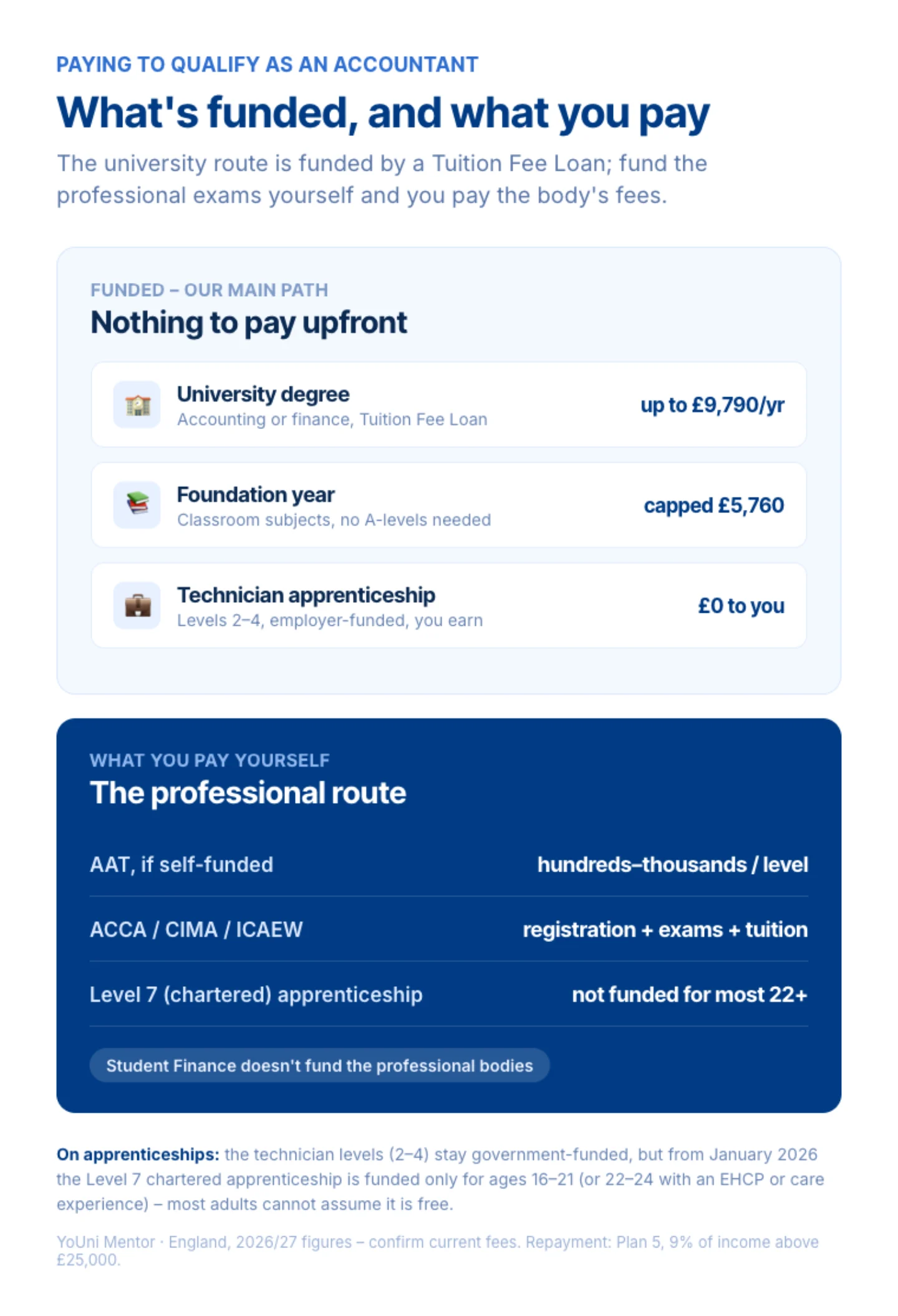
Costs depend on the route, and fees change every year, so confirm current figures before you commit. The technician apprenticeship route costs the learner effectively nothing in course fees, and you earn while you train. The degree route is funded by a Tuition Fee Loan for a first degree, so nothing is due upfront for tuition. If you fund your own AAT and professional qualifications, you pay registration, an annual subscription, tuition (if you use a training provider) and exam fees to the relevant body; these run from a few hundred to a few thousand pounds per level, so check each body's current fee schedule.
What accountants earn
At the entry stage, an accounting technician starts at around £24,000 and reaches about £35,000 with experience. Once qualified, a private practice accountant ranges from about £25,000 to £60,000, and a management accountant from about £30,000 to £60,000 (all National Careers Service).
The stage most career-changers ask about is newly qualified, and here the figures vary a lot by sector and location, so treat any single number with care. A trainee accountant sits roughly in the £22,500 to £37,000 range, and a part-qualified accountant can reach "as much as £50,000" (both Hays 2025 figures, reported by ICAEW Jobs). UK-wide recruiter guides put newly qualified roughly in the £42,000 to £52,000 range, higher in London and the South East; ICAEW separately reports a global average newly-qualified ACA salary of about £55,000 for 2025 (its own figure, not UK-specific).
The very large averages you will see quoted for the profession, well into six figures, are senior accountants with years behind them, not what anyone earns on qualifying. The most reliable check is to compare current vacancies for the qualification and location you are considering.
Where we come in
If your route in is a university degree, this is exactly what we do. We work with partner universities across England that offer accounting and finance degrees, including full-time, part-time and evening study, and a foundation year for people without standard entry qualifications. We help you choose the right course and campus, get your application and documents ready, and guide you through the Student Finance application early, though the decision itself rests with Student Finance England.
Our application support is free to students.
Frequently asked questions
Can you become an accountant in the UK without a degree?
Yes. A degree is not required. The usual route is the AAT qualification (open access, no formal entry requirements) followed by a chartered qualification such as ACCA, CIMA or ICAEW/ACA. ACCA states that "you don't need a university degree to build a successful career in accountancy", and ICAEW confirms "you do not need to hold a degree" to register as an ACA student.
Can anyone call themselves an accountant in the UK?
More or less, yes: "accountant" is not a protected title, so the word on its own is not regulated. What is protected is chartered status - titles like chartered accountant, chartered certified accountant and chartered management accountant can only be used by members of the relevant body. That is why the professional qualification, not the job title, is what carries weight with employers.
I'm changing careers in my 30s or 40s. Is it too late to become an accountant?
No. AAT is designed for "anyone wishing to change career" and has no age barrier, and apprenticeships are open to adults. You can study around a job, part-time or by distance learning, and expect roughly three to six years from scratch to fully qualified.
Can I get Student Finance for an accounting degree if I already have a degree?
Usually not for a course starting before 2027, because accounting is not on the gov.uk list of subjects exempt from the ELQ rule. But you do not need one: you can qualify professionally through AAT and ACCA or CIMA. From January 2027 the Lifelong Learning Entitlement lets you access funding at the same or a lower level, up to a lifetime loan limit with previous funding deducted, so check what you have left.
How much does a newly qualified accountant earn in the UK?
It varies widely by sector and location. UK recruiter guides put newly qualified roughly in the £42,000 to £52,000 range, higher in London; ICAEW reports a global average of about £55,000 (2025, its own figure). Entry-level accounting technician roles start lower, around £24,000 to £25,000. Compare current vacancies for your qualification and area for a realistic figure.
What's the difference between AAT, ACCA, CIMA and ICAEW?
AAT is the open-access, technician-level starting qualification (no degree or A-levels needed). The others are chartered qualifications you progress to: ACCA suits practice and audit, CIMA suits management and commercial finance, and ICAEW awards the ACA. AAT Level 4 can count towards exemptions for all three, depending on the body.
Can I use my overseas accounting degree or qualification in the UK?
Often, yes. The professional body you want to join will assess your qualification directly and decide on any exam exemptions, and that, not ENIC, is what counts for membership. A UK ENIC Statement of Comparability (currently £69.60 including the e-Statement, about 15 working days) separately shows how your qualification compares to the UK system, which helps with employers and university admissions.
Ready to look at your route? One free call, about 20 minutes, and you will have a clear picture: whether a funded degree or the professional route fits you best, what you would study, and which funding options you may be eligible for.
Book a free consultation